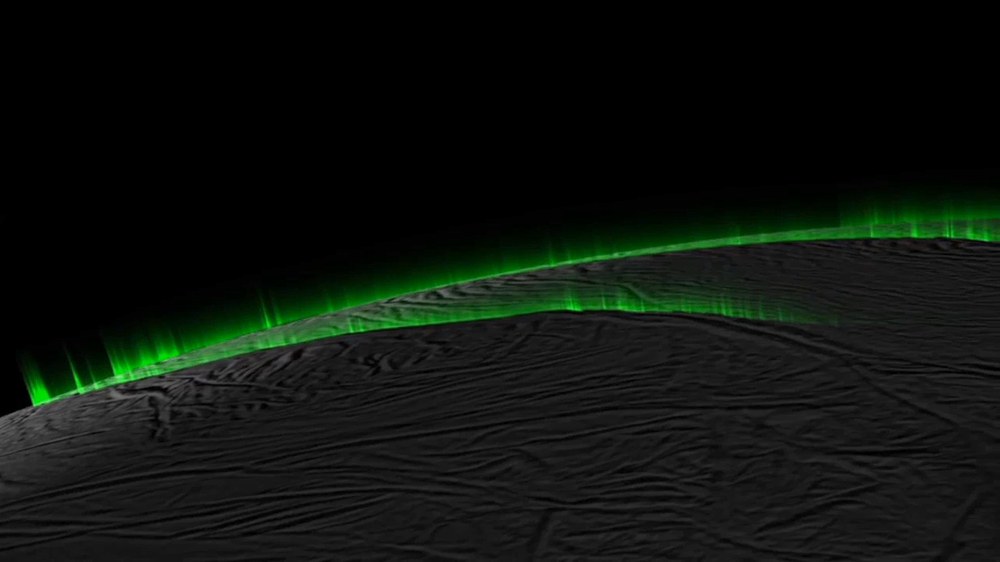
The Enceladus Explorer space mission aims to search for life on Saturn's moon Enceladus. Researchers and engineers are developing new technologies within the EnEx Enceladus Explorer Initiative to make this mission possible. The moon Enceladus, measuring only about 500 kilometres in diameter, is a particularly promising candidate for the search for life. The small icy moon made headlines as early as 2005, when active ice geysers were discovered in the southern hemisphere by the Cassini spacecraft.
This recently discovered ice volcanism (cryovolcanism) in the Saturn system ejects ice particles from the moon's surface up to a distance of about 500 kilometres. These ejections are caused by liquid water beneath the icy surface, which is forced upward through cracks and fissures in the moon's icy crust. Due to the extremely low ambient pressure at the surface, the once liquid water immediately vapourises and freezes, thus escaping in the form of ice particles.
In the search for extraterrestrial life, the presence of liquid water beneath the icy surface is not the only factor of interest; the presence of organic compounds in the ice plumes is also important. Given our current understanding of astrobiology, Enceladus appears to meet the basic conditions necessary for the emergence of life. However, it is unlikely for organic life forms to exist on the surface of Enceladus due to the hostile environmental conditions; instead, they are more likely to be found within the liquid water reservoirs located below the ice crust. The thickness of this ice crust can range from a few metres to several kilometres.
Living microorganisms could exist beneath Enceladus' icy crust
From a technical standpoint, this constitutes a major challenge. One potential solution is the “EnEx – Enceladus Explorer” space mission. Scientists currently posit the following scenario: any microorganisms that may have developed in the water reservoirs beneath the ice crust may also be carried along in the water pushed up through cracks and fissures that escape through cryovolcanoes.
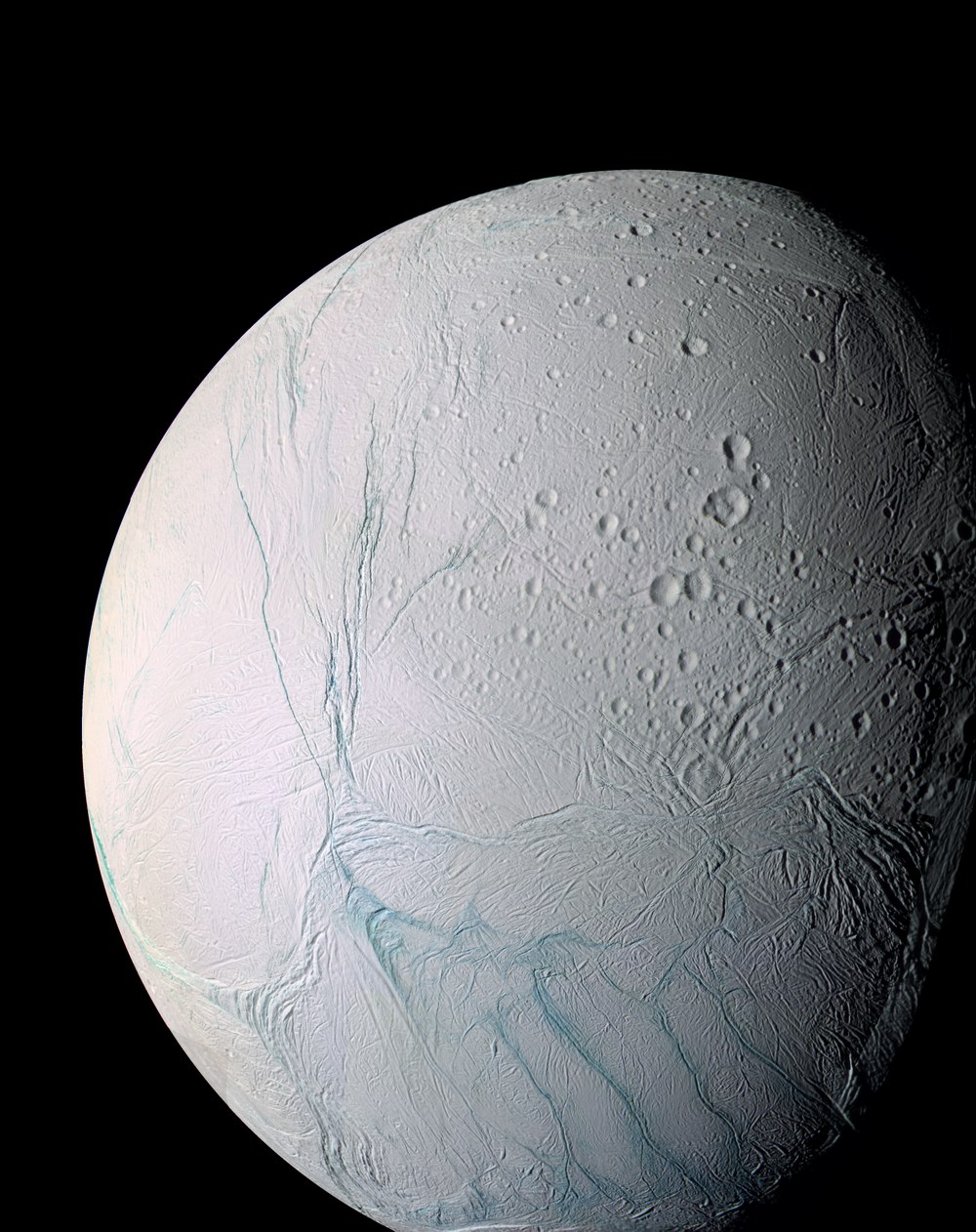
The icy moon Enceladus
The entire surface of Saturn's moon Enceladus is covered by a layer of ice. The image, which was composed from photographs captured by the Cassini spacecraft, shows the moon's southern hemisphere and its south pole region.
The moment the ambient pressure drops to a certain level during this ascent, the microorganisms burst, leaving behind the organic compounds detected in the fountains. Were it possible to take a sample of the rising, still-liquid water from the ‘chimney’ of a cryovolcano, it is possible that the microorganisms in it would still be alive.
It might be sufficient to ‘tap into’ a cryovolcano at a depth of ‘only’ about 100 metres for sampling. This would require the use of a melting probe capable of moving freely in three dimensions within the solid ice. It would need to be able to reliably locate a fissure containing liquid water over a distance of more than 100 metres, as well as cavities that it must avoid. Based on this information, it would then need to be able to plan and follow its path from the surface to the target in a completely autonomous manner.
An important milestone on the way to achieving this goal has already been reached: The EnEx-IceMole melting probe was developed as part of the EnEx initiative. In November 2014, scientists used this probe to successfully collect water samples from beneath the ice layer in Antarctica without contamination and bring them to the surface - a world first. What has now been achieved on Earth at the Antarctic “Blood Falls” is to be replicated in a similar manner on Saturn’s moon Enceladus
These new space technologies are being developed within the EnEx Initiative projects funded by the German Space Agency at the DLR. Project partners include Aachen University of Applied Sciences, RWTH Aachen University, the University of the Bundeswehr Munich, TU Braunschweig, the University of Bremen and the University of Wuppertal. The long-term goal is to realise the Enceladus Explorer space mission.