
Engineering the Path Towards Hydrogen Combustion for Aviation

DLR (CC BY-NC-ND 3.0)
DLR (CC BY-NC-ND 3.0)
Advancing hydrogen-powered flight does not happen overnight. It is a collaborative process built on intensive concept development and downselections, test campaigns using complex infrastructure and rigorous final validation. The DLR’s Institute of Propulsion Technology provided essential expertise in burner and combustion chamber development, playing a key role in enabling Rolls-Royce’s breakthrough in a hydrogen-powered engine demonstration earlier this year.
Earlier this year, Rolls-Royce (RR) completed a four-year hydrogen combustion testing program at NASA’s (National Aeronautics and Space Administration) Stennis Space Center and achieved a major breakthrough for clean aviation. The team successfully demonstrated their first full-scale operation of a jet engine running on 100% hydrogen. The test used a modified Rolls-Royce Pearl 15 engine and marked an important milestone in validating the role of hydrogen in future aviation and further reducing carbon emission.
Such achievements rarely happen overnight and oftentimes include a long path of development and previous tests. As a longstanding collaborator of Rolls-Royce plc, the Institute of Propulsion Technology played a key role in this breakthrough by supporting the company across the entire technology development pathway, from early concept screening towards final system validation, and providing the necessary infrastructure for vital test campaigns.
2022: First operation of Rolls-Royce burners using pure hydrogen under atmospheric conditions
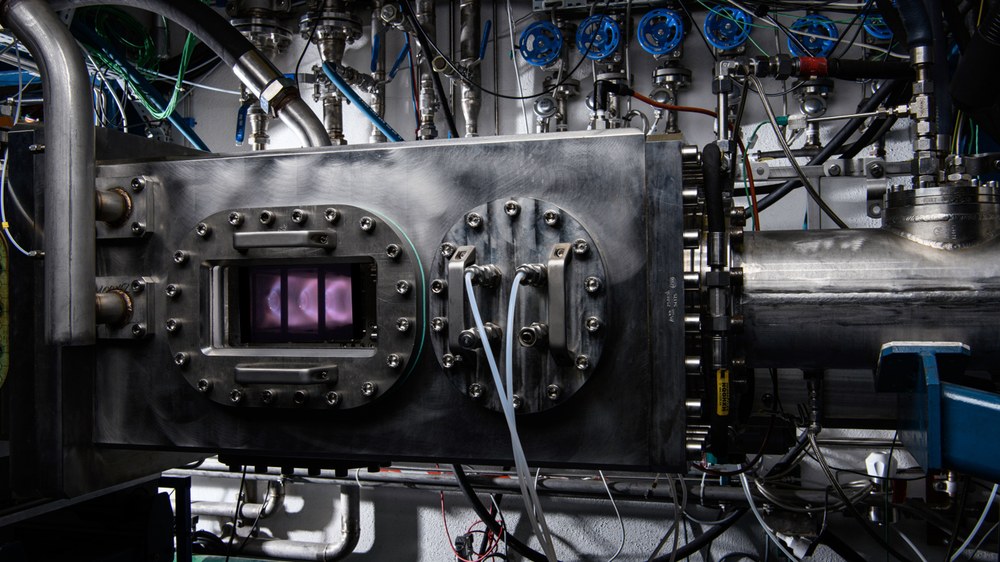
The journey towards this milestone started, for our Institute, at the end of 2022 in our Atmospheric Primary Zone (APZ) test rig. During a comprehensive test campaign with Rolls-Royce, numerous burner designs from Rolls-Royce were evaluated for stability, emissions, and flame behavior during hydrogen combustion. The tests were accompanied by optical measurements, that provided important insights into the different combustion characteristics, helping to explain differences in operating behavior and emissions.
The testing was conducted under the project WotAn, in which so-called Rich-Quench-Lean (RQL) combustion chambers form the basis for newly developed hydrogen combustion chambers. The project aims to investigate the various effects caused by the change in fuel properties – an important step in order to be able to design safe, efficient and climate-friendly hydrogen combustors. The project is part of the Federal Aviation research program (LuFo) and funded by the Federal Ministry for Economic Affairs and Energy.
RQL combustion chambers for kerosene operation are highly matured systems that are most widely used in aircraft engines. They are designed for very robust and stable combustion as well as low emissions. Switching the fuel from kerosene to pure hydrogen fundamentally changes the combustion behavior, as a result of the unique chemical-physical properties of hydrogen. Compared to kerosene, hydrogen burns significantly faster and can reach higher peak temperatures. Consequently, while this can lead to higher thermal loads on the combustion chamber, the wider stability range also allows for greater design flexibility. The RQL approach thereby offers a safe and robust basis in particular for hydrogen in jet engines, considering the challenges of the altered combustion characteristics.
2023: First operation of Rolls-Royce burners using pure hydrogen under high-pressure conditions
Based on the encouraging results and insights from before, a smaller group of burner designs was down selected for further investigation in an more application-oriented experimental environment in mid 2023. Together with Rolls-Royce we advanced towards testing the selected burner variants in our High-Pressure Combustor Test Facility 1 (HBK 1), which was simultaneously connected to the hydrogen infrastructure on the DLR site in cologne. Unlike previous tests, in which the burner designs were only tested under simplified ambient pressures, the HBK 1 enabled performance tests under realistic temperatures, high-pressures and flow regimes, thereby simulating real engine conditions. These tests were also part of the project WotAn.
As an optically accessible test rig with three burners, the HOTS-combustor (High Pressure Optical Triple Sector) in the HBK 1 provided important data on the flame stability, heat load on the combustor and emissions from the burners. This enabled the evaluation and validation of the burner selection under realistic operation conditions in an engine like RQL test sector and provided early findings on how the flame and emission characteristics of hydrogen burners change depending on the operating pressures.
The tests not only confirmed the technological maturity of the selected burners but also demonstrated that the risk of operating hydrogen burners in existing combustion chambers designed for kerosene is sufficiently low to proceed with the next validation level.
2023: First operation of Rolls-Royce burners using pure hydrogen in a real annular combustion chamber under real operating conditions of the PEARL engine
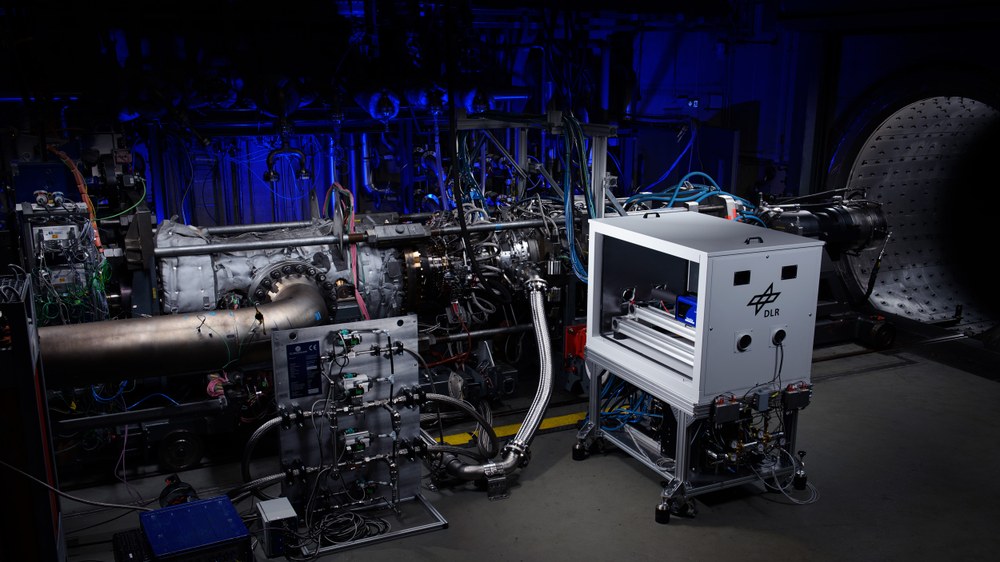
The promising results of the triple sector tests in HBK 1, encouraged the final and most demanding stage: the integration and testing of a full-scale Rolls-Royce annular combustor in our High-Pressure Combustor Test Facility 5 (HBK 5) at the end of 2023. This high-fidelity test environment allowed to validate the entire combustion system under real engine operating conditions, which corresponded to those of the final engine demonstration earlier this year.
The tests were conducted under the EU-project CAVENDISH and showed that all four Rolls-Royce burners can safely operate across the entire operating range as well as meet current Nitrogen Oxides (NOx) emission requirements, proving that hydrogen can be safely, and efficiently burned in a modern jet engine combustor. The tests also provide the first-ever use of optical probes and endoscopes for optical measurements during the full annular tests, enabling a visual inspection of the combustion chamber and especially the flame behavior.
Based on the HBK 5 test results, the final burner type was selected for the concluding engine test at the beginning of 2026 by Rolls-Royce. By combining rigorous and systematic screening, advanced diagnostics, and real-world testing, this joint development helped to reduce the risks associated with hydrogen combustion and accelerate the path towards potential commercial deployment.
This success underscores the importance of a stepwise and evidence-based approach to technology development – an approach that lies at the heart of the ongoing work of our institute and institution. Further it shows, that with continued collaboration and innovation, hydrogen-powered flight is not so far from reality.
Further publications from the projects:
- Clemen, C., et al, “Considerations for hydrogen fueled aerospace gas turbine combustion sub-system design“, Proc. of ASME TurboExpo, GT2024-122593.
- Berger, J. et al., “ Atmospheric testing of hydrogen fuel injectors for RQL combustion within the Rolls-Royce Pearl 15 hydrogen demonstrator engine program”, CAES Journal, 2026.
- Eisenring, S., et al., “High-pressure testing of hydrogen fuel injectors in a triple-sector RQL-rig for the Rolls-Royce Pearl 15 Hydrogen Demonstrator Engine Program”, CAES Journal, 2025.