New design processes for future turbomachinery developed in EU project
February 7, 2024
New design processes for future turbomachinery developed in EU project
Credit:
DLR. Alle Rechte vorbehalten.
Future propulsion concepts require new design processes
The project is revolutionising industrial design processes for climate-neutral propulsion systems.
DLR is contributing its expertise in scale-resolution simulations, high-fidelity optimisation methods and optical engine measurement technology.
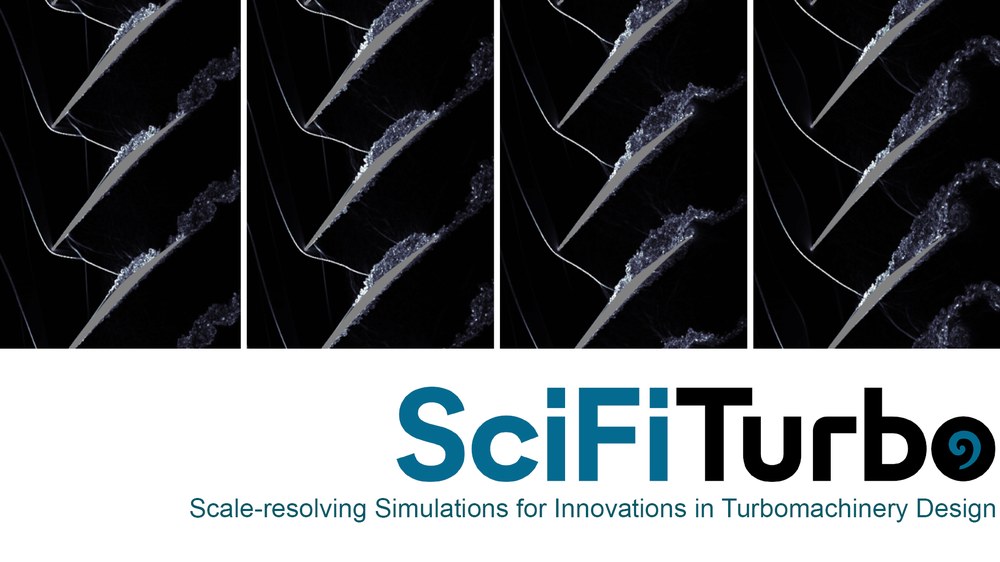
The EU Horizon Europe project Sci-Fi-Turbo (Scale-resolving simulations for innovations in turbomachinery design) was launched under the leadership of the DLR Institute of Propulsion Technology. In addition to the German Aerospace Center (DLR), nine international partners from research and industry are taking part. Sci-Fi-Turbo aims to revolutionise industrial design processes for future, climate-neutral propulsion systems. DLR is contributing its expertise in the areas of scale-resolving simulations (SRS), high-fidelity optimisation methods and optical engine measurement technology.
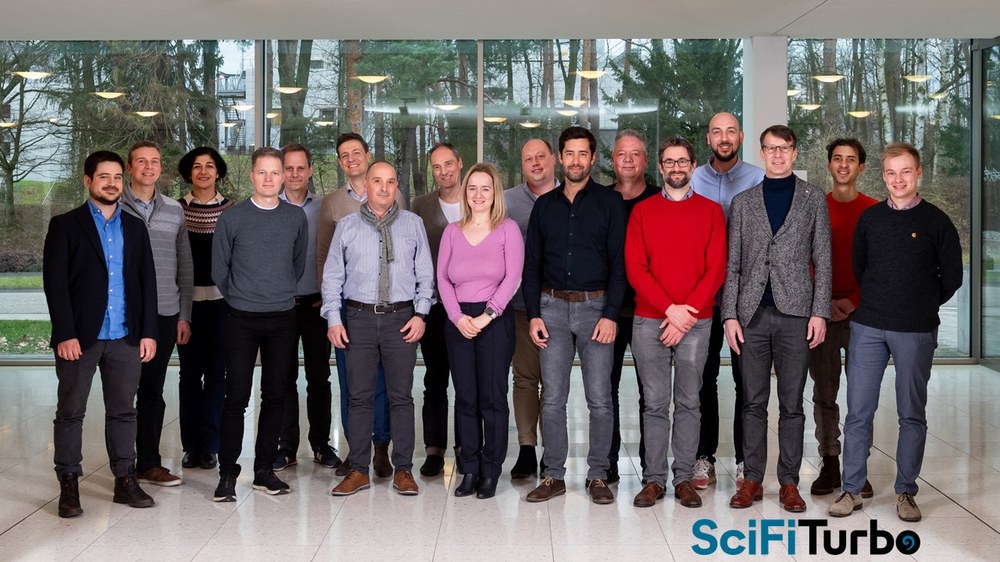
EU Sci-Fi-Turbo international consortium
The Sci-Fi Turbo consortium brings together world-leading expertise in computational science, numerical method development, all major research areas of computational fluid dynamics, high performance computing and turbomachinery design optimisation.
Climate-neutral engine concepts cannot be realised with today's standard industrial design processes within the timeframe set by the EU until 2050. Future engine concepts require new design processes. Sci-Fi-Turbo addresses this need by exploiting the potential of three fundamental technologies: High Performance Computing, Higher Order Numerical Methods and Artificial Intelligence (AI) / Machine Learning (ML).
By combining these technologies, DLR and its partners are implementing and demonstrating two key developments:
Establish a highly integrated SRS-based design process for advanced CPU/GPU hardware that meets the needs of the industry: Robustness, accuracy and turnaround time requirements.
An SRS-assisted, multi-level, data-driven optimisation framework is developed that takes advantage of high-accuracy, higher-order SRS while using AI/ML methods to increase the predictive power of lower-accuracy simulations and maximise the overall accuracy and speed of the process.
In the final third of the project, experiments at the DLR Institute of Propulsion Technology will support technology development, enabling the design of net-zero emission engines and contributing to the digital transformation of the aviation industry.
European Union's Horizon 2023-24 research and innovation programme under the funding code 10113808.
Credit:
Europäische Union
About Sci-Fi-Turbo:
Sci-Fi-Turbo aims to revolutionise the aero-engine design process by integrating high-resolution simulation (SRS) and optimisation methods into standard industrial workflows. SRS is a key enabler for the development of highly efficient propulsion systems that will dramatically reduce greenhouse gas emissions by 2035 and meet the EU's target of climate neutrality by 2050. The advances will improve the capabilities of the design process and shorten product development cycles.