Validation of Heat Exchangers
Future Propulsion Test Facility
Validation of Heat Exchangers
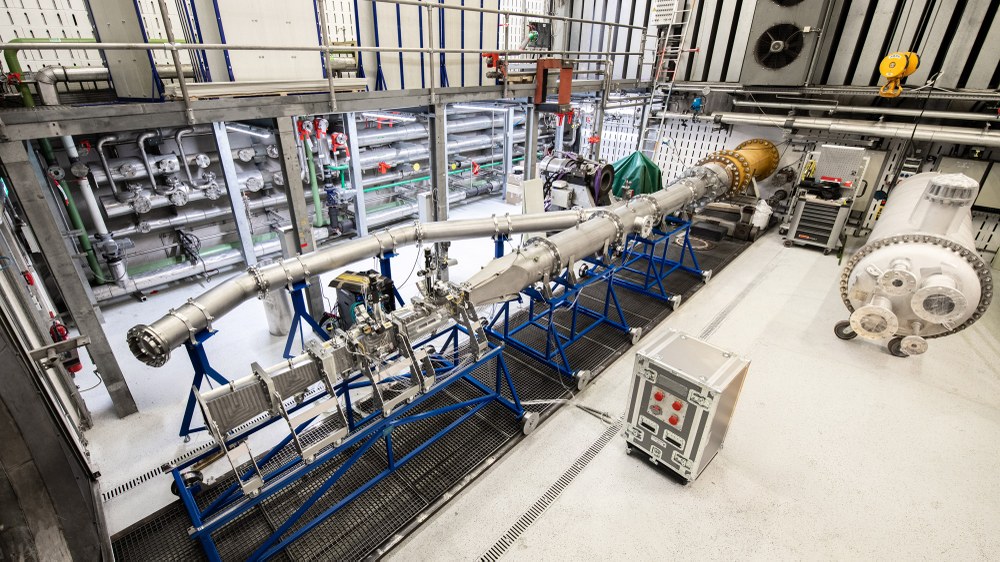
At the Future Propulsion Test Facility, experiments can be carried out under the real-world operating conditions of an aircraft engine to validate heat exchangers. These tests support the further development of simulation methods and the verification of prototype performance.
Research at the Future Propulsion Test Facility (FPT) focuses on validating innovative propulsion concepts for climate-friendly aviation. Within the powertrain, for example, the exhaust heat exchanger is a key core technology responsible for the phase change from liquid hydrogen (LH2) to gaseous hydrogen (GH2). Furthermore, temperature conditioning is achieved through exhaust heat recovery. Cryogenic nitrogen is currently being used as a substitute for hydrogen to explore new scientific territory.
The FPT research platform is equipped with state-of-the-art measurement technology. Together with the qualified test rig team, this enables the conduct of test campaigns to verify heat exchangers under the real-world operating conditions of an aircraft engine. The measurement data obtained supports the validation of simulation and design methods. Furthermore, it enables the performance characteristics of the prototypes to be verified. On this basis, it becomes possible to optimise the design of the demonstrators specifically for desired target metrics, such as maximum power density.
The Future Propulsion Test Facility provides the necessary infrastructure for testing and supplies the technology demonstrator with gaseous media (GH2 & GN2), compressed air, demineralised water and electrical power. In addition, cryogenic media (LN2 & LH2) are made available on a project-specific basis upon request. Thanks to its modular design, the test rig can be used across various sectors for aerospace, energy and marine applications.
Characteristics of the test rig
- Development for measurement technology
- Cross-industry application for aviation, marine, energy
Research Topics
- Demonstration of heat exchangers for recuperative propulsion concepts
- Validation of simulation and design methods for components in the heat transfer process
- Generation of scientific added value
- Measurement and evaluation of pressure differentials in the system
- Thermal characterisation of the temperature distribution in the system
- Performance testing / performance analysis under defined boundary conditions
Media | LN2, O2 |
|---|
Pressure | up to 160 bar(g) |
Mass flows | 0,5 to 2,5 kg/s |
N2-Temperature conditioning | -196°C to + 150°C |
Media | GN2, O2 |
|---|
Pressure | up to 250 bar(g) |
Mass flows | 0,5 to 2,5 kg/s |
N2-Temperature conditioning | -196°C to + 100°C |
Medium | GH2 |
|---|
Pressure | up to 250 bar(g) |
Mass flows | up to 500 g/s |
Temperature | up to 250 °C |
Simulation of exhaust gas parameters using heated air
Medium | Air |
|---|
Pressure | up to 40 kg/s |
Mass flows | up to 40 kg/s |
Temperature | up to 700°C |
Parameters outside the specified ranges are available upon request