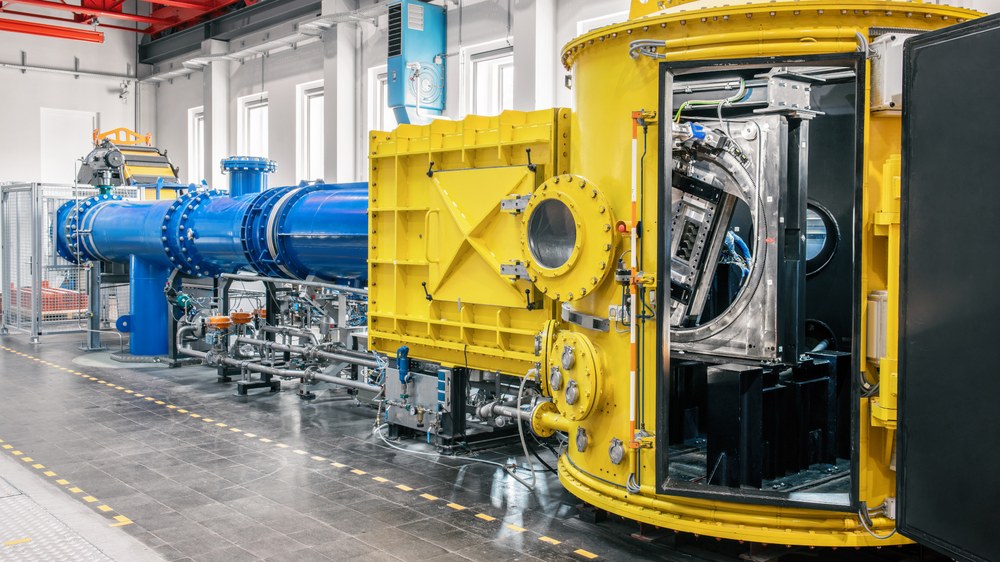
Straight Cascade Wind Tunnel
Straight Cascade Wind Tunnel
The Straight Cascade Wind Tunnel at the DLR Institute of Propulsion Technology in Göttingen is used for aerothermodynamic investigations on planar, vertical cascades of high, medium or low pressure turbines of aircraft engines as well as gas and steam turbines.
The straight cascade wind tunnel can be used to investigate planar cascades at Mach numbers in the sub- to supersonic range and at engine-relevant Reynolds numbers. Depending on the application, either profile or end wall tests are performed. A row of blades can be installed over a height of 400mm to approximate a theoretically infinite grid. Three independently controllable cooling ducts are available for analysing cooling air problems. The particular advantage of this test rig is its excellent accessibility. This allows the flow to be easily visualised and analysed using sophisticated measurement technology.
Measurement techniques such as pressure, temperature and multi-hole probes are recorded both stationary and time-resolved as standard. Hot wires and hot films are also used.
Characteristics of the test bed
- Technology Readiness Level 3-4
Research topics
- High, medium or low pressure turbines
- Gas and steam turbines for power generation
- Heat transfer and cooling air effects
- Shock boundary layer interaction and transition
Optical
Measurement Technology
- Particle Image Velocimetry (PIV)
- Pressure-Sensitive Paint (PSP)
- Temperature-Sensitive Paint (TSP)
Technical Data
| | Hauptkanal | Kühlluftversorgung |
|---|
Inlet pressure [kPa] | 15-140 | < 450 |
Inlet temperature [K] | 293-313 | 253 - 300 |
Air mass flow [kg/s] | < 5 | < 2 |
Mach number (outflow) [-] | 0,4-1,9 | |
Reynolds number (outflow) [-] | 0,1-2,7 Mio. | |