
30 years of monitoring the ozone layer
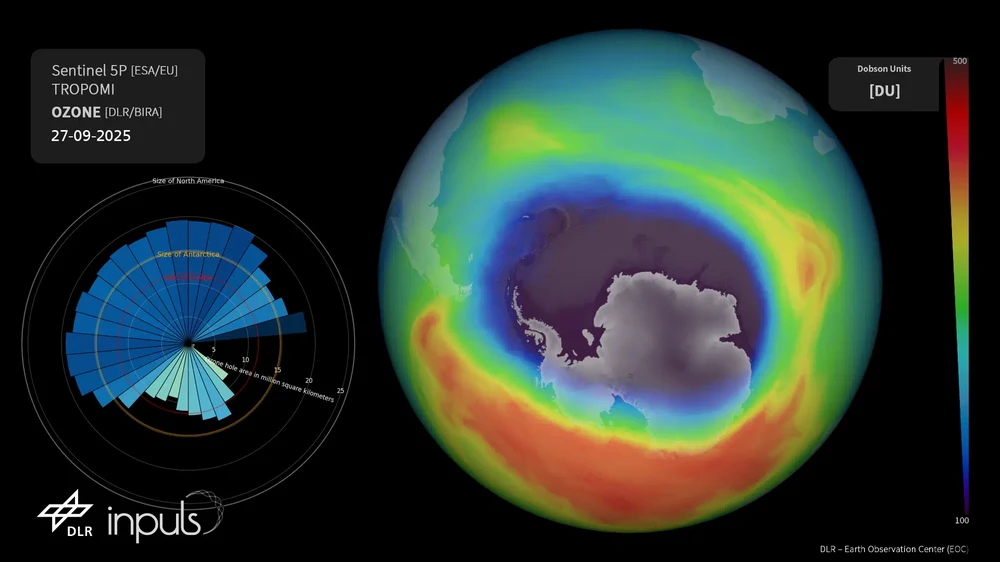
Current evolution of the ozone layer (right) and the size of the ozone hole (left) observed by TROPOMI aboard Sentinel-5 Precursor
Your consent to the storage of data ('cookies') is required for the playback of this video on Quickchannel.com. You can view and change your current data storage settings at any time under privacy.
Forty years ago, the international community responded to the drastic, human-induced ozone depletion in the atmosphere with the "Vienna Convention for the Protection of the Ozone Layer" and two years later with the ban on CFCs. Since then, the state of the thin protective layer has been continuously monitored.
DLR has played a key role in this task for more than 30 years. As part of a global initiative, DLR researchers not only monitor the ozone layer to better understand its evolution, but also track how the air quality in the lower atmosphere is developing. Data from numerous European satellite missions have been combined into a seamless observational series, including data from GOME on ERS-2, SCIAMACHY on ENVISAT, GOME-2 on MetOp-A, -B and -C, OMI on AURA and TROPOMI on Sentinel-5 Precursor.
DLR's thirty-year, homogenised satellite data time series is regularly used in scientific publications that are highly relevant to politics. These include the "State of the Climate" report of the Bulletin of the American Meteorological Society (BAMS), the "Scientific Assessment of Ozone Depletion" of the World Meteorological Organisation (WMO) and the reports of the Intergovernmental Panel on Climate Change (IPCC).
Monitoring the ozone layer remains indispensable, as it is essential for life on earth. While the ban on CFCs has led to a recovery of the ozone concentration in the atmosphere, the Earth's protective shield faces new threats from climate change and warming of the stratosphere, new substitute chemicals, forest fires and biomass burning. Pollutants from burning up rockets and satellites could also harm the ozone layer in the future.
Satellite observations also help to protect life in the lower atmosphere. Be it through the observation of volcanic clouds, which pose a direct threat to air traffic, or through the monitoring of air pollutants, which cost the lives of tens of thousands of people in Germany every year.
The Earth Observation Centre (EOC) will continue the ozone layer monitoring with data from the recently launched Copernicus missions Sentinel-4 (MTG-S1) and Sentinel-5 (MetOp-SG-A1), thus ensuring high-quality observations of atmospheric composition for decades to come.
Links
- INPULS (Innovative Product Development for Analyzing the Atmosphere Composition)
- TROPOMI
- Unwetter präziser und früher vorhersagen
- German multispectral camera METimage set to improve weather forecasts
- Evolution of the ozone layer and the size of the ozone hole observed by TROPOMI aboard Sentinel-5 Precursor in the same period 2024