Your consent to the storage of data ('cookies') is required for the playback of this video on Youtube.com. You can view and change your current data storage settings at any time under privacy.
NEPOS (Near-Surface Seismic Exploration of Planetary Bodies with Adaptive Networks)
Was verbirgt sich unter der Mondoberfläche? Unter simulierten Mondbedingungen in der LUNA-Halle testen wir seismische Verfahren zur Erkundung von Bodenschätzen wie Wassereis – und ebnen damit den Weg für autonome Monderkundung und nachhaltige Weltraummissionen.
Is there water ice on the Moon, and are there cave-like structures that could serve as valuable resources in future lunar missions?
Lava tubes beneath the lunar surface could provide protection from radiation, micrometeorites, and extreme temperature fluctuations. Water ice could serve as a crucial resource for future missions, offering a source for drinking water, oxygen, and rocket fuel. Moreover, water is a fascinating record of the early solar system, making it of great scientific interest. To locate such resources on the Moon, reliable detection systems and methods are essential. These future orientated questions are currently a major focus of scientific research.
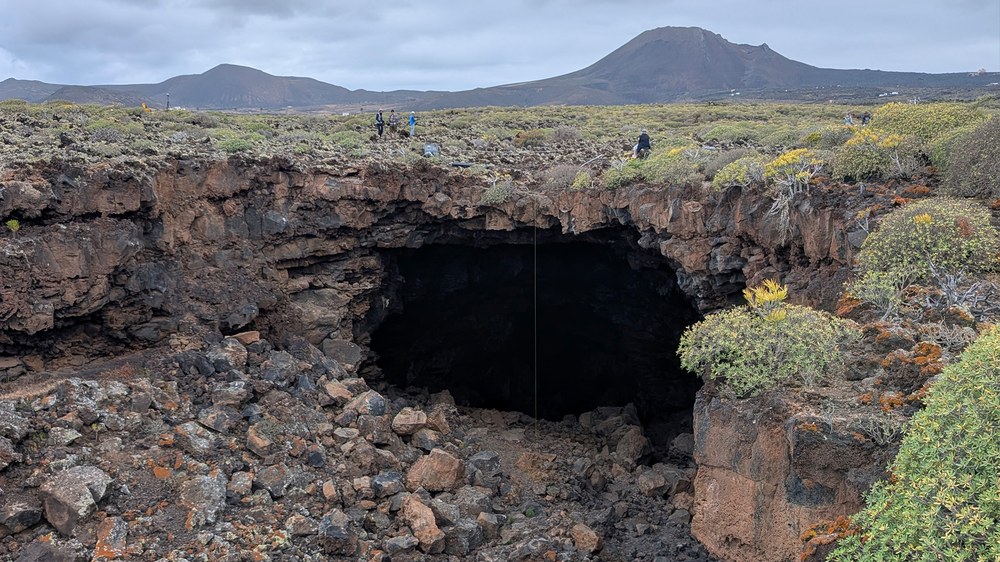
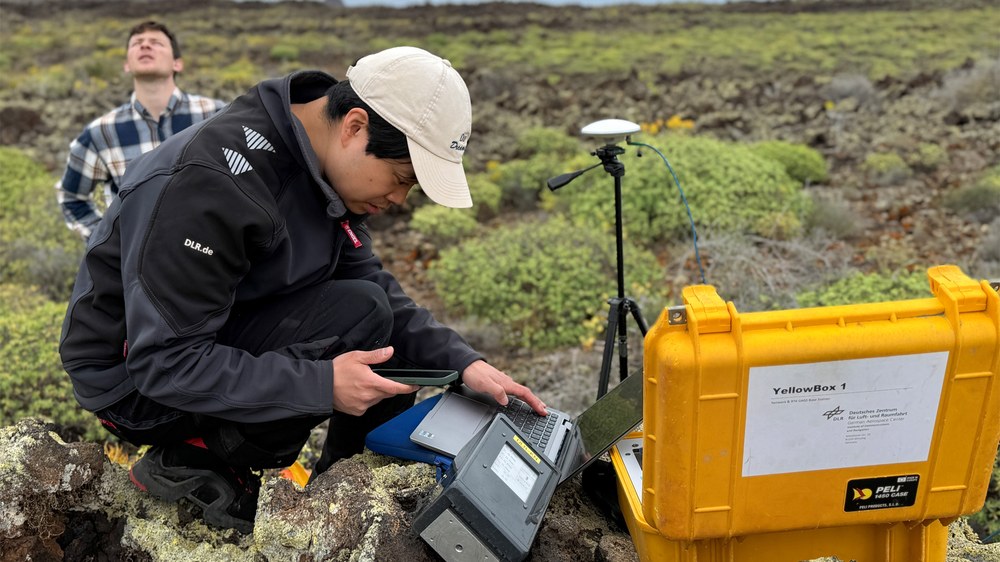
Project NEPOS: Measurement Techniques under Moon-Analog Conditions in the Field
A key contribution to this effort comes from the NEPOS project (Near-Surface Seismic Exploration of Planetary Bodies with Adaptive Networks). Within the project, seismic measurement techniques and adaptive sensor networks are being investigated to detect features such as lava tubes and water ice on the Moon in the future.
Different rock types transmit seismic waves at varying speeds – seismic methods exploit this variation to map subsurface features. By analyzing differences in wave propagation, researchers can detect voids, cavities, or materials with distinct physical or chemical properties beneath the surface. In passive seismic measurements, natural vibrations originating from the Earth’s crust are recorded using sensors.
“The data we collected on site over a multi-day measurement campaign above the lava caves were highly informative, allowing us to validate and further develop measurement techniques under real-world conditions. The trip was a wonderful opportunity for us,” confirm Kai Nierula, Ban-Sok Shin and Dmitriy Shutin from DLR. Heiner Igel, Professor of Geophysics and Seismology at LMU, who is collaborating on the project with Sabrina Keil and Dominic Strutz, adds: “Exploration of the near-surface structures of the moon (and of Mars and other planetary objects) is a top priority for future manned and unmanned missions. It’s important, therefore, to develop optimal experimental approaches to practice seismic tomography as efficiently as possible.”
Prior Laboratory Research in the LUNA Hall under Controlled Conditions
Similar measurements were conducted just months earlier within the LUNA Fnalog Facility in Cologne.
Since 2024, DLR and ESA provide in a joint project a simulated lunar surface infrastructure designed for a wide range of scientific investigations. The DLR research team considers the recent field measurements on Lanzarote – conducted over an extended period and with high intensity – to be groundbreaking for future research on detecting lunar caves and water ice.