


Blog
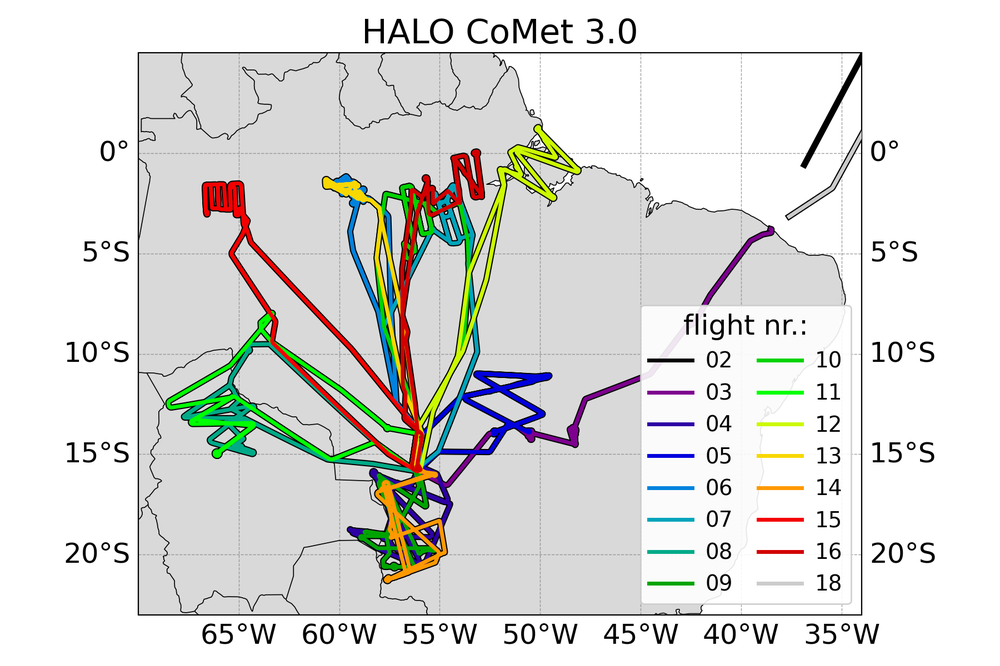
Reports on the individual measurement flights and information on the CoMet 3.0 Tropics mission in Brazil.

Sprünken
Instrument | Messgrößen und Beschreibung |
|---|---|
CHARM-F | Integrated Path Differential Absorption Lidar for Measurement of the integrated partial column of CO2 und CH4 (XCO2 & XCH4) between aircraft and ground. |
Passive imaging spectrometer using solar radiation to measure the integrated partial column of CO2 and CH4 (XCO2 & XCH4) between aircraft and ground | |
JIG - Jena Instrument for Green- house gas measurements | In-situ measurements of CO2, CH4, CO, and H2O |
JAS - Jena Airborne Sampler | Air sampler for monitoring CO2, CH4, CO, N2O, H2, SF6, and thair isotopes 13C in CH4, 2H in CH4, 13C in CO2 and 18O in CO2 |
Optical spectrometer with six channels in three wavelength ranges (UV-A: 310-440 nm, visible: 420-640 nm and near infrared: 1100-1680 nm) for analysing NO2, HONO, CH2O, C2H2O2, C3H4O2 | |
MIRO MGA - 10 | In-situ measurements of CH4, CO2, N2O, CO, H2O, NO, NO2, SO2, NH3, O3 |
BAHAMAS - BAsic HAlo Measurement And Sensor system | Basic meteorological parameters such as pressure, temperature, 3-D wind vectors and aircraft attitude data |
FOKAL | Monitoring the frequency stability of the CO2online wavelength of CHARM-F |
Meteorological dropsondes | Relative humidity, temperature and pressure profiles |