

CoMet 2.0 Arctic

The aim of CoMet 2.0 Arctic was to collect airborne remote sensing and in-situ data to gain new insights into the distribution and temporal changes of the two most important anthropogenic greenhouse gases, carbon dioxide and methane, and their tracers in high northern latitudes. The results of the project will prepare future satellite missions such as MERLIN and contribute to an improved understanding of the global methane and carbon cycle. The aim is to further develop synergistic combinations of active and passive remote sensing methods for greenhouse gas measurements and to support technological advances required for the validation of current satellite missions and for the development of future Earth observation satellites. Four years after the previous mission (CoMet 1.0), the instrumentation developed at that time has now been fully deployed on the HALO research aircraft.

As part of the project, central scientific questions of current greenhouse gas research were investigated. These include the contribution of large Arctic wetlands to the summer greenhouse gas budget in comparison to emissions from natural geological sources, biomass combustion and the extraction of fossil fuels.

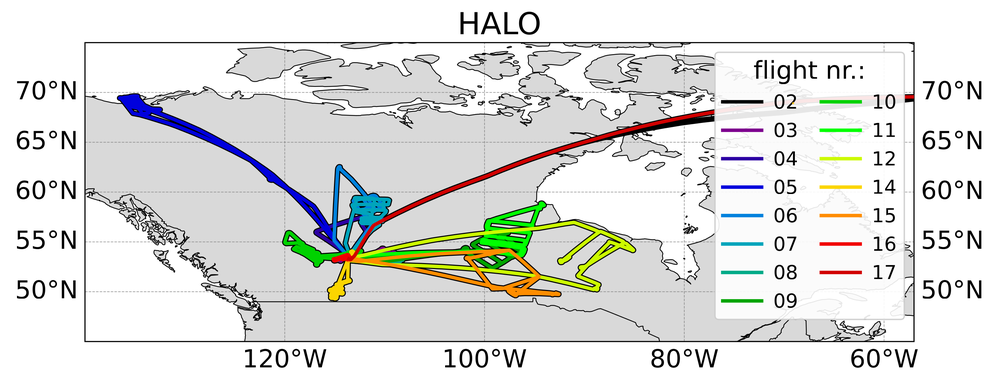
The 6-week flight measurement campaign took place in Canada from 6 August to 16 September 2022. The campaign was based at Edmonton Airport, from where 13 scientific flights were carried out. Canada is an excellent study area because not only are some of the largest Arctic wetlands located here, but antrhopogenic sources such as oil and gas fields, coal mines and landfills also contribute to the greenhouse gas budget.

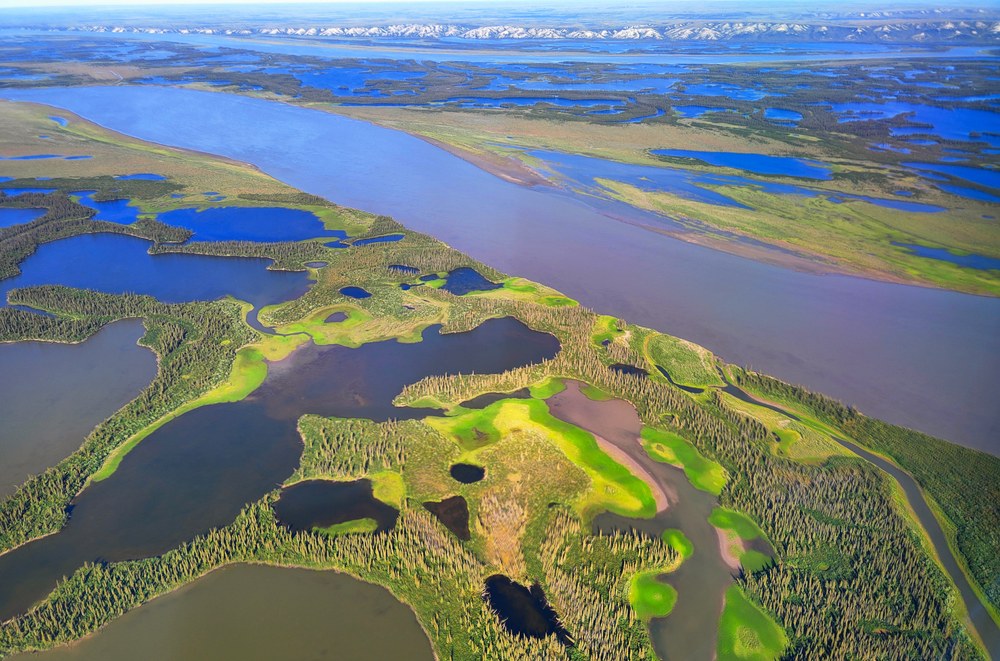
During the campaign, a subset of the instrumentation already used during CoMet 1.0 was deployed and integrated as an optimised payload on the HALO research aircraft. In addition to continuing the synergistic use of various measuring instruments to record different greenhouse gases, the campaign focussed on quantifying emissions from Arctic wetlands such as the Hudson Bay Lowlands, the Mackenzie Delta and the region around the city of Lloydminster, as well as emissions from diffuse anthropogenic sources from small gas and oil wells or coal mines.

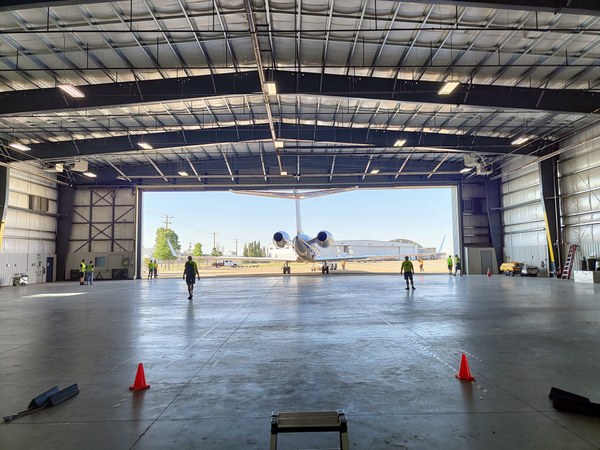
Payload on the HALO research aircraft

Instrument

Messgrößen und Beschreibung

CHARM-F

Integrated Path Differential Absorption Lidar for

Measurement of the integrated partial column of CO2 and CH4 (XCO2 & XCH4) between aircraft and ground

MAMAP2DL

Passive imaging spectrometer using solar radiation to measure the integrated partial column of CO2 and CH4 (XCO2 & XCH4) between aircraft and ground

JIG - Jena Instrument for Green- house gas measurements

In-situ measurements of CO2, CH4, CO, and H2O

JAS - Jena Airborne Sampler

Air sampler for monitoring CO2, CH4, CO, N2O, H2, SF6, and thair isotopes 13C in CH4, 2H in CH4, 13C in CO2 and 18O in CO2

MIRACLE

In-situ measurements of CO2, CH4, C2H6, and thair methan isotops D13C(CH4)

specMACS - Hyperspectral imager

Hyperspectral camera in the visible and near infrared spectral range (400 - 2500 nm); polarised wide-angle imager

FOKAL

Monitoring the frequency stability of the CO2online wavelength of CHARM-F

BAHAMAS - BAsic HAlo Measurement And Sensor system

Basic meteorological parameters such as pressure, temperature, 3-D wind vectors and aircraft attitude data

meterological Dropsonds

Relative humidity, temperature and pressure profiles

Projekt partners and international colaborations

  • AMPAC - Arctic Methane and Permafrost Challenge
  • Government of the Northwest Territories, Environment and Natural Resources
  • Environment and Climate Change Canada (ECCC)
  • NRCan Geological Survey of Canada
  • Canadian Space Agency
  • Northern Forestry Centre, Edmonton
  • National Research Council (NRC) Flight Research Laboratory
  • University of Toronto
  • McGill University, Montreal
  • University of Alberta, Environmental Soil Science
  • University of Montreal
  • Environmental Defense Fund (EDF)
  • Fluxlab
  • University of Saskatchewan, Institute of Space and Atmospheric Studies
  • GHGSat Inc.

Further links

Reporting