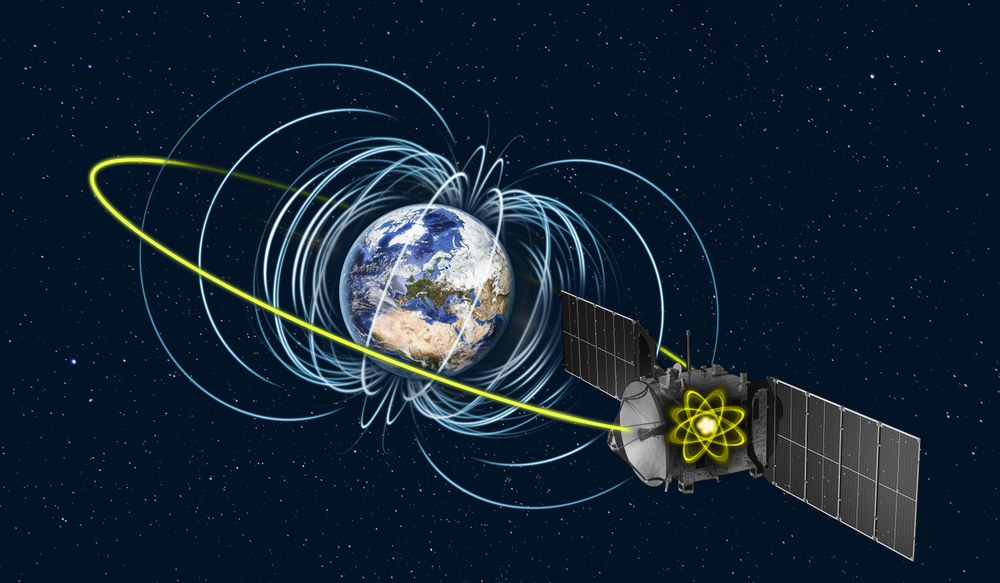
Schematic diagram of a radio frequency sensor (RF sensor) based on Rydberg atoms. These are produced by laser excitation in vapour cells.
Image: 2/2, Credit:
DLR (CC BY-NC-ND 3.0)
Electromagnetic radiation is the basis for numerous applications ranging from wireless data transfer to navigation via GPS. While typically classical antennas are used as receivers, quantum-based solutions promise enhanced capabilities with respect to sensitivity, stability, and tuning range [1]. One especially interesting technology in this regard uses highly-excited atoms in so-called Rydberg states. By using single atoms instead of a macroscopic antenna, the receiver is insensitive to aging effects and provides absolute and drift-free measurements. This makes them very well suited for long term monitoring of electric or magnetic fields for instance in space [2].
We design, build, and test Rydberg-based field sensors for space applications. This encompasses sensors for radio frequencies as well as magnetic fields. To realize this, we are developing experimental platforms using three-photon-excitation and effect such as the Autler-Townes splitting to detect incoming radiation [3]. To bring the technology into application, we put special emphasis on miniaturizing the overall sensor and its components together with internal and external collaborators as well as early adopters.
Highly compact and tunable receivers provide new and interesting capabilities of communication and sensing both in space and on Earth. Our research provides a stepping stone to bring the technology into application and thus usable for numerous applications and thus its industrialization.
References
[1] Adams, C. S. et al., J. Phys. B 53, 012002 (2020). [2] Dietsche, E. K. et al., Nat. Phys. 15, 326–329 (2019). [3] Fancher, C. T. et al., IEEE Transactions on Quantum Engineering 2, 1-13 (2021).