RM team wins assistance robot race at Cybathlon 2024
October 30, 2024
RM team wins assistance robot race at Cybathlon 2024
First place for DLR team EDAN with pilot Mattias Atzenhofer
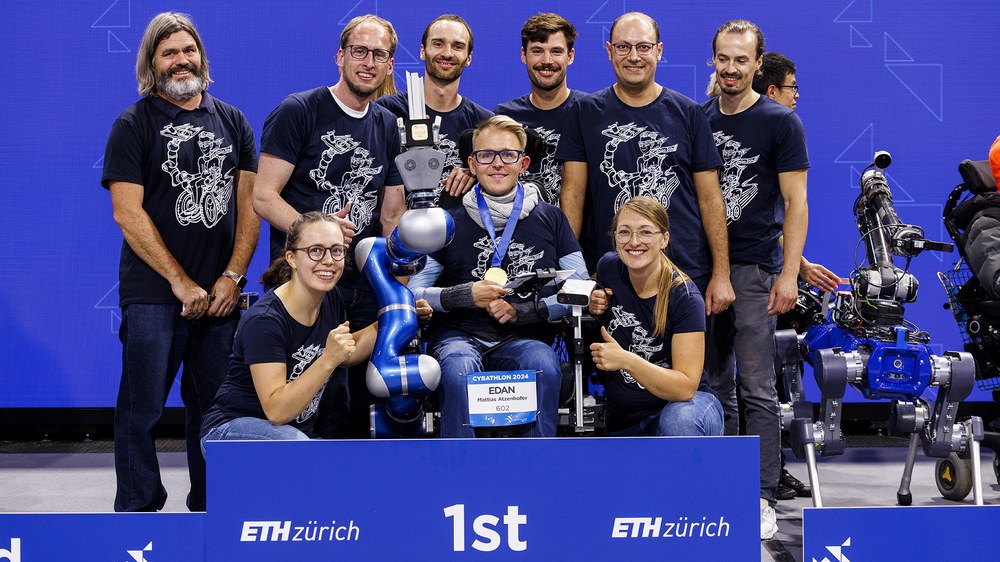
Team EDAN of the German Aerospace Center (DLR) poses with its gold medal after winning the ROB - Assistance Robot Race during the international Cybathlon 2024 in Kloten, Switzerland, Saturday, 26 October 2024.
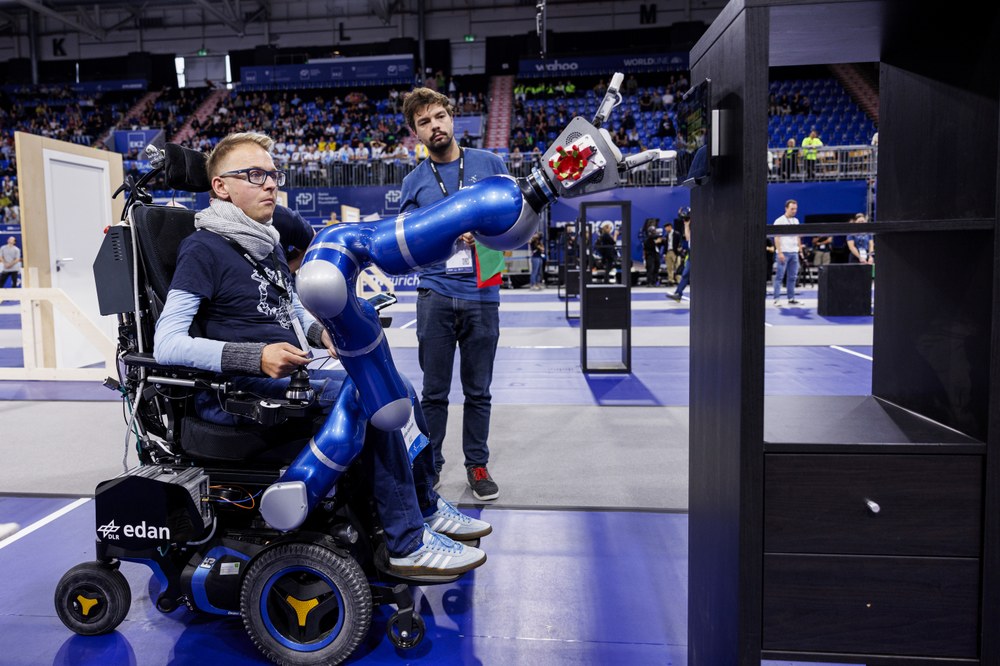
Pilot Mattias Atzenhofer highly focussed during the assistance robot race
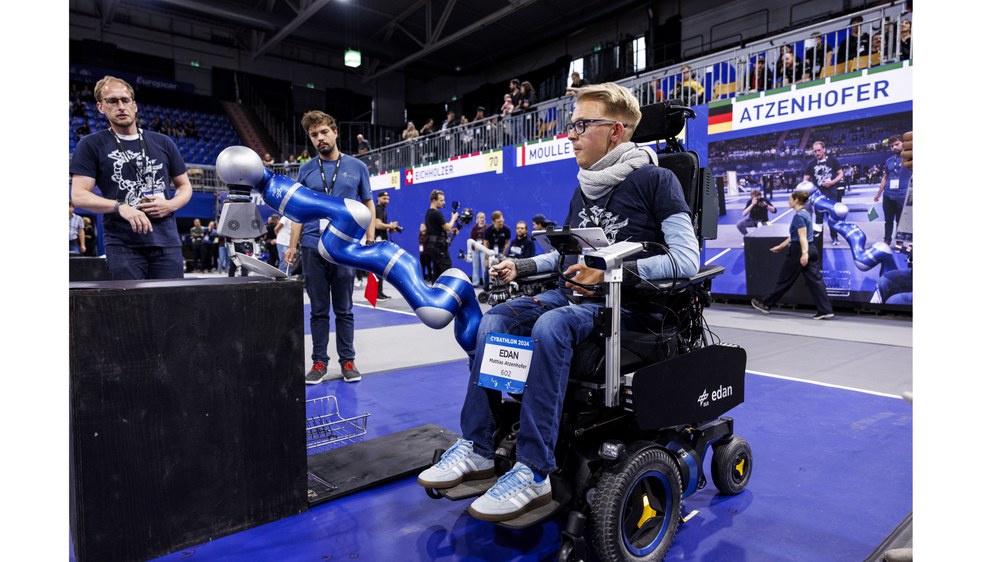
Team EDAN from Germany on their way to victory in the ROB - Assistance Robot Race during the Cybathlon 2024 in Kloten, Switzerland, Saturday, 26 October 2024.
Team EDAN of the German Aerospace Center (DLR) on their way to victory in the ROB - Assistance Robot Race during the Cybathlon 2024 in Kloten, Switzerland, Saturday, 26 October 2024.
People with physical disabilities compete in completing tasks relevant to everyday life using state-of-the-art technical assistance systems: In the Cybathlon, the Olympics of assistive technologies at ETH Zurich, 78 international teams from research and industry competed against each other from 25 to 27 October 2024.
The team from the German Aerospace Centre (DLR) took first place in the "Assistance Robot Race" category with Mattias Atzenhofer from Dachau and the EDAN robot system. The category is one of eight different disciplines in the competition. Other disciplines test new arm and leg prostheses, for example. The Cybathlon has existed since 2016 and takes place every four years in public at the Swiss Arena ice hockey stadium. The aim is to increase the acceptance of assistive technologies and narrow the gaps between development and application.
Control via joystick and AI
The EDAN robotic system consists of an electric wheelchair and a DLR lightweight robotic arm. This is controlled by the 30-year-old Cybathlon pilot, who lives with muscular dystrophy, using a joystick. With the help of a camera, the DLR system can recognise various objects and supports the pilot in difficult movement sequences using artificial intelligence (AI). All Mattias Atzenhofer has to do is steer the robot arm in the approximate direction of a known object. The robot's AI then takes over the precise movement sequences so that simple joystick commands are enough to carry out the task smoothly.
This semi-autonomous operating concept enables intuitive use of the assistance robot and intelligent support in carrying out everyday activities. EDAN is designed to enable people with severe physical disabilities to perform seemingly simple tasks such as drinking or opening doors independently. The basic idea behind the Cybathlon competition is that such everyday tasks can pose a major challenge for people with disabilities. In eight different disciplines, pilots and teams will demonstrate how well the developed technology is able to support people in their everyday lives.
In the assistance robot race, Mattias Atzenhofer mastered a course with ten stations: As a pilot, he had to show that he could bite into an apple, hang up an item of clothing, pick up various spices and clear a plate from a dishwasher with the help of EDAN. One particular challenge was driving through a door - which had to be opened by turning the knob and closed again using the door handle.
Competition hurdles from everyday life
"There are various hurdles to overcome with the door," explains Jörn Vogel, head of the EDAN team at the DLR Institute of Robotics and Mechatronics. "For one thing, it's difficult to turn the doorknob because it requires force. What's more, the task cannot be performed with one arm movement alone; the wheelchair has to move back at the same time to create space so that the door can be opened at all. Closing the door again requires the coordinated movement of the wheelchair and arm - but the pilot with the wheelchair has to turn round first. We have our full-body control system, which ensures coordination between the wheelchair and arm, for precisely such tasks."
Nevertheless, everything depends on the pilot: Mattias Atzenhofer completed the ten tasks in a highly focussed but visibly happy manner. After a perfect score in the qualifying rounds, the EDAN team was slightly over time in the last task, but the nine other tasks, which had already been completed flawlessly in record time, ensured a commanding victory. At seven minutes and forty-five seconds, the DLR team was almost two minutes faster than the second-placed team from France.
From the lab to the people
"Of course, a new technology like this is an adjustment at first. I trained with the EDAN team every week for four months. It's a lot of fun to help shape new inventions so closely, and it's important to me that technical aids are developed in such a way that they really provide support," says Mattias Atzenhofer.
"This collaboration is also a real gift for us developers," adds Jörn Vogel. Now it's all about making DLR's cutting-edge research accessible to users. "First place in the assistance robotics race makes us all very happy - especially as it shows how robust and unique EDAN is. So we are on the right track." The scientist is about to launch a spin-off with this technology. The technology transfer is supported by the DLR_Startup Factory. The aim is to take the research work out of the laboratory and into the hands of people who will benefit directly from this technology.
Contact
Lioba Suchenwirth
Public Relations
Institute of Robotics and Mechatronics
Institute Development and Central Management
Münchener Straße 20, 82234 Oberpfaffenhofen-Weßling