Remote-controlled from the ISS: DLR robot Rollin' Justin and the ESA rover Interact
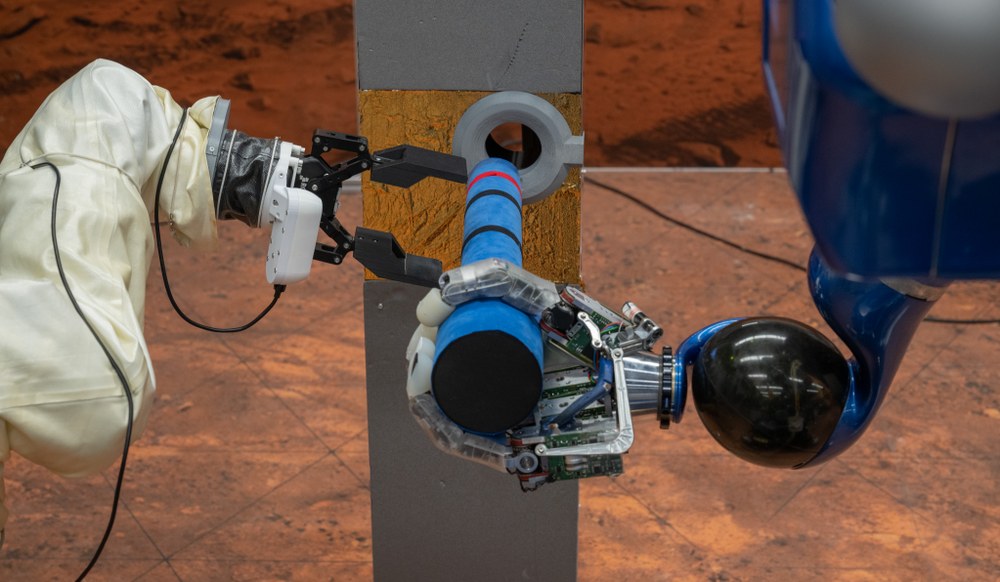
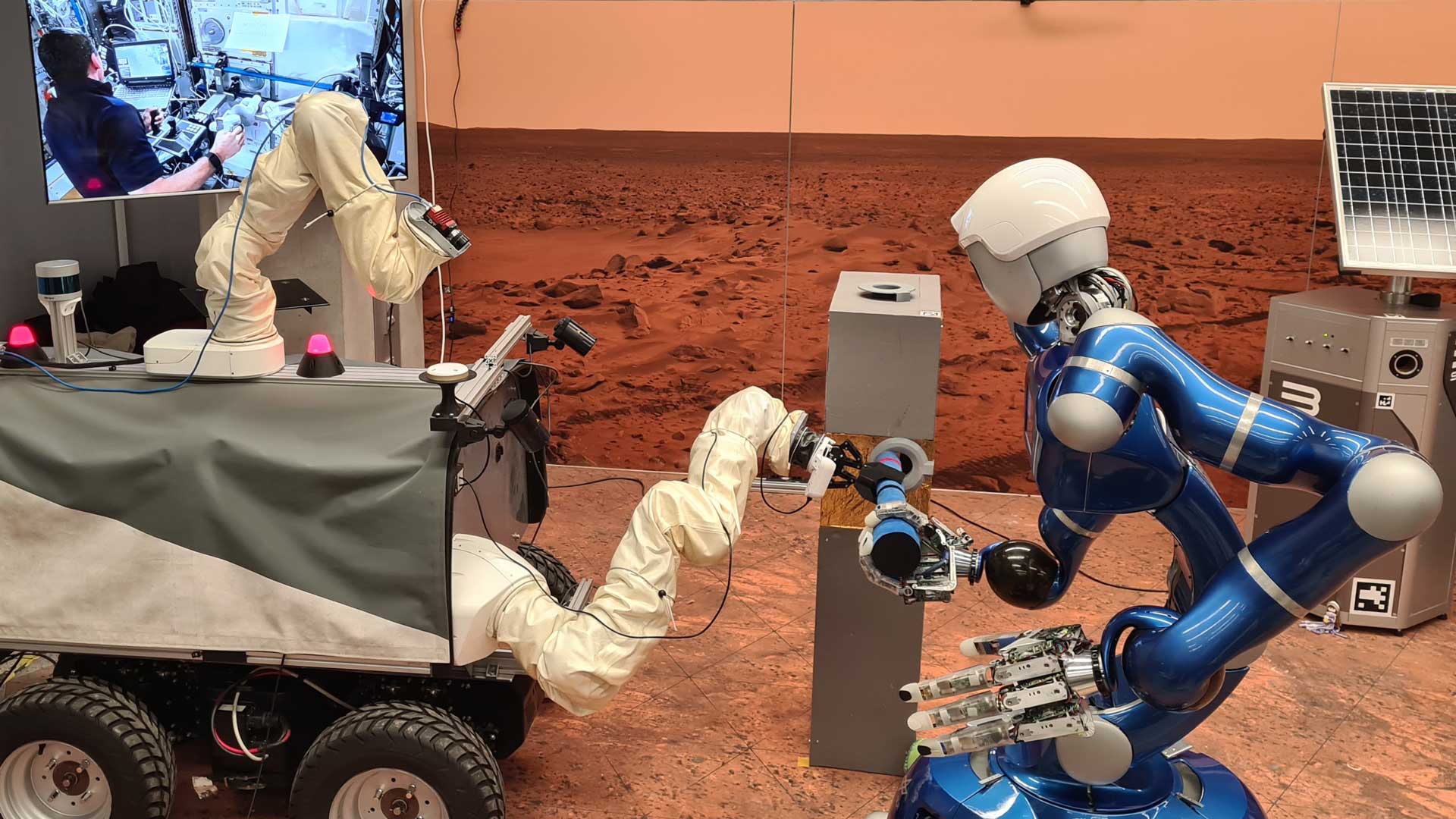
The autonomous humanoid DLR robot Rollin' Justin (right) and the ESA rover Interact (left) are controlled from the International Space Station ISS. They work together to handle a tool.
Two robotic hands co-operate when handling a tool together
While the arm of the humanoid DLR robot (right) carries an object independently, the astronaut controls the arm of the ESA rover Interact (left) from the ISS. The astronaut guides the object to the target position. The new approach makes it possible for the humanoid to maintain the rotation of the object, but to be particularly flexible in the translations
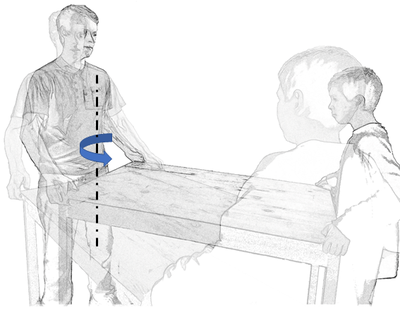
Visualisation of complex human cooperation for robots
The visualisation of human cooperation shows how the person on the left adapts to the movement of the person on the right through a rotational movement. The person on the left senses a force and a movement and reacts compliantly without pushing back to the starting position. This interaction principle is the basis for the published compliant robot control.
DLR concept allows collaborative robots to yield without being forced back to their initial state as if by a mechanical spring.
The yielding of machines refers to their ability not to stand rigidly in space, but to adapt their position flexibly to the conditions of their environment.
Progress in terms of yielding and adaptability increases the safety and effectiveness of robots and accelerates their integration into everyday life.
Focus areas: Space travel, robotics in space research and care
The use of robots in human environments is increasing rapidly. All the more reason to focus on the flexibility of these machines as a key safety feature. This ability to adapt flexibly to the circumstances makes the difference between smooth operation and potential dangers such as collisions with people in the immediate vicinity. The German Aerospace Centre (DLR) has established itself as a pioneer in the world of cobots – collaborative robots that work in close cooperation with humans. The aim of this development to date is for robots to act in such a way that they are moved towards a desired position like a mechanical spring. However, springs always return to their original position. DLR researchers have now presented a more advanced concept in the journal Science Robotics. Their approach allows robots to yield without moving back to their original position like a spring; a behaviour that is similar to humans when joint practical tasks are to be completed – one person takes command, the other remains flexible and yielding.
Michael Panzirsch, scientist at the Institute of Robotics and Mechatronics, explains: "The new elasto-plastic approach makes cooperation between humans and robots much easier, as the robot can now clearly distinguish whether its movement is the result of its own command or has been influenced by a moving environment. The robot should only react plastically to the influence of such an environment, i.e. it should move out of the way and stop in place."
In addition, the innovative controller generally offers the option of simplifying interaction with objects that have a complex movement. For example, a door can only be opened by rotating it around an axis. The robot follows the correct direction of movement, i.e. the rotation around the axis by the controller, almost automatically and without the need for an additional model of the door. This is comparable to a person who opens a door with their eyes closed, simply pulls on the door handle and automatically adapts to the circular path in a plastically compliant manner.
Application in space research and care
The Institute of Robotics and Mechatronics has been researching sensitive robots for decades. It developed the first robot arm, which stands out from classic, rigid industrial robots thanks to its remarkable flexibility. The elasto-plastic control approach was successfully tested in a space mission in January 2024. As part of the Surface Avatar project series, the teleoperation of several robot-based avatars on a planetary surface is being investigated. The focus here is on the successful cooperation of a heterogeneous team of robots, which should be able to perform collaborative tasks. "For the first time, our controller enabled cooperation between a rover from the Human Robot Interaction Laboratory of the European Space Agency ESA and a humanoid DLR robot controlled by an astronaut on the International Space Station ISS," explains Neal Y. Lii, scientific director of the Surface Avatar programme.
However, the versatility of the technology is not only evident in space. In the care sector, the elasto-plastic controller is proving to be a valuable aid. In the SMiLE (service robotics for people in life situations with limitations) project series, DLR researchers such as Jörn Vogel are developing concepts for assistance systems designed to provide effective support in everyday life for people with physical limitations and those in need of care. The elasto-plastic controller not only facilitates cooperation between humans and robots, but also enables the robot to automatically slip into a subordinate role without the need for additional, complex sensor technology.
Advances in robotics, particularly in terms of compliance and adaptability, are not only accelerating the integration of robots into everyday life, but also increasing their safety and effectiveness. In a future where humans and machines work ever more closely together, it will be crucial that these machines not only react, but also understand – and do so in a way that fulfils human needs and idiosyncrasies and is modelled on human capabilities.