
GRETA – the 'green' rocket engine
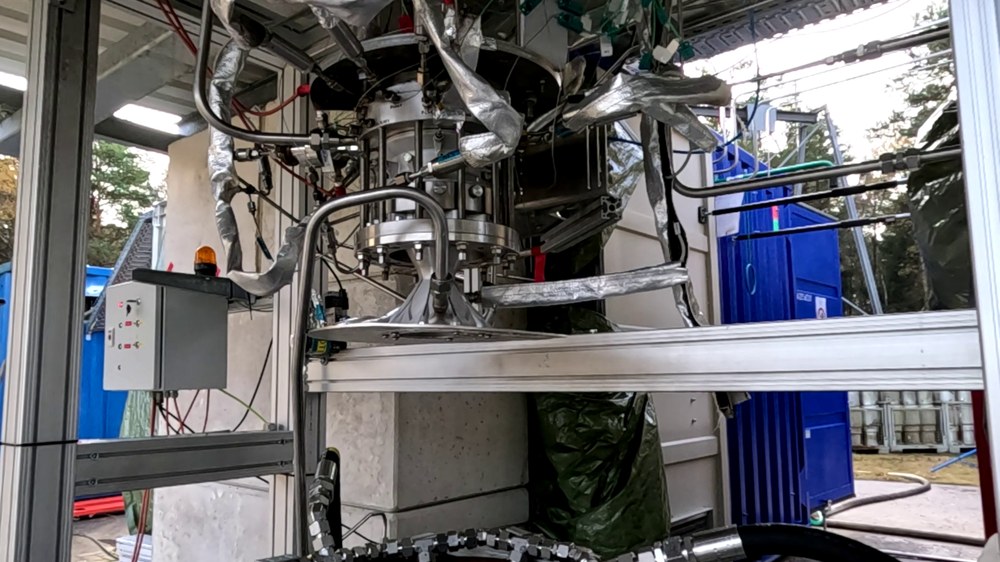

GRETA stands for GReen BERTA and is a further development of the 3D-printed BERTA engine, whose name stems from the German acronym for 'bipropellant space transportation propulsion'. GRETA introduces numerous technical innovations. Notably, GRETA is powered by highly concentrated hydrogen peroxide and ethanol, unlike BERTA, which uses toxic and carcinogenic propellants. These new fuels are both significantly more sustainable to produce, as well as considerably safer to handle and store.
More power for future launch vehicles and Moon exploration
Engines like GRETA and BERTA can be fired multiple times while maintaining high reliability, making them well-suited as engines for so-called kick stages. These are propulsion systems responsible for precisely delivering payloads into target orbits after separation from the main rocket. For instance, BERTA will serve as the engine for the ASTRIS kick stage currently under development for the Ariane 6 launch vehicle. This will allow multiple payloads on the same launch to be deployed very efficiently into different Earth orbits, or placed directly into their target orbit. This means satellites can be launched without a separate engine, making them lighter and more cost-effective.
Looking further ahead, GRETA could serve as the upper stage of future small launch vehicles, or as the propulsion system for Moon landers.
Cheaper and better engines through 3D printing
3D printing brings significant advantages to engine construction. In particular, 3D printing can significantly reduce production times. Currently, combustion chambers are produced by forging, with cooling channels subsequently being milled out, resulting in typical delivery times of up to one and a half years. With 3D printing however, complete engines can be delivered within just a few weeks.
GRETA is manufactured using a process called laser melting, in which metal powder is melted by a laser and built up layer by layer. This allows for the creation of complex structures that cannot be produced using conventional methods. Consequently, numerous machining steps are eliminated, reducing development- and production costs.
First hot gas test successfully completed
Between July and November 2025, the GRETA rocket engine successfully passed its first test campaign. In a hot gas test, the engine is first ignited, then brought into stable operation, and finally shut down in a controlled manner. During the test, instruments measure essential data such as pressure and temperature, which are used to further optimize the engine. The hot gas test of GRETA took place at the Trauen site of the German Aerospace Center (Deutsches Zentrum für Luft- und Raumfahrt; DLR), which is shared with ArianeGroup and the German Armed Forces.
GRETA is part of the Future Launchers Preparatory Programme (FLPP) of the European Space Agency (ESA), with contributions coordinated by the German Space Agency at DLR. ArianeGroup Ottobrunn serves as the prime contractor responsible for the development and construction of the engine. The next project phase began in February 2026 and will focus on optimizing the tested engine for potential in-flight operation.
Related links
Contact
Launch Systems