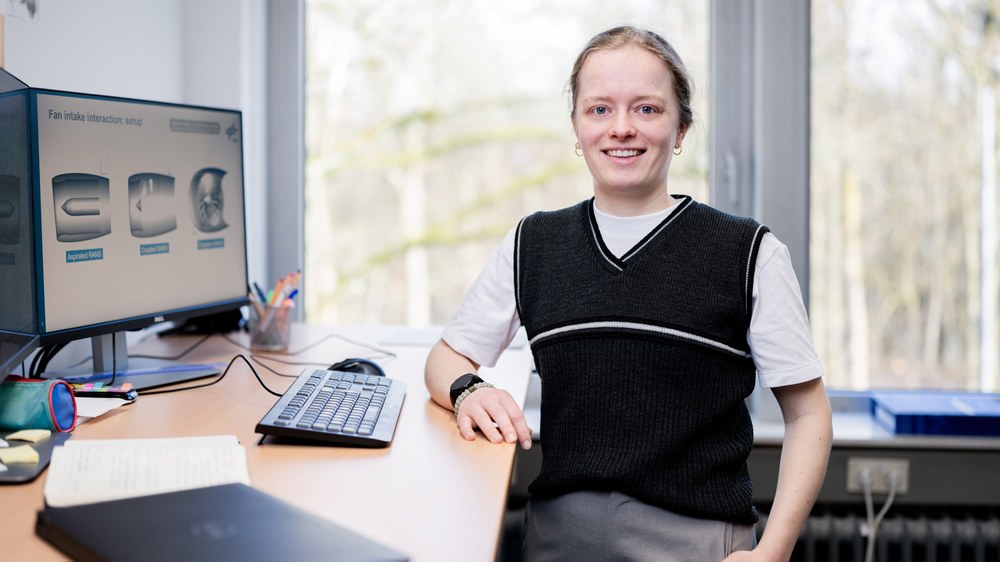
Hellen De Winter

“What they had here just sounded really cool”
Originally, Hellen wasn’t necessarily looking for a new job. The mechanical engineering graduate was very happy in her previous role. By chance, however, she came across a vacancy at the Institute of Propulsion Technology, which “was a much better fit for what I found really interesting”, she admits. “What they had here just sounded really cool.”
Without further ado, Hellen applied. She is now working on her PhD at the Institute of Propulsion Technology, where she is working on researching the interaction between the inlet and fan flow in an aircraft engine. The transition from the inlet to the fan forms the interface between aircraft and engine manufacturers. “This cross-component interaction is particularly challenging, but a good design is very important for efficient and robust aircraft engines,” she says.
Simulations are thereby certainly part of her daily work. First of all, the scientist always needs an inlet and fan geometry: “Sometimes this already exists, or I have to generate it myself,” she explains. This geometry is then broken down into a large number of smaller, simpler elements to create a grid (also known as a mesh). Various software solutions can then use this mesh to calculate the flow in 2D or 3D. The coupled components are subsequently evaluated step by step in various simulations. “There are different levels of complexity for this, depending on how accurately I want to represent reality,” explains Hellen.
Once the simulation has been successfully completed, Hellen moves on to post-processing. This involves preparing the collected data so that the results can be viewed, analysed and documented. “That’s a completely different job altogether. But sometimes the plots and images are really annoying, because you have to redo something ten thousand times to get everything right,” she says with a laugh.
Why Hellen recommends working at the institute: “Because it’s just so much fun! And because you always have the chance to understand what you’re actually doing. You’re not just using tools and getting a result. If you want to know how something really works, you can get expert input straight away.”
Teamwork as a driving force
However, it is not just the simulations that give Hellen a sense of fulfilment in her day-to-day work. “I really love the fact that my PhD involves collaborating with the industry. This partnership provides a very direct link to what is actually needed right now,” she explains. This collaboration not only successfully advances development but also ensures that “you become even more interested in the topic because everyone is so enthusiastic”. This positive atmosphere motivates her.
She also values the close teamwork: “It’s not always the case that you can work so well with your colleagues,” explains the researcher. Sometimes the topic of a PhD thesis is so specialised and individual that they don’t actually know that much about it. “But the way the institute is organised – and because so many different aspects of the engine are researched here – you really have the opportunity to exchange ideas extensively.”
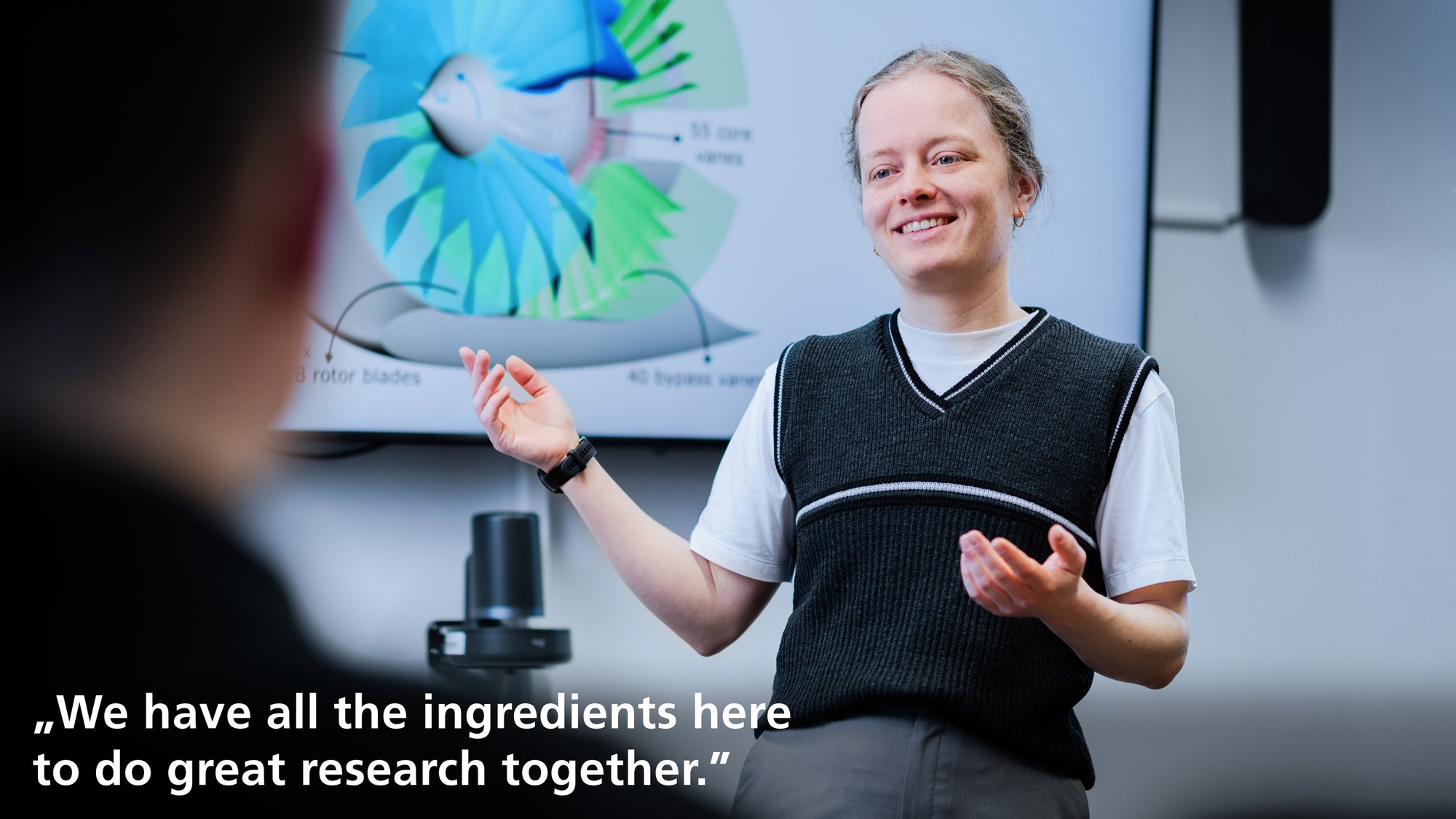
“We have all the ingredients here to do great research together”
But it is not just the range, but also the depth of knowledge that impresses Hellen: “I think what we have here is quite special. There are many colleagues who have been here for a very long time and who really know a great deal.”
For the simulations, for example, Hellen uses the in-house flow solver TRACE, which is developed by the department Numerical Methods at the institute. “If I then have a question or don’t understand something, I can simply walk down a few offices and ask. And I immediately get a technically sound explanation. You don’t come across that very often.”
For Hellen, it’s important not just to use simulation software, but also to gain an insight into what goes on behind the scenes. “You get that feedback straight away, and your colleagues are always happy to answer your questions.” But they’re not just there for questions – they’re also open to discussions. “I think we have all the ingredients here to do good research together.”
Would you also like to find a job that perfectly matches your interests? Then take a look at our job vacancies and apply at the Institute of Propulsion Technology.