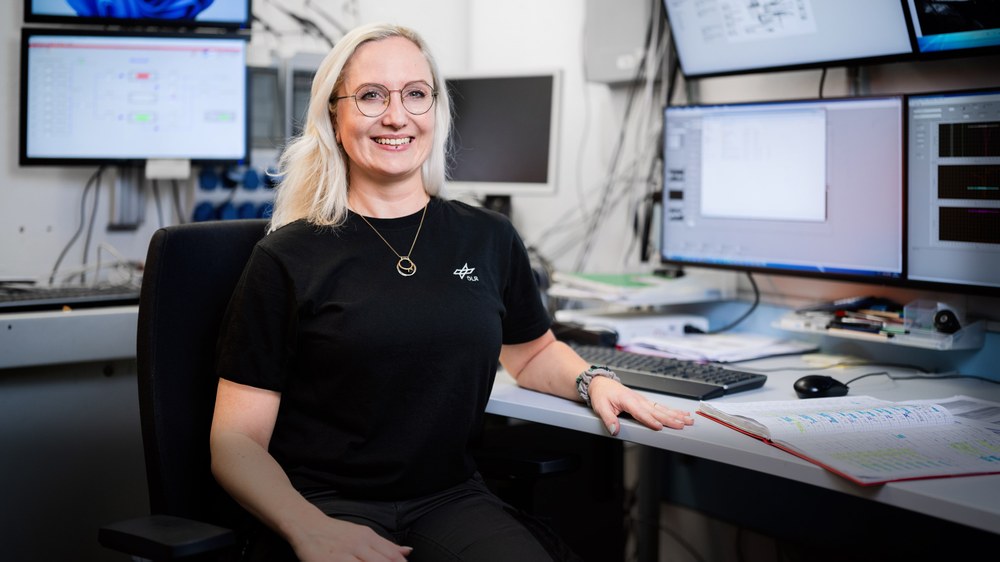
Jasmin Flamm

“As a mechanic, you can make everything yourself”
“I didn’t really have a knack for mechanics,” Jasmin admits honestly. She just knew she wanted to do something practical in her career. After getting a taste of the field by chance, she discovered the industrial mechanic apprenticeship at the DLR and thought to herself: “Why not just give it a go?”
She particularly enjoyed the design aspect of the training because there’s so much you can do yourself: “As a mechanic, you can make everything yourself.”
After completing her apprenticeship as a mechanic, Jasmin quickly realised, “there’s more to it than that,” and promptly began further training as a mechanical engineering technician. The great thing about it: she could draw directly on her work at the test rigs and develop a component for the test bench as part of her final project. “That went down very well at vocational college too,” she admits. Access to the knowledge of her colleagues at the test rig was also particularly helpful here; they always supported Jasmin whenever she had a question. “It’s very helpful when you’ve got loads of scientists around you,” she jokes.
What Jasmin would say to young scientists: “I’d never had anything to do with mechanical work before. I enjoyed doing crafts as a child, but that was about it. But I just gave it a go. If you’re still undecided during your studies or training, it’s a good idea to look for voluntary work placements or even just spend a day getting a taste of what it’s like somewhere – Try it and see!
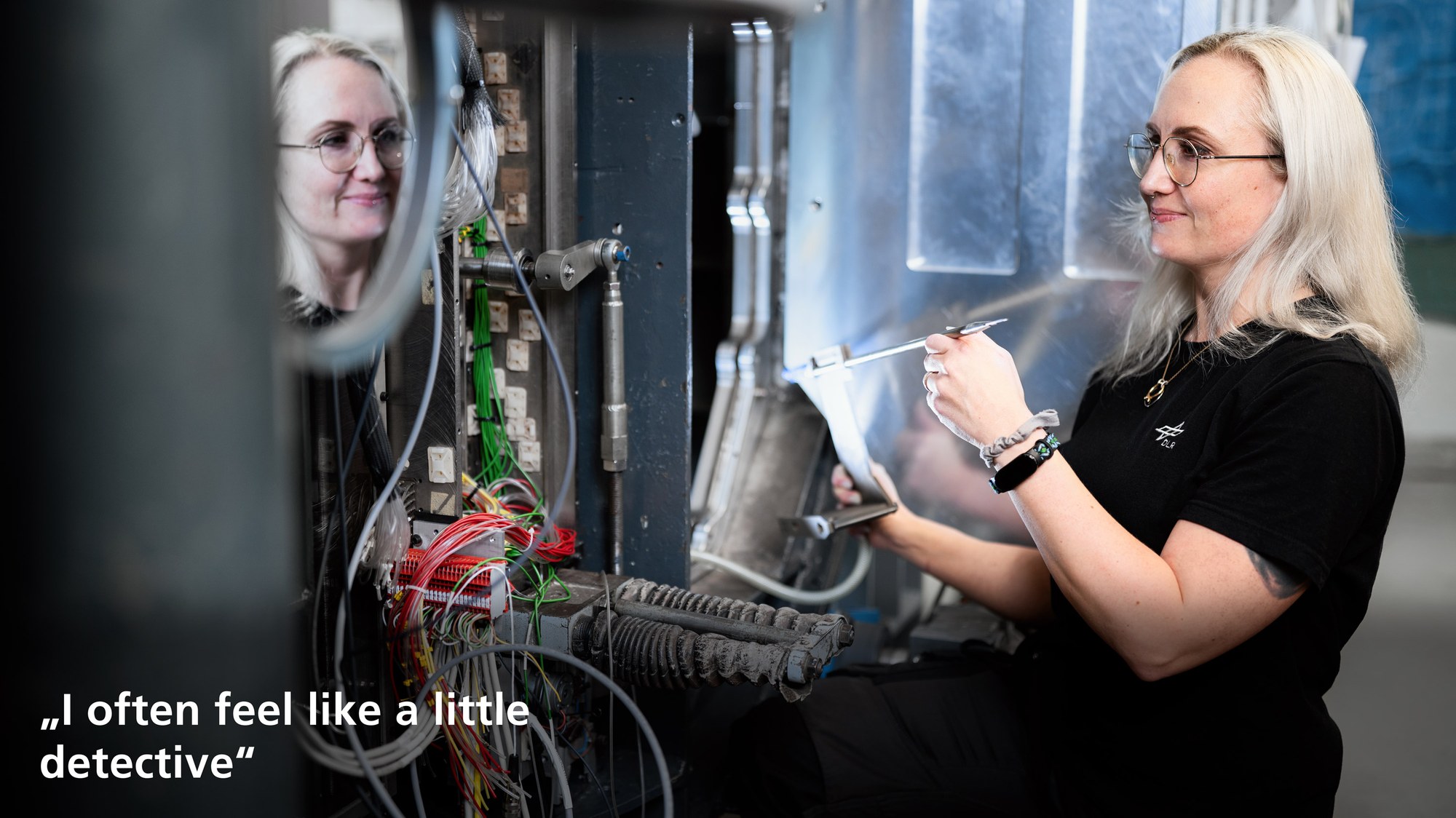
“I often feel like a little detective”
The work at the test rig is very varied – there’s no such thing as a typical working day for Jasmin. But that’s precisely why she enjoys her work so much: “It really never gets boring”.
“I love crime thrillers and I often feel like a little detective when we have to find new ways to make something work,” she says jokingly. When scientists want to carry out a specific experiment on the test rigs, Jasmin has to work with her colleagues to figure out the best way to implement the project. “Depending on the project, individual components need to be manufactured or new prototypes built, which are essential for mounting test specimens on the test bench.”
Once everything is ready for the test, Jasmin also assists with the experiments: adapting software, installing components in the test rig or calibrating the measurement equipment. And that is just a small part of the range of tasks her job offers her.
But even when there isn’t a major project on the horizon, things never get boring at the test rig: “There are always individual parts that need repairing or recalibrating from time to time. And the test rigs themselves need to be serviced at regular intervals or replaced with new technology,” says Jasmin.
Of course, this variety can also lead to challenges. But for Jasmin, it mostly means learning something new: “The number of things I’ve looked at or read up on – it really helps you grow beyond your own limits.” For Jasmin, the intensive exchange with her colleagues in the team is therefore a top priority. Further training is also available if the necessary specialist knowledge isn’t immediately available within the team. For her, it’s therefore important to “look beyond her own horizons every now and then”.
Would you like to get a taste of the different departments at DLR or the Institute of Propulsion Technology? Then check out DLR_School_Lab and apply for an internship.