What began in 1994 as a collaboration between the DLR Institute of Propulsion Technology and MTU Aero Engines is now a key tool for the digital development of aircraft engines and gas turbines. TRACE forms the backbone of aerodynamic design at leading industrial partners such as MTU and Siemens Energy, and is also used in research at numerous universities.
30 years of TRACE in the turbomachinery industry
Your consent to the storage of data ('cookies') is required for the playback of this video on Quickchannel.com. You can view and change your current data storage settings at any time under privacy.
30 years of TRACE in the turbomachinery industry
What began in 1994 as a collaboration between the DLR Institute of Propulsion Technology and MTU Aero Engines is now a key tool for the digital development of aircraft engines and gas turbines. TRACE forms the backbone of aerodynamic design at leading industrial partners such as MTU and Siemens Energy, and is also used in research at numerous universities.
The TRACE flow solver is celebrating its 30th anniversary. Developed at the German Aerospace Center (DLR) in close cooperation with MTU Aero Engines and universities, TRACE has become a key tool for flow prediction and the design of engine and turbomachinery components in the German turbomachinery industry. TRACE is not only an essential component of the virtual engine, a digital representation of real engines. It also exemplifies the sustainable transfer of technology from research to industrial application.
The importance of TRACE for research and industry
TRACE forms the backbone of 3D aerodynamic design at MTU Aero Engines and other partners, and supports research into turbomachinery at leading universities. The flow solver has been used in the design of passenger aircraft engines such as the Airbus A320 and A380, Dassault and Gulfstream business jets, and helicopter engines. TRACE has also contributed to significant efficiency gains in stationary gas turbines, for example at Siemens Energy. "TRACE is based on three pillars: research, industry and universities.
The DLR Institute of Propulsion Technology plays a key role in this. As the leading developer and architect of the software, it connects the partners involved and coordinates the continuous further development of TRACE," emphasises Prof. Florian Herbst, Director of the Institute of Propulsion Technology. ‘TRACE is an excellent example of successful technology transfer in Germany: close and long-term cooperation across academic and industrial organisations,’ Herbst continues. Dr Nina Wolfrum, Head of Aerodynamics at MTU in Munich, adds: ‘TRACE is tailored to our very specific requirements and is constantly being further developed. This gives us a real competitive advantage.’
From idea to successful design tool
TRACE was first set up in 1994 when the DLR Institute of Propulsion Technology and MTU Aero Engines worked together. The aim was to develop calculation methods for more economical and lower-emission engines. After looking at the simulation and analysis tools available at the time, the people in charge chose the method developed at DLR, which was named TRACE (Turbomachinery Research Aerodynamics Computational Environment) and has been developed together ever since. In 2005, Siemens AG (now Siemens Energy) joined as another industrial partner using the code. Later, the DLR spin-off AeroDesignWorks was created. This company specialises in turbomachinery and small gas turbines. What started out as a research project is now used all over the world by experts. TRACE has been at the forefront of digital development for aircraft engines and gas turbines for 30 years. We are designing the next generation virtually, precisely and together with our partners,' says Dr Edmund Kügeler, Head of the Numerical Methods Department at the Institute of Propulsion Technology. 'It's great to see how a code that was initially more research-oriented has developed over many years into a truly competitive flow solver,' explains MTU expert Wolfrum. MTU has invested significantly in quality assurance and user-friendlyness.
Today, TRACE is being further developed and used in research not only at DLR and in cooperation with MTU, but also by numerous universities. Around 50 to 60 engineers from research, industry and universities across Germany are working together to improve the software package.
Info
TRACE is not just a flow solver, but an entire simulation suite for setting up, running and analysing highly complex simulations. The most important features of TRACE at a glance:
• Specialised boundary conditions for efficient calculation of multi-stage configurations
• Frequency domain method for efficient calculation of unsteady flow
• Adjoint methods
• Physical models optimised for use in turbomachinery
• Machine learning framework
• Higher-order discontinuous Galerkin solver as the basis for highly accurate numerical experiments
• FSI and linear solver
TRACE User Conference am Deutschen Zentrum für Luft- und Raumfahrt
To mark the 30th anniversary of TRACE, the DLR Institute of Propulsion Technology is organising a special anniversary programme from 24 to 27 November 2025. In addition to a celebratory event with companions and pioneers, the TRACE User Conference 2025 will take place immediately afterwards.
The conference offers researchers, industry representatives and universities a platform for exchanging experiences, presenting current applications and jointly developing the tool. It underscores the close networking between science, industry and universities that has characterised TRACE for three decades and made it an internationally recognised software.
A look at the TRACE User Conference 2025
30 years of TRACE in the turbomachinery industry
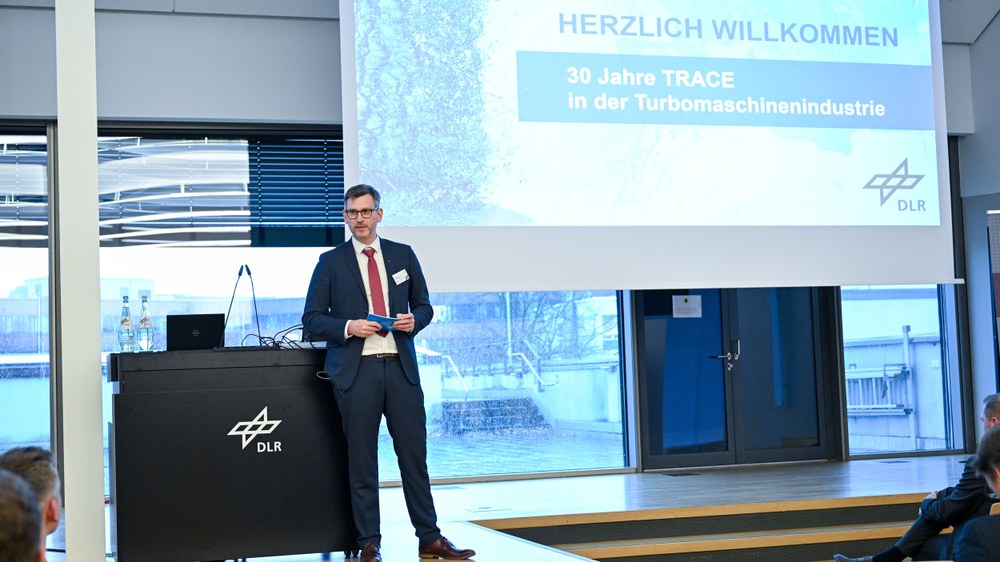
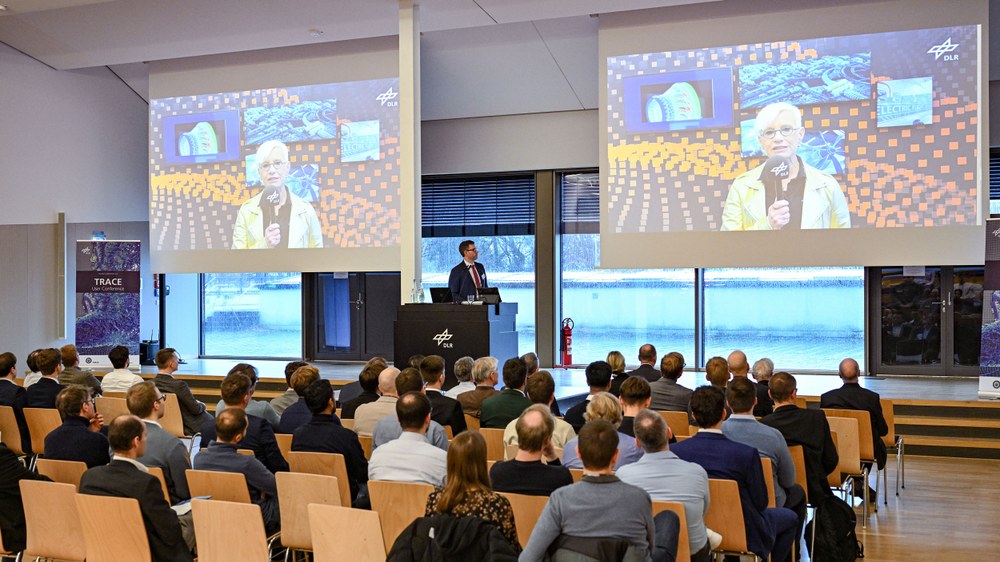
The institute's director, Prof. Florian Herbst, opens the TRACE User Conference on November 24, 2025.
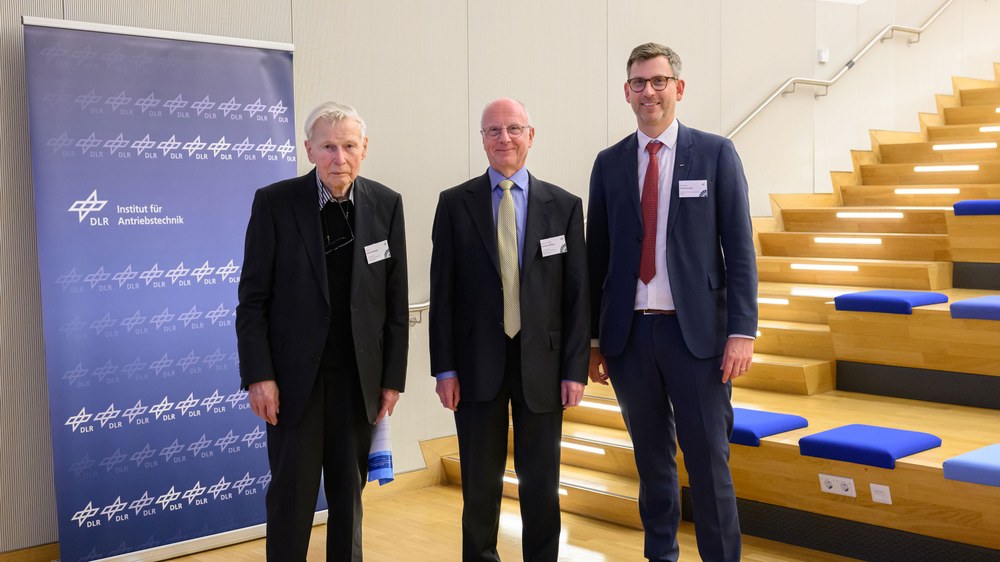
Three generations of institute directors were represented at the TRACE User Conference: Prof. Heinrich Weyer, Prof. Reinhard Mönig, Prof. Florian Herbst (from left to right)