
Cargo MPS Task Group meets in Trauen
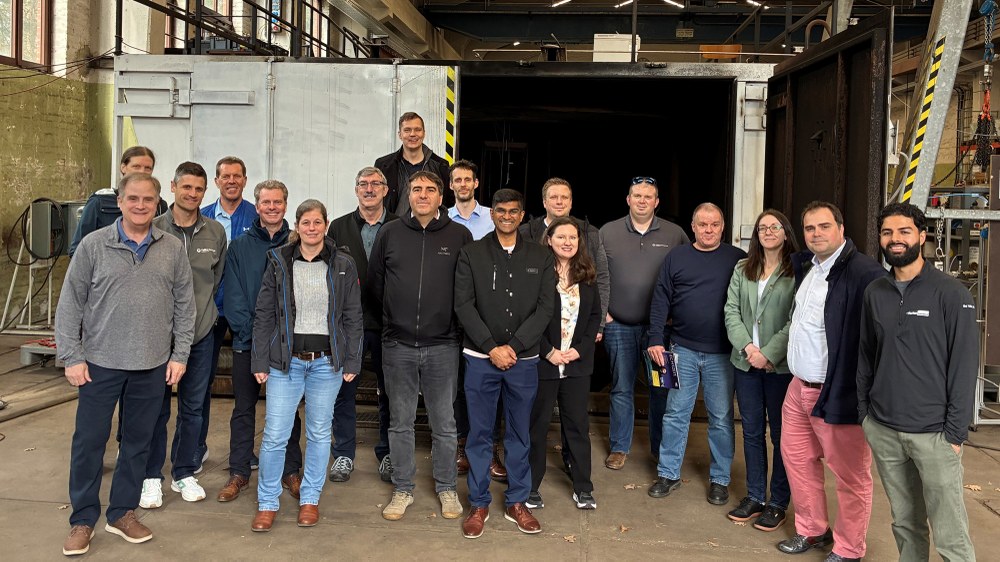

The Cargo MPS is a panel of experts including major aircraft manufacturers, the supply industry, research institutions, universities and aviation authorities who are working on Halon Replacement Fire Suppression Systems.
The International Aircraft Materials & Systems Forum is organized twice a year in the United States or Europe, by the Federal Aviation Administration (FAA), to inform its members and attendees on the latest Fire Safety Updates and provide an opportunity for a cross-industry exchange on the latest research and regulatory development.
Within the framework of the Forum, the Cargo Minimum Performance Standard Task Group (Cargo MPS Task Group), which is also led by the FAA, meets regularly to work on the further development of the FAA test regulation “Minimum Performance Standard for Aircraft Cargo Compartment Halon Replacement Fire Suppression Systems“. For most applications, Halon fire-extinguishing agents are no longer permitted, due to their harmful effect on the ozone layer. The production of halons has already been banned globally since 1994.
Although Halon fire suppression systems are still in use for unoccupied aircraft cargo compartments, the 'cut-off' date for these systems was reached at the end of 2024. Any new aircraft type now requires a Halon-free fire suppression system. The existing fleet is also affected, as EU regulations require existing aircraft to be retrofitted with alternative fire suppression systems by the 'end date' of 2040. Intensive research is therefore being carried out into alternative fire suppression systems in cargo holds to meet these regulations.
This year we were thrilled to be able to host this task group meeting at the Institute’s facility in Trauen. In addition to representatives from the FAA and EASA, members of the major aircraft manufacturers Airbus and Boeing as well as representatives from the supply industry have registered and attended the group meeting on Friday.
The Institute of Propulsion Technology has been actively researching in the field of cargo hold fire testing and Halon Replacement for over three decades. The current cargo hold test cell was originally build in the 1990s and has been modified several times since then. The main focus of the meeting was on reviewing the results produced in the projects AirPED (funded by EASA) and WAKOS (funded by the BMWE as part of LuFo VI-2) with the current test cell over the past five years. Additionally, members had the opportunity to view the test cell on site.
To date, there are only two test facilities whose results are officially recognized by the authorities including the EASA: one is run by the FAA and the other by Boeing. In close cooperation with Airbus we are working to ensure that our test cell will also be accepted by the authorities in the future. That way, we can directly contribute to the approval of alternative fire-extinguishing agents without Halon. The MPS Task Group Meeting was another important step in that direction.
Contact
Alea Sonntag