
Girls'Day at the Institute of Propulsion Technology
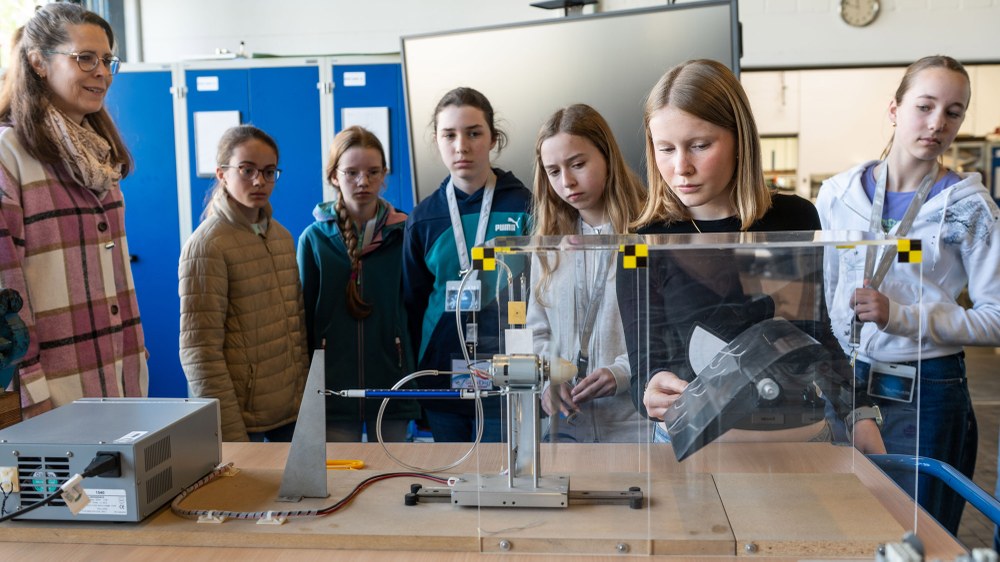

On 23 April 2026, the German Aerospace Center (DLR) opened its doors at its Cologne-Porz site as part of the nationwide Girls’Day. The aim of the event is to give schoolgirls in Years 6 to 9 an insight into career fields where the proportion of women is typically still below 40 per cent. The Institute of Propulsion Technology also took part in the day organised by the DLR_School_Lab with a varied programme.
Dr. Melanie Voges takes the girls in small groups to the institute’s Two Shaft Compressor Test Facility (M2VP), where a number of exhibits are already on display. First, Melanie and two other female employees of the institute welcome the group. They talk about their various fields of work as scientists and mechanics – offering a brief insight into career opportunities as well as the different areas of research at the institute.
Melanie has been supporting Girls’Day at the institute for many years. “I think it’s absolutely vital to show the girls what careers in science and engineering can offer. I believe many of them still have no idea what opportunities exist in the world of work. I want to spark their enthusiasm here,” she says. But Girls’ Day takes place not only in Cologne, but also at other DLR sites. At the Göttingen site, the Institute of Propulsion Technology was also able to show the schoolgirls some exciting experiments.
Why can an airplane actually fly?
A short introductory film lightens the mood in Melanie’s group, and then they get straight down to business. The visitors eagerly make their way to a board bearing the heading “Why can an airplan actually fly?”. In simple terms Melanie explains the forces acting on an aeroplane and why it needs propulsion. In between, she asks a few questions and the girls are invited to join in.
Things get particularly exciting during the practical session: Melanie demonstrates an experiment in the wind tunnel that illustrates the forces explained earlier. One by one, the girls get to experience for themselves what lift actually feels like. A brass rod that initially seems heavy begins to almost float under the airflow in the wind tunnel, aided by an airfoil profile.
Melanie shows further exhibits and then explains the influence of airflow on wings. What happens, for example, if you change parameters such as the angle? Along the way, she repeatedly refers to small everyday moments that make the physical phenomena tangible for the pupils.
Experiments in the digital wind tunnel
To round things off, a little challenge awaits the visitors. One by one, the girls design digital shapes on a tablet, which are then displayed on a screen. There, the shapes are tested for lift and air resistance in a wind tunnel simulation. Whoever manages to achieve the greatest lift wins! A drawn heart performs particularly well.
Time at the test rig flies by far too quickly, but the day is far from over. Back at the DLR_School_Lab, the rest of the day features further exciting stations at other institutes as well as a visit to the European Astronaut Centre. Melanie says: “I think sometimes you have to put topics on a pedestal and show: this isn’t so far removed from reality – you can do all this, you just have to want it and get stuck in.” She therefore hopes to have motivated some of the schoolgirls with today’s activities.
This is precisely where the Institute’s Women in Tech campaign comes in. It shines a spotlight on women in STEM professions and offers insights into the perspectives and personal journeys of female scientists and engineers at the Institute. Melanie also shares her story at the Institute of Propulsion Technology.