
The Founding Father of the Institute of Propulsion Technology: 120 Years of Prof. Heinrich Kühl

Prof. Hanns-Jürgen Lichtfuss
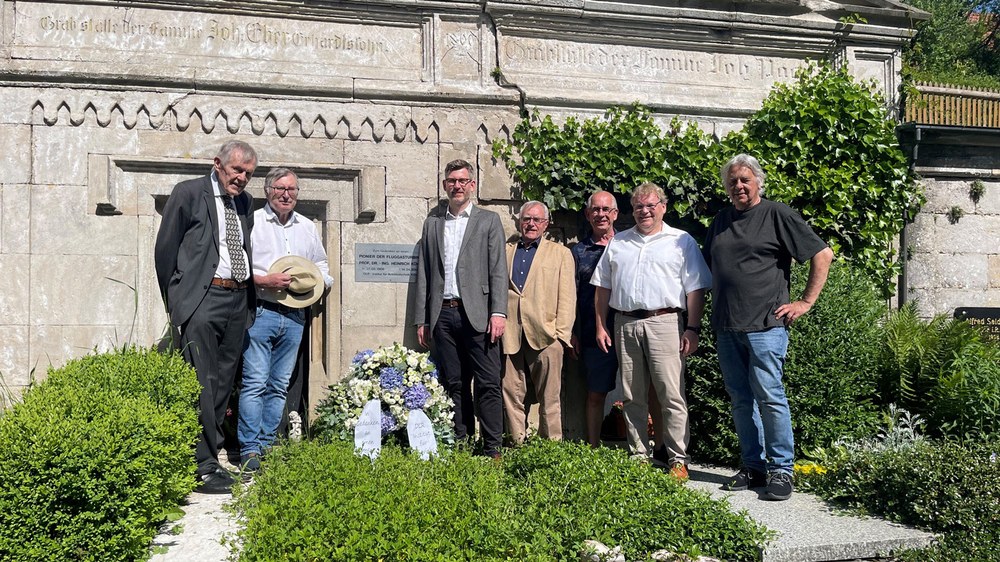
To commemorate the 120th anniversary of the birth of the institute’s founder, Prof. Dr.-Ing. Heinrich Kühl, Institute Director Prof. Florian Herbst and Department Head Dr. Andreas Döpelheuer visited the former institute director’s grave in Unterrodach, Franken, and laid a wreath.
The commemorative event honoring the 120th birthday of Prof. Dr.-Ing. Heinrich Kühl was largely organized by his former students, Prof. Dr.-Ing. Dietrich Eckardt and Prof. Dr.-Ing. Hanns-Jürgen Lichtfuss. Together with Mayor Thomas Hümmrich, the attendees visited not only the gravesite but also the Rafting Museum and the houses of the former timber rafting merchants of the Eber-Erhardtssohn family, in whose family crypt Heinrich Kühl is buried. Gerd Wich-Heiter and Rolf Müller provided additional historical insights into Prof. Kühl’s maternal family. This glimpse into history highlighted the significance of rafting and the rafting family for the town of Unterrodach.
Research on Aircraft Gas Turbines
Yet the connection to rafting is only one part of Prof. Kühl’s past. As the founder of the Institute of Propulsion Technology and a long-time employee at the DLR, he contributed significantly to the history and success of the institute. In doing so, he made important contributions to the development of aircraft engines and gas turbines. A memorial plaque at the grave site also describes Prof. Kühl as a pioneer of the aircraft gas turbine. The plaque was installed several years ago under the then-director of the institute, Prof. Heinrich Weyer, on behalf of the Institute of Propulsion Technology.
Prof. Kühl earned his Dr.-Ing. degree from the Technical University of Munich in 1935, with a dissertation on the dissociation of combustion gases and its influence on the efficiency of carburetor engines. Shortly before that, in 1934, he first joined what was then the Deutsche Versuchsanstalt für Luftfahrt (DVL) in Berlin - now the German Aerospace Center (DLR). There, he had already exerted considerable indirect influence on the ongoing development of turbojets and soon became head of the Department of Motor Power Processes and Thermodynamics.
Starting in the 1940s, Prof. Kühl focused his research entirely on the aircraft gas turbine as well as gas turbine control and regulation.
During the Nazi era, all research in the German Reich was geared towards rearmament and preparations for a war of aggression. Aeronautical research, too, was required to serve these objectives.
After the war, he worked for a short time as a lead engineer and combustion chamber specialist at Safran Helicopter Engines (formerly Turboméca), a French manufacturer of gas turbines for aviation. He also worked temporarily in gas turbine development at Mercedes-Benz in Stuttgart (formerly Daimler-Benz). There, he completed his habilitation at the Technical University of Stuttgart with a thesis on Problems of the Cross-Flow Heat Exchanger and received the venia legendi, that is, the official teaching authorization, for thermodynamics.
Founding of the Institute of Propulsion Technology
Back at the DVL, the Institute of Propulsion Technology was finally founded in 1959 under the direction of Prof. Heinrich Kühl, initially under the name “Institute for Air-Jet Propulsion”. The new institute was formed from the former DVL Institute for Jet Propulsion and Gas Turbines and the DVL Institute for Thermodynamics and Combustion.
This merger remains the foundation to this day for the broad scope of the Institute of Propulsion Technology, covering all components of a turbojet engine through to the research field of fire protection. Prof. Kühl’s exceptionally broad theoretical and practical background certainly contributed to this comprehensive spectrum. In 1963, he was also appointed adjunct professor of thermodynamics at RWTH Aachen University.
During his time as institute director, he devoted himself in particular to the development and acquisition of high-performance, adaptable test facilities, some of which remain in use at the institute to this day and play a key role in cutting-edge engine research. He led the institute as director until 1973 before passing away in 2000 at the age of 94 and being laid to rest in the family crypt in Unterrodach.
Sixty-seven years after its founding, the Institute for Propulsion Technology looks back on an impressive history of development. The institute is now based not only in Cologne but also in Göttingen, Trauen, and Berlin, and employs more than 200 staff members. This development is closely linked to the contributions of Prof. Kühl, whose pioneering work laid the foundation for our institute today and for research in the field of propulsion technology.
Further Reading
Eckardt, Dietrich: Jet Web. Springer Nature, 2023.
Kuehl, Heinrich: Die Dissoziation von Verbrennungsgasen und ihr Einfluss auf den Wirkungsgrad von Vergasermaschinen, TU Munich (Profs. Nusselt und Loschge), 1935.
Richter, Hans-Leo: „50 Jahre DLR-Standort Köln-Porz.”, 2009, www.dlr.de/de/aktuelles/nachrichten/2009/20090715_50-jahre-dlr-standort-koeln-porz_18577.