Low-emission combustion chamber system for CO2-free flight
Research Project EmBreCOfF
Low-emission combustion chamber system for CO2-free flight
Research Project EmBreCOfF
Low-emission combustion chamber system for CO2-free flight
The “EmBreCOfF” project is being carried out under the leadership of Rolls-Royce Deutschland Ltd & Co KG in collaboration with the following partners: the German Aerospace Centre (DLR) – Institute of Propulsion Technology and Institute of Combustion Technology, Technical University of Darmstadt – Department of Simulation of Reactive Thermo-Fluid Systems, and Technical University of Munich – Chair of Thermofluid Dynamics.
With the “EmBreCOfF” project, the consortium is continuing its work on an emissions-optimised, fuel-flexible combustion chamber system. The work began as part of the LuFo VI-3 project TeTeAnt-H2 within the BreTuFlex sub-project and falls under the Industrial Research programme line, with a focus on “Conventional Aircraft Propulsion Systems”. There is an expanded focus on sustainable and digital manufacturing methods, as well as more precise advanced measurement and design methods.
Fuel flexibility is a central component of climate-compatible aviation and is geared towards the goal of reducing all climate-impacting emissions. The DLR project addresses this goal through both technological and methodological research. In close cooperation with the project partners, important contributions are thus being made towards a further reduction in particulate matter and nitrogen oxide emissions from fuel-flexible aircraft gas turbines. These contributions include scientific work on the following topics:
Interaction between the combustion chamber and the turbine
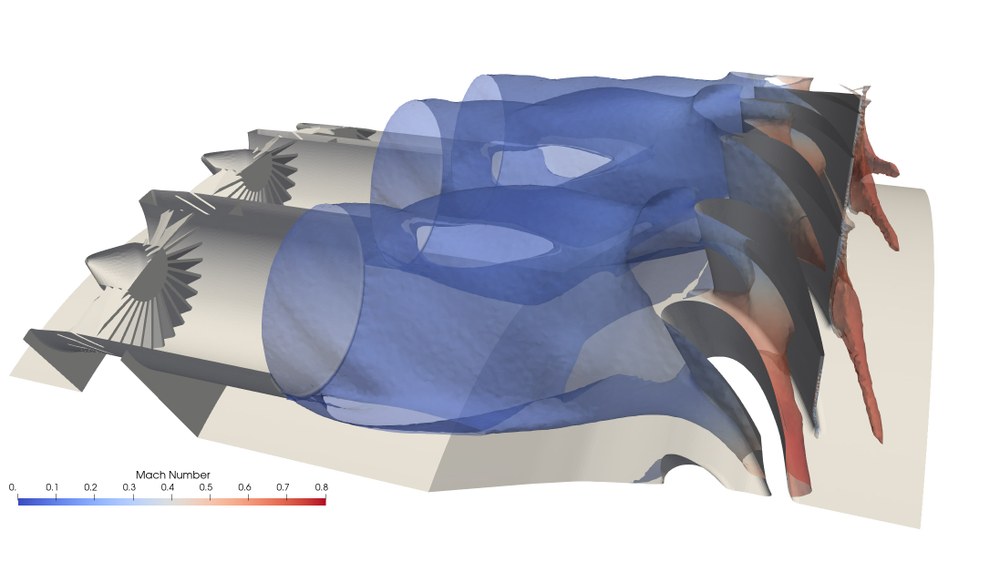
The flow from the combustion chamber has a direct impact on the performance and efficiency of the downstream turbine. Using CFD (Computational Fluid Dynamics) simulations, the project aims to lay the groundwork for further research into combustion chamber–turbine interaction in fuel-flexible combustion chambers. The aerodynamic requirements arising from a novel fuel-flexible combustion chamber are investigated in order to understand the influence of different fuels on turbine design. The fuels range from SAF (Sustainable Aviation Fuel) to hydrogen. The aim is to broaden the understanding of cross-component aspects when using a wide variety of fuels.
Convection of a hot spot through the interface between the combustion chamber and the turbine
As part of the EmBreCOfF project (Low-emission combustion chamber system for CO2-free flight), the Institute of Propulsion Technology is conducting research into advanced technologies for flexible fuels.
Endoscopic measurement technology for the combustion chamber
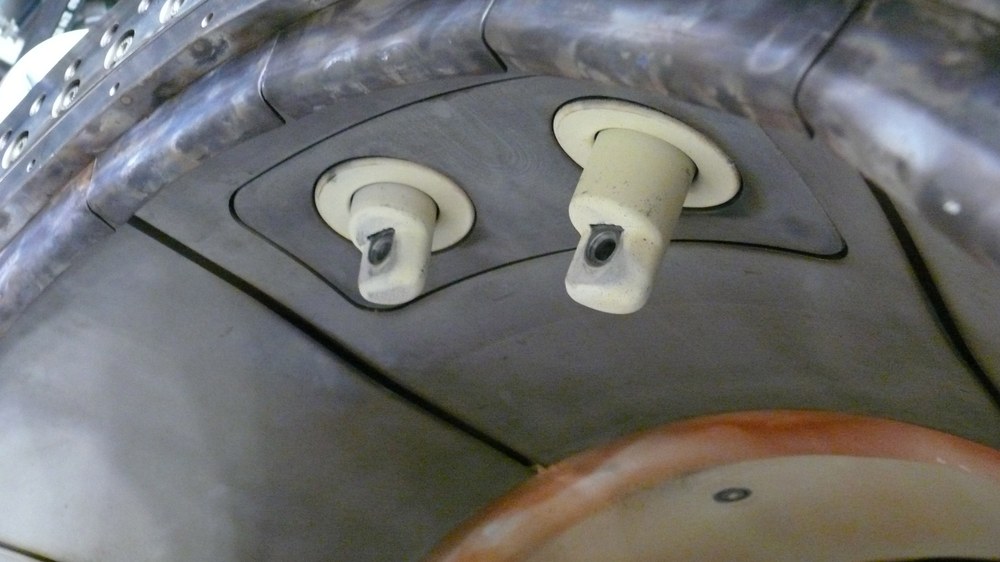
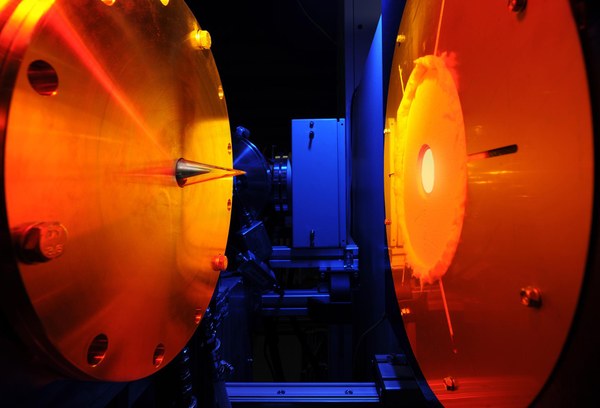
To enhance the insights gained from full-ring tests conducted under realistic pressure conditions, optical diagnostics are being developed and demonstrated for the High-Pressure Combustion Chamber Test Facility 5 (HBK5) in Cologne. To this end, existing, purely qualitative endoscopic measurement techniques are being expanded to include minimally invasive, laser-assisted quantitative methods.
In particular, the non-contact in-situ measurement of temperature in the full-ring combustion chamber represents new scientific and technical territory, which will significantly improve the joint design of combustion chambers and turbines in the future.
Doppelsonden-System im „Optical Duct“ Segment hinter der Abströmung einer Vollring-Brennkammer im HBK-5
Particle (nvPM) measurement technology on test rigs
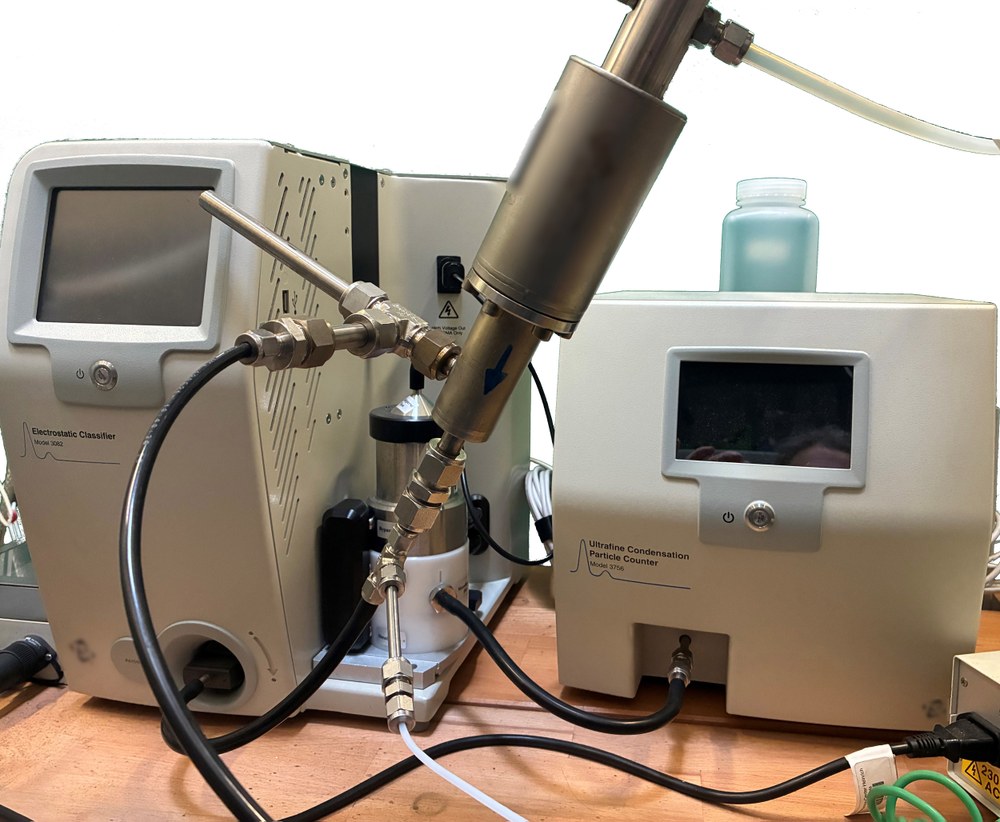
When measuring the smallest particles in the sub-micrometre range, measurement losses and uncertainties are inevitable. To address this, the existing measurement setup is optimised and suitable correction formulas are being developed for different environments. The aim is to improve the transferability and comparability of measurements across different environments (e.g. comparison of test bench with engine).
The findings will be incorporated into the design and construction of a mobile measurement system, enabling measurements to be carried out on various test benches with greater accuracy. This should also improve the transferability of measurement results across the various TRL levels of these test benches. Our own research will thus gain greater significance and, in collaboration with industry partners, can help to accelerate development work in a targeted manner.
Further development of fuel injector technology
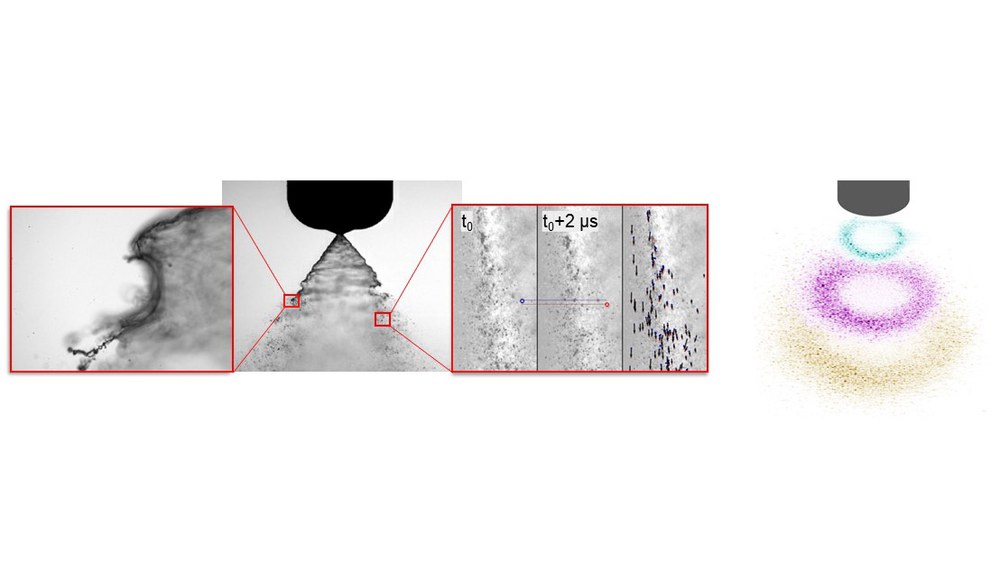
Research is being conducted into various aspects of pressure atomisation technologies for low-emission, staged burners in aero-engines: to this end, the necessary specifications are being determined, design tools are being improved and expanded, and advances in manufacturing processes and quality assurance methods are being utilised.
With the aid of a high-pressure test rig adapted for liquid fuel sprays, various atomisation concepts are being developed and tested iteratively. Finally, measurement campaigns are carried out to evaluate the performance of the atomisers under high-pressure conditions and to gain insights for more efficient designs. The aim of this work is to drastically reduce aviation emissions, as the combustion process is very closely linked to the fineness and distribution of the spray droplets.