
New engine control using AI for greater efficiency and safety
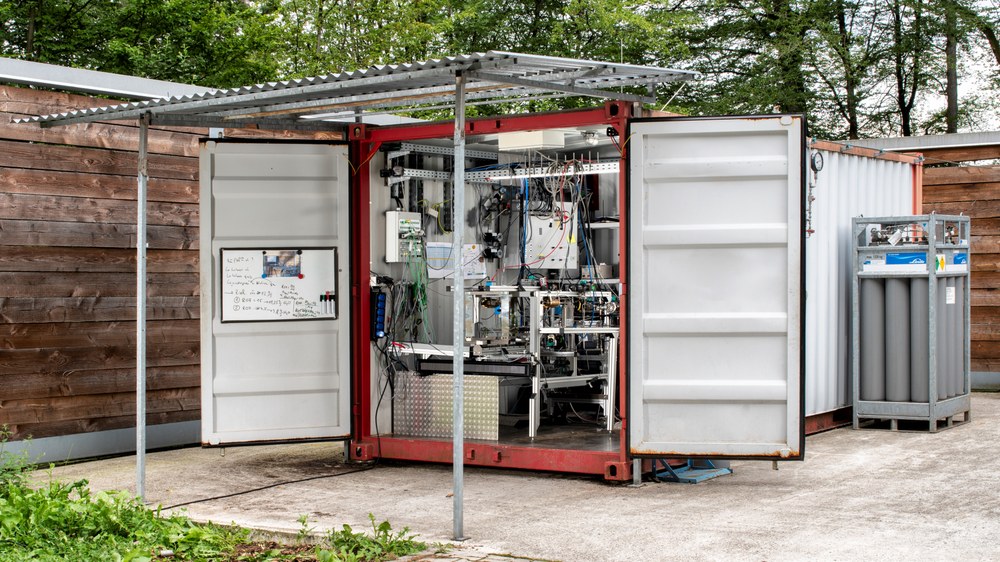

Testing space propulsion systems is a challenging task – in future, artificial intelligence (AI) methods will play an important role. To this end, the DLR Institute of Space Propulsion at the Lampoldshausen site is pooling the expertise of the two research departments 'Satellite and Orbital Propulsion' and 'Rocket Propulsion Systems'. Working closely together, the team of scientists has succeeded for the first time in controlling a test stand including an integrated rocket engine with artificial intelligence. At the M11 test stand complex, a research combustion chamber was tested in so-called cold gas mode with pressurized nitrogen; no combustion takes place in the combustion chamber.
More efficient test operation with the help of AI
First, the test bench setup and the engine's fluid system are recreated on the computer in a simulation environment and compared with measurement data from real tests. In the next step, the artificial intelligence is trained in the simulation environment. Deep reinforcement learning algorithms are used for this. After training in the simulation environment, the trained controller is transferred to the test bench. This then takes over the autonomous control of the test bench, i.e. the control of the control valves installed in the test bench, in order to achieve the desired operating point of the engine. During a test, different operating points of the combustion chamber are approached, all of which are successfully reached by the control system.
Increasing the service life and efficiency of an engine through AI control
By using artificial intelligence, the scientists hope to achieve a number of benefits in the application: Firstly, a more efficient operating point of the engine can be found. The system can react independently and intelligently to changes in the drive system, thus minimizing the risk of damage to the engine. By incorporating fatigue models of engine components into the control system, the service life of the engine can also be increased. "Artificial intelligence can be used in addition to the regular test operation of rocket engines. This will increase the efficiency and safety of tests on our test benches," says Prof. Stefan Schlechtriem, Director of the DLR Institute of Space Propulsion, adding: "The use of AI in test operations will significantly expand and improve the range of applications and the operation of rocket engines. With regard to the safe operation, reusability and thrust controllability of the engines, significant improvements can also be expected in the near future."