
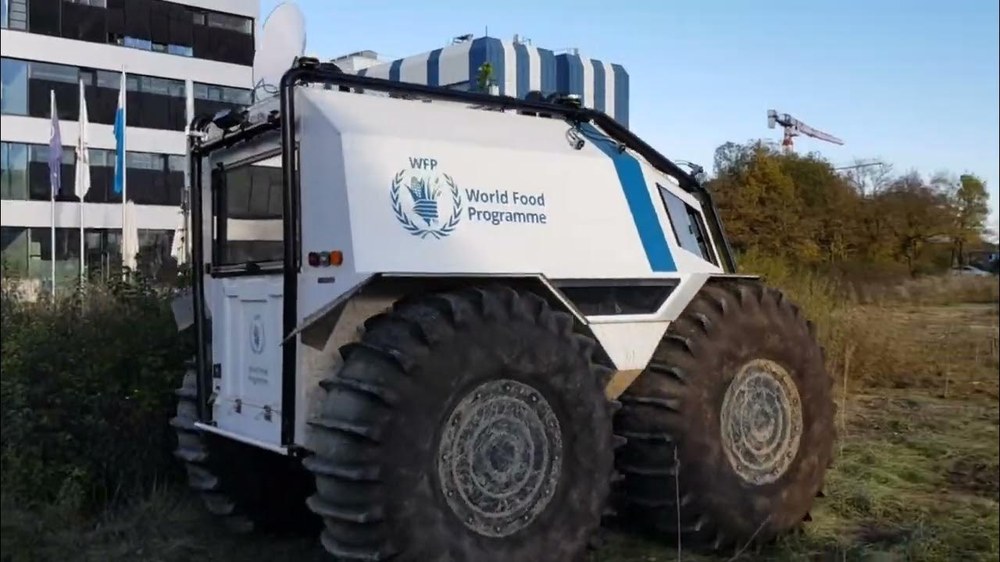
Remote-controlled SHERP vehicle successfully tested
Scientists from the Institute of Robotics and Mechatronics and a consortium of other DLR institutes and technology partners are working with the World Food Programme (WFP) to investigate how remote-controlled trucks can be used to deliver relief supplies safely to their destinations. In future, robot-controlled vehicles will be used to travel routes that pose major risks for human drivers, for example in the impassable and flood-affected areas of South Sudan. They will be controlled by telepresence from a safe location. After two years of research, all components of the AHEAD cooperation project were presented for the first time in a successful overall demonstration on 9 November 2022 at the DLR site in Oberpfaffenhofen.
SHERP vehicles, which the WFP is already using successfully for missions in crisis areas, are being deployed. The off-roaders can move in any terrain, even in water or swamps, and can overcome climbing obstacles of up to one metre. The vehicle in Oberpfaffenhofen was equipped with several sensors for real-time monitoring of its surroundings and automated for remote control. In order to be able to cope with an interruption in the radio link to the control system, the SHERPs must be able to make safety and emergency stops at any time in future. To do this, they record their surroundings using perception sensors, stereo cameras and LIDAR systems.
During the demonstration in Oberpfaffenhofen, the SHERP was not driven directly, but remotely controlled. The procedure on the DLR site was based on a possible future, real application. The SHERP was first loaded at the starting point. The overall mission was planned in the GMOC (Global Mission Operation Centre) and important information was made available to the LMOC (Local Mission Operation Centre) so that the SHERP could be controlled from there.
This enabled the project partners to test all the individual components of the mission together for the first time. In addition to the Institute of Robotics and Mechatronics, the Institute of Communication and Navigation (KN), the Centre for Satellite Based Crisis Information (ZKI) of the Earth Observation Centre (EOC) and the Institute of Transport Systems Technology (TS) are involved on the DLR side. The industrial partners Roboception GmbH and Sensodrive GmbH took part, while the end users were the WFP, the Bavarian Red Cross (BRK), the German Federal Agency for Technical Relief (THW), the German Rescue Robotics Centre (DRZ) and the NRW Fire Service Institute.
The test demonstration was part of a joint two-day workshop of the projects AHEAD, KI4HE (AI-based capabilities for autonomous vehicles in humanitarian operations) and MaiSHU (Multimodal perception and human-machine interfaces of semi-autonomous intelligent systems for humanitarian aid in unsafe and unstructured environments), which took place on 9 and 10 November 2022 in Oberpfaffenhofen. and 10 November 2022 in Oberpfaffenhofen.
The technology partners from VDI/VDE and Blickfeld GmbH, partner in the MaiSHU project, were also involved. The KI4HE and MaiSHU projects complement AHEAD with important technology work packages and started at the end of 2021. In these projects, technologies from various programmes are synergistically combined and continued in order to be able to operate vehicles remotely or even semi-autonomously in unstructured environments. This includes the interaction of remote control and semi-autonomous driving, special driver assistance systems, communication between subsystems, long-range and short-range reconnaissance, current situation display and assessment, positioning, navigation and routing and much more.
Your consent to the storage of data ('cookies') is required for the playback of this video on Youtube.com. You can view and change your current data storage settings at any time under privacy.