Federated Data Spaces for Railway
Visit us at Booth 440, Hall 2.2 at the InnoTrans 2026!
The European railway sector is facing growing challenges in sharing and leveraging data across organizational and technological boundaries. A Rail Data Space provides a federated and trusted framework for secure, sovereign, and interoperable data sharing across the rail ecosystem. By connecting stakeholders through standardized technologies and trusted data exchange mechanisms, it enables more efficient collaboration, innovation, and data-driven operations. Discover how Data Spaces are helping to build a more connected, resilient, and future-ready railway sector. At InnoTrans 2026, we are pleased to present and discuss how Data Spaces can contribute to this vision and leverage the digital transformation of the railway sector.
Digital Data Challenges in the Rail Industry
The European railway sector is characterized by a highly interconnected ecosystem of operators, infrastructure providers, manufacturers, suppliers, service providers, and other stakeholders. Yet, the sector still faces significant digital and data-related challenges that limit efficient collaboration and innovation.
Operational disruptions can have far-reaching consequences across the rail network and supply chain, while limited connectivity with other modes of transport makes seamless, multimodal mobility more difficult. At the same time, fragmented data landscapes and data silos within and across organizations lead to duplicated data, isolated storage environments, and analyses tailored to individual use cases rather than shared industry needs.
A further challenge is the reluctance to share data. Security, liability, and competitive concerns often prevent organizations from making valuable data available to other stakeholders. Finally, lack of interoperability between data types, standards, systems, and storage environments makes it difficult to exchange and use data seamlessly across organizational and technological boundaries.
Together, these challenges limit the railway sector's ability to leverage data for more resilient operations, efficient processes, and collaborative innovation.
The Solution: A Federated Data Space for Railway in ERJU FP1 MOTIONAL WP31
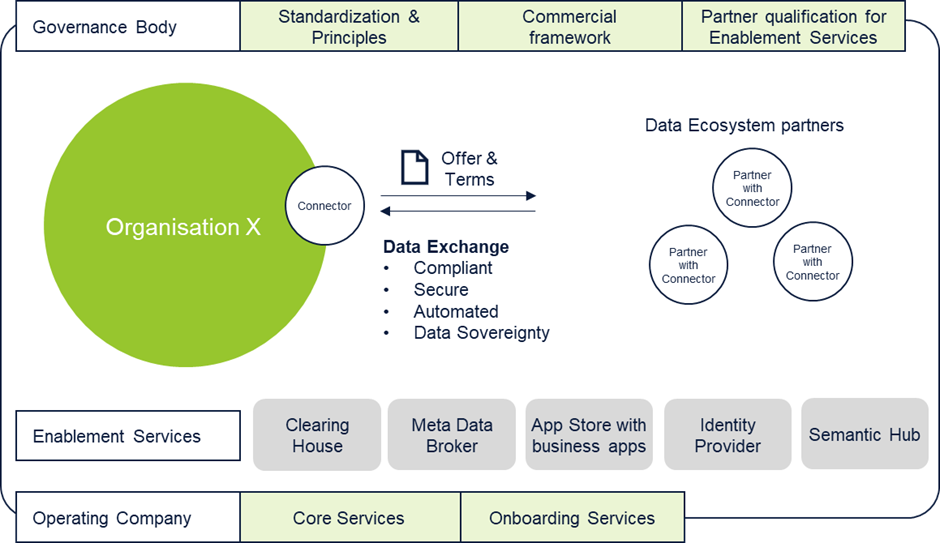
Data spaces provide a scalable, federated software architecture for secure and trusted data sharing across organizational boundaries. Rather than requiring data to be transferred into a central repository, data spaces connect existing data environments through a set of interoperable software components and standardized mechanisms.
Key components and principles include secure data exchange, identity and access management, connectors, usage and access policies, data catalogs, semantic models, and mechanisms for verifying participants and data transactions. Based on a federated architecture and EU standards, the Data Space for railway provides a trusted framework in which organizations can share and access data while retaining sovereignty and control over their own data.
A Rail Data Space enables railway stakeholders to share data in a secure, trustworthy, and efficient way, creating a trusted data exchange ecosystem for collaborative innovation.
Key Capabilities and Advantages
A Rail Data Space is designed to deliver tangible operational and business benefits through a data-driven, actionable, scalable, and interoperable ecosystem.
- Trusted data exchange: Provides a secure and trusted framework for exchanging data across organizational boundaries while maintaining data sovereignty and provider control.
- Data sovereignty and trust: Data remains under the control of its providers, with decentralized storage and policies governing who can access data and how it can be used.
- Interoperability across the rail sector: Enables seamless integration between systems through standardized data formats, protocols, interfaces, and semantic models.
- Secure and controlled data access: Identity and access management, usage policies, and verified participants support secure and transparent data sharing.
- Verified data and traceability: Verification mechanisms and transaction logging create transparency and traceability across the value chain.
- Efficient and automated data exchange: Certified and proven standards enable efficient, automated, and interoperable exchange between heterogeneous systems.
- Regulatory alignment: Supports alignment with European regulations and future strategies, including the Data Act, Data Governance Act, AI Act, and Digital Markets Act.
- Collaborative innovation: Creates a trusted environment in which operators, suppliers, manufacturers, infrastructure providers, and service providers can collaborate on industry-wide challenges and develop new data-driven solutions.
- Scalable infrastructure: A federated approach enables stakeholders to participate without giving up control of their existing data infrastructures while supporting shared costs for scalable data space infrastructure.
Ultimately, a Rail Data Space aims to transform the European railway sector through trusted, sovereign, interoperable, and actionable data sharing—turning data into operational value and enabling new opportunities across the rail ecosystem.
Who Benefits?
The Rail Data Space is designed for stakeholders across the entire railway value chain. This includes OEMs, railway operators, infrastructure and maintenance providers, and other railway ecosystem participants.
By connecting these stakeholders through a trusted and interoperable data ecosystem, the Rail Data Space enables them to share relevant data securely, access trusted information, coordinate activities, optimise processes, and develop new collaborative services.
For manufacturers and suppliers, this can mean better access to relevant operational data and improved coordination across the supply chain. Operators and service providers can benefit from more timely and actionable information, supporting more efficient and resilient operations. Infrastructure and maintenance stakeholders can improve coordination, diagnostics, and predictive maintenance. Transport and ticketing providers can benefit from better integration with other mobility services and data sources.
Ultimately, passengers benefit from the resulting more reliable, efficient, connected, and customer-oriented railway system.
The Rail Data Space developed through FP1 MOTIONAL WP31 connects the railway ecosystem—enabling stakeholders to share data with trust, retain data sovereignty, overcome interoperability barriers, and turn collaboration into tangible business and operational value.
The project FP1-MOTIONAL
The project FP1-MOTIONAL aims to improve planning and operational management of rail services and offers to meet the European goal of making rail the preferred mode of transport. The project aims to develop a future European Traffic Management System (TMS) that is interoperable, resilient, able to adapt the capacity and able to integrate all involved services, including last mile operations provided by other transport modes, by taking advantage of the potential of digitalisation.
Funding statement: Co-funded by the European Union. Views and opinions expressed are however those of the author(s) only and do not necessarily reflect those of the European Union or Europe's Rail Joint Undertaking. Neither the European Union nor the granting authority can be held responsible for them.
More information about the MOTIONAL project:
https://rail-research.europa.eu/rail-projects/fp1-motional/