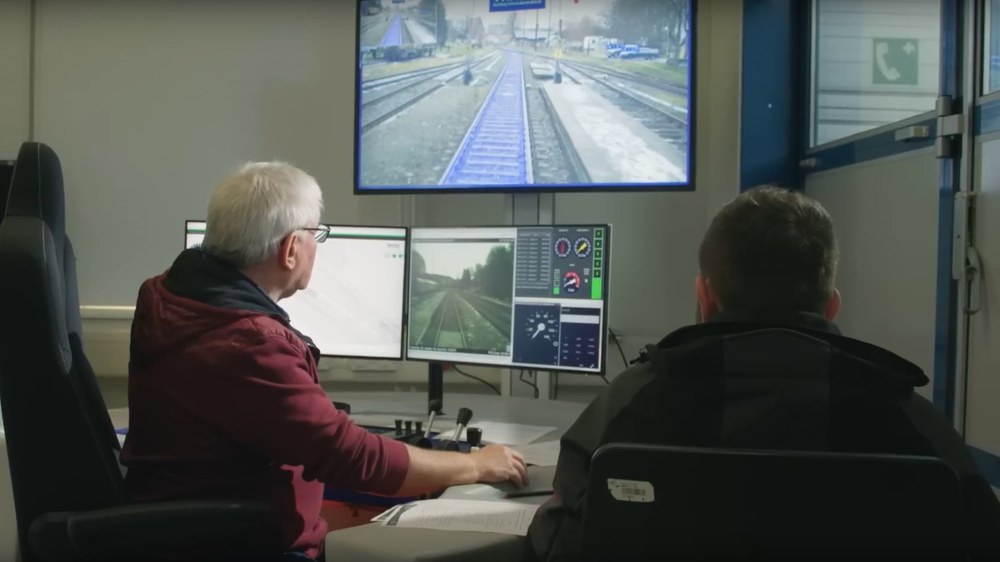
RTO-Testing: Validation of Remote Operating Concepts and Operator Workstations in the Simulation
Remote Train Operation (RTO) transfers key control and monitoring tasks from the train to the control centre. To ensure that such operating modes can be safely and efficiently integrated into regular service in a way that is accepted by users, human performance, technology and organisation must be validated in conjunction with one another. Our laboratories provide a controlled test environment in which remote operation concepts, human-machine interfaces and organisational processes can be tested under realistic conditions.
Why RTO laboratory validation?
Unlike field trials alone, our setup enables:
- Reproducible operational and fault scenarios: consistent conditions for repeatable and comparable tests
- Controlled variables: the degree of automation, information load, time pressure and communication requirements are specifically varied
- Safe testing of critical interventions: faults, rollback situations and degraded modes can be tested without disrupting operations
- Early identification of risks: Usability, workload and decision-making risks are identified prior to roll-out
- Parallel testing of concept variants: Multiple design and operational variants can be compared more quickly
- Transferable findings: Laboratory findings are enriched by real-world operational contexts and user feedback
Our test environment
We combine simulated operational control, operator workstations, scenario control and measurement infrastructure to create a human-in-the-loop test environment. This creates realistic conditions for testing human-machine systems:
Simulated operational control
- Representative routes, operational states and fault scenarios
- Modelling of traffic control systems and operational framework conditions
- Control of scenarios, operational phases and system behaviour
Operator workstations
- Realistic human-machine interfaces, control and monitoring functions
- Communication channels between operators, technical systems, transport operators and the control centre
- Variation in display layout, alarm logic, control functions and feedback mechanisms
Scenario control
- Targeted variation in the degree of automation, information load, time pressure and severity of faults
- Comparison of operational processes under reproducible conditions
Measurement infrastructure
- Recording of behaviour, workload, attention and usability
- Recording of psychophysiological and behavioural data
- Comparison of system variants
- Longitudinal measurements
Our services
We develop and test remote working concepts across the entire value chain – from requirements and workplace design through to evidence-based roll-out.
1. Requirements analysis and role design
We identify the tasks, skills and information requirements necessary for RTO and use these to develop viable role profiles.
- Activity and requirements analysis for control centres, remote control and vehicle operations
- Identification of new roles in network-wide operation of automated vehicles
- Definition of responsibilities, competences and scope for intervention
- Result: Clearly defined task profiles that provide a binding framework for both technology and organisation
2. Design and evaluation of operator workstations
We design and test operating concepts that are safe, intuitive and robust.
- Design of displays, alarms, control functions and feedback channels
- Evaluation of information architecture and operating logic
- Development of design variants for different levels of automation and intervention options
- Result: Usable, safety-oriented workstations with transparent design decisions
3. Scenario and operational mode tests
We investigate how people and systems behave in defined operational situations.
- Analysis of decision-making quality, response behaviour and coordination in normal, abnormal and critical situations
- Assessment of interfaces between operators, technology and transport operators
- Derivation of requirements for technology, processes and organisation
- Result: Reliable findings on human behaviour and system performance prior to implementation
4. Organisational and operational process design
We examine how remote operation is integrated into existing operational workflows.
- Analysis of operational, escalation and communication processes
- Development of shift, responsibility and role models
- Optimisation of collaboration between transport operators, network operators and control centres
- Derivation of scaling and design approaches for operational and service structures
- Result: Practical organisational concepts for scalable remote operations
5. Acceptance and usage validation
We assess whether systems are not only functional but are also accepted and used in everyday life.
- Survey of attitudes, experiences and usage behaviour
- Assessment of perceived usefulness, ease of use, workload and usage
- Development of measures to increase the intention to use
- Result: Evidence-based recommendations for action to promote acceptance and long-term use
6. Field studies, training and support during roll-out
We translate laboratory findings into real-world applications and prepare people for new jobs.
- Conducting field studies, pilot projects and accompanying surveys
- Development of training programmes and simulation exercises
- Identifying feedback mechanisms and areas for further development
- Result: More mature systems, well-prepared staff and smoother transitions to routine operations
Tangible added value for industrial clients |
|---|
Cost-effective development: adjustments to human-machine interfaces, processes and organisation are made prior to roll-out |
More stable operational quality: transparent decision-making and monitoring tasks increase operational reliability |
Greater acceptance: Employees are more likely to use new systems if they have been involved in their design |
Scalable and resource-efficient operating models: Roles, responsibilities and processes are defined at network and corporate level |
Shorter decision-making cycles: Standardised test findings facilitate investment and change management decisions |
Documented evidence: Robust results for internal coordination, further development and external communication |
We support you with
- People, technology and organisation: A holistic approach considering technology, users, organisation and the transport system
- Objective evaluation criteria: Standardised procedures for analysing safety, efficiency and user satisfaction
- Simulation and laboratory research: Controlled experiments on remote operation, automation and monitoring
- Human factors methods: Psychological and ergonomics-based methods for assessing workload, attention, decision-making quality, acceptance and compliance
- Quantitative and qualitative methods: Surveys, interviews, observation, psychophysiological measurements, eye tracking and operational data analysis
- Co-creation with users: workshops, co-design and guided pilot studies
- Transfer and scaling: Derivation of design principles for new levels of automation, control centre models and intermodal systems
From idea to validation
We guide you through the entire validation process – from initial conception through test design, implementation and evaluation to robust design and organisational recommendations.
Get in touch to find out how you can safely and efficiently transition your remote operations concepts into routine operation.
Click here to visit our railway laboratory: