Automated Driving in the Most Challenging Environments: STADT:up presents results
- AI-driven automated urban driving reaches a new level of maturity.
- The DLR and 19 other project partners are organising a final presentation, including driving demonstrations, on 10 and 11 June 2026 at the Aldenhoven Testing Centre.
- Project details: 3.5 years | €62.2 million budget | 20 partners from automotive industry and research.
- Key areas: automated driving, urban transport, digital twin
With a closing event at the Aldenhoven Testing Centre, the STADT:up consortium is presenting the results of three and a half years of joint research and development. During the two-day event, representatives from academia, politics, industry, and municipalities will gain first-hand insights into the technologies and concepts developed for end-to-end automated driving in urban traffic. Visitors can experience the prototypes during live driving demonstrations on the extensive test site.
Automated driving as a key technology for urban mobility
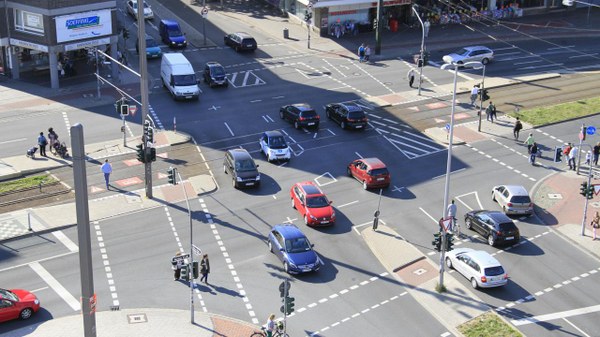
Automated driving is regarded as a central component of future mobility concepts. While initial automated driving functions are already in series use on motorways, inner-city environments remain one of the greatest challenges. Dense, heterogeneous traffic, complex intersections, unpredictable situations, temporary obstacles, and interaction with pedestrians, cyclists and other road users require highly robust, anticipatory, and cooperative driving behaviour from automated systems.
This is where STADT:up comes in: the aim of the project was to enable fully automated driving in urban traffic, thereby permanently relieving drivers of the driving task – even in dynamic environments and complex traffic scenarios.
Comprehensive use of AI
STADT:up developed urban driving automation systems that leverage artificial intelligence across the entire functional chain – from environmental perception and sensor fusion to behaviour prediction and motion planning.
One key breakthrough was achieved, for example, in sensor-based environmental perception. This must always operate reliably, even under adverse conditions. To achieve maximum robustness, AI intelligently fuses data from a wide range of sensors. Even if individual sensors fail or deliver unreliable data – for example in heavy rain – the systems maintain a precise and reliable overall understanding of their surroundings.
The project partners also successfully integrated AI methods for predicting the behaviour of other road users and for corresponding motion planning. These methods enable the automated vehicle to correctly anticipate the behaviour of other road users and to adapt its driving manoeuvres safely and efficiently. At the same time, the vehicle must clearly communicate its intended actions to its surroundings. Within the project, this was realised using external light based signalling concepts. To ensure a seamless transition between different levels of automation, the partners also developed adaptive control and display solutions for the interior.
Holistic approach to sustainable urban mobility
STADT:up combines technological innovation in automated driving with forward-looking concepts for sustainable urban mobility. Working in collaboration with various cities, the project analysed requirements, usage conflicts, and future mobility scenarios. These insights were considered in the development of a digital twin that maps intermodal mobility flows and simulates the impact of automated vehicles on the overall transport system.
About STADT:up
The STADT:up (“Solutions and Technologies for Automated Driving in Town”) project was supported by the German Federal Ministry for Economic Affairs and Energy. A total of twenty partners from the automotive industry, the supplier sector, technology companies, and academia collaborated on the project. With a duration of three and a half years and a total budget of €62.2 million, STADT:up has made a significant contribution to the advancement of safe, user-centric, and sustainable automated mobility in urban environments.
The project brought together the automotive manufacturers CARIAD SE, Mercedes-Benz AG and Opel Automobile GmbH, as well as the supplier and technology companies Aptiv Services Deutschland GmbH, AUMOVIO SE, AVL Deutschland GmbH, DeepScenario GmbH, Ergosign GmbH, gestigon GmbH, HELLA GmbH & Co. KGaA, Robert Bosch GmbH, Valeo and ZF Friedrichshafen AG. Partners from science and research included the Federal Highway Research Institute (BASt), the German Aerospace Center (DLR), Munich University of Applied Sciences, Technical University of Chemnitz, Technical University of Darmstadt, and the Technical University of Munich.