
Successful synergy meeting in Cochstedt
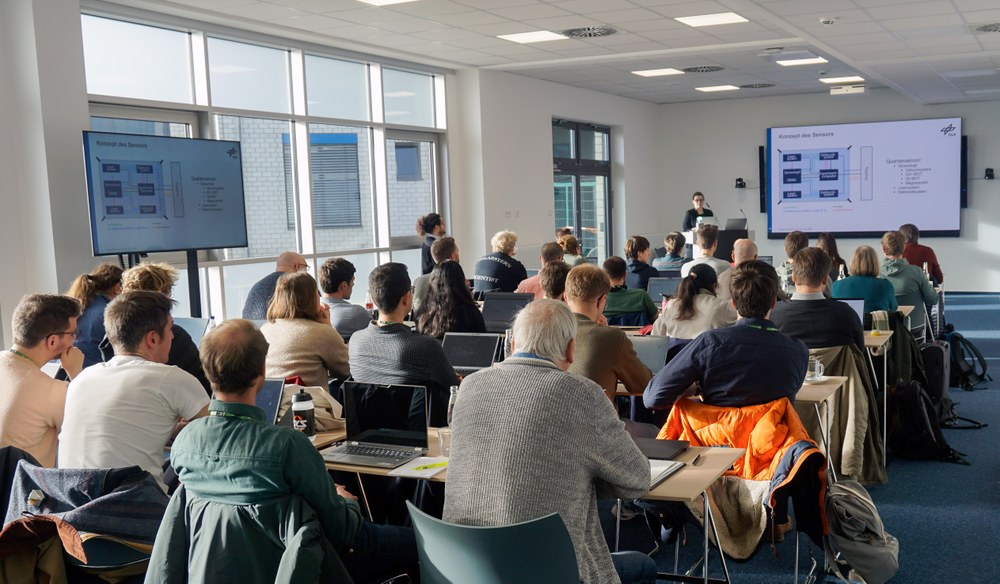
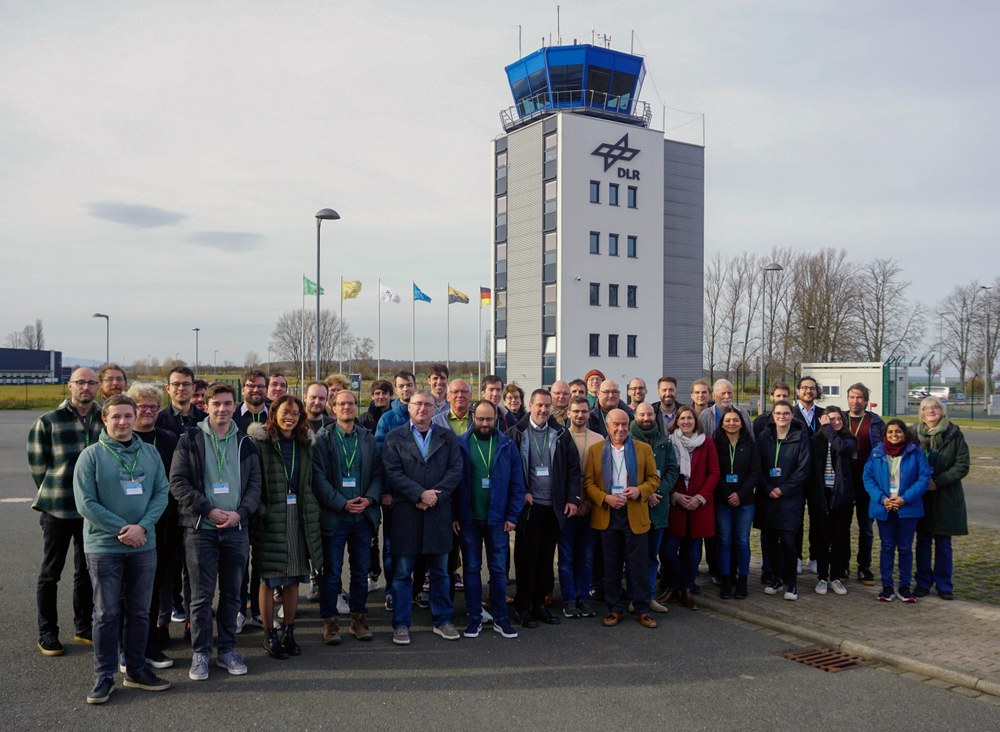
In mid-November, more than 50 representatives of the DLR Explorer initiatives met at the National Experimental Test Center for Unmanned Aircraft Systems in Cochstedt. These biannual meetings serve to identify and exploit synergies at an early stage between the initiatives and project lines funded by the German Space Agency at DLR with federal funds.

The TRIPLE project (Technologies for Rapid Ice Penetration and subglacial Lake Exploration) presented the latest progress in the development of key technologies required for a future space mission to explore Jupiter's moon Europa and the ocean of water lying beneath its kilometer-thick ice surface. Participants were also introduced to the nanoAUV, a miniature submarine that can be used for exploration.
The VaMEx initiative (Valles Marineris Explorer) presented its work on the search for liquid water in Valles Marineris, a massive canyon system on Mars that is 4000 km long and up to 11 km deep. To this end, DLR is pursuing a swarm robotics approach. The robots are designed to navigate autonomously and reach various locations of interest cooperatively and collaboratively. The VaMEx initiative is investigating how these robots and their interaction can function optimally.
During the synergy meeting, particular attention was paid to the area of navigation and the components required for the mission. ADMIRe, iQNav, and SaiNSOR presented themselves as potential supporters on the DLR side. ADMIRe is an impulse project for miniaturization in the aerospace segment, whose main goal is to develop techniques and technologies for satellite constellations with a focus on space-based radar systems. iQNav deals with quantum technology in the field of navigation. SaiNSOR works on a space-qualified platform to process and consolidate information from multiple sensors based on AI.
In addition, the student initiative WARR Space Robotics (Robotics for Climate Monitoring and Planetary Exploration) at the Technical University of Munich (TUM) and the Chair of Space Mobility and Propulsion at TUM presented themselves as potential project partners with a presentation on water electrolysis-based propulsion technology. Participants also gained deep insights into computer chemistry under space conditions, provided by colleagues from the University of Bremen, as well as an overview of exploration activities in analog field tests conducted by the Austrian Space Forum.

During the meeting in Cochstedt, it became clear that the projects and initiatives can indeed support each other. True to the name of the event, a wide variety of synergies were once again identified at this meeting, which will also be utilized in further development work. Not only will the projects benefit from this, but new testing opportunities have also arisen at the National Experimental Test Center in Cochstedt: One of the outcomes of the Explorer Conference is that a robot challenge for disaster relief scenarios will now be organized in June 2026. This challenge is intended to demonstrate how heterogeneous robot swarms can also provide meaningful support to emergency services operating on site in search and rescue missions.
In addition to the successful professional exchange, participants also had the opportunity to learn about the work at the National Test Center. The next synergy meeting is planned for July 15-17, 2026, in Bad Honnef.