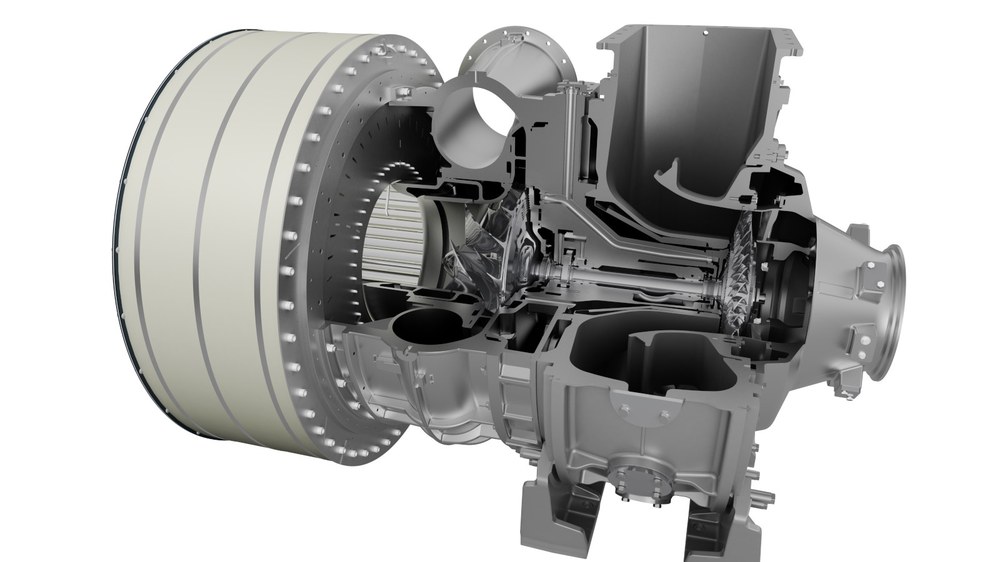
Diversification of the energy system through hydrogen, heat pumps and energy storage – turbomachinery
Joint project DiWaTurb
Diversification of the energy system through hydrogen, heat pumps and energy storage – turbomachinery
The transformation towards a climate-neutral and decarbonized economy places high demands on our energy system. Electricity is gaining further importance as an energy carrier in current scenarios, also driven by additional application areas such as mobility, data centers / digitalization, and heat supply.
The central challenges of the energy transition are the continued expansion of the share of renewable energies and the transport networks required for this, the highly efficient use of energy, and a significant reduction of energy-related carbon dioxide emissions. At the same time, security of supply and internationally competitive cost structures must be ensured.
Turbomachinery plays a central role in this context. It comprises essential components in power generation, energy storage, heat pumps, and industrial processes, as well as in the future hydrogen infrastructure. At the same time, its operating conditions are changing: alternative fuels and working media such as hydrogen and CO₂ as well as increasingly flexible modes of operation, are placing new demands on the design and operation of turbomachinery.
Research for a future energy system
The joint research project develops innovative turbomachinery components to contribute to an efficient, flexible, resilient, and climate-neutral energy system. The work focuses on increasing the efficiency of turbomachinery, improving operational and fuel flexibility, and extending service life and reliability. Particular emphasis is placed on the development of turbomachinery components for hydrogen and CO₂ applications, as well as on advancing technologies for the hydrogen infrastructure and the power generation from hydrogen in gas turbines.
The research within the joint project DiWaTurb focuses on the key technological challenges of the energy transition. The work packages cover a broad spectrum – from highly efficient turbomachinery for energy and heat applications, through the hydrogen infrastructure, to the flexible power generation from hydrogen.
WP 1 – Power and Heat Transition
A secure and affordable energy supply based on renewable energy sources requires highly efficient technologies and suitable storage solutions. This work package investigates the application of expansion technologies in energy storage systems and possibilities for further increasing turbine efficiency.
A key focus is the optimization of compressor components for industrial heat pumps in order to improve the efficiency of the turbomachinery used and enable a climate-neutral heat supply.
WP 2 – Energy System: Overall Efficiency and Sustainability
A future energy system must be efficient, flexible, and adaptable to different operating conditions. This work package therefore addresses fundamental technological questions for the flexible operation of turbomachinery under demanding thermodynamic conditions.
A key focus is on novel lattice structures that can be additively manufactured and that improve the dynamic characteristics of turbomachinery. Furthermore, the behavior of compressor stages near the critical point of compressed working media is investigated, as well as additively manufactured lightweight impellers for compressors.
WP 3 – Hydrogen: Resilient Infrastructure
The establishment of a high-performance hydrogen economy requires reliable technologies for the compression and transport of hydrogen. In particular, pipeline transport places high demands on the turbomachinery used.
This work package focuses on the development and advancement of bearing technologies for high rotational speeds, as required in future hydrogen compressors. The results provide an important basis for high-performance and reliable compression technologies in the hydrogen infrastructure.
WP 4 – Hydrogen: Efficient and Flexible Power Generation
Hydrogen-fueled power plants can play a crucial role in the stability and security of supply of the energy system by converting renewable hydrogen into electrical energy on demand, thereby balancing fluctuations in renewable energy generation.
However, the direct use of hydrogen in gas turbines places specific demands on combustion systems, turbine components, and their cooling. The work package investigates the efficient, flexible, and low-emission power recovery from hydrogen, encompassing hydrogen combustion including combustion systems and combustion chambers, numerical methods for optimizing turbine blades for flexible operating modes, as well as improved cooling of highly loaded gas turbine components.
The aim is the further development of gas turbines for safe, efficient, and flexible operation with hydrogen.
WP 5 – Cross-Mission: Accelerating the Energy Transition
To accelerate the development of innovative turbomachinery, this work package is devoted to the advancement of central simulation and design methods. Various numerical methods and simulation approaches are investigated and improved in order to make development processes more efficient and to optimize the design of future turbomachinery.
The results provide a basis for the faster transfer of research findings into industrial application, thereby supporting the energy transition in Germany.
Running Time
01.10.2026-30.09.2029
Funding
Federal Ministry for Economic Affairs and Energy (BMWE)
| |
|---|
DLR-Institute of Propulsion Technology |
Everllence SE |
Forschungszentrum Jülich, Materials Synthesis and Processing (IMD-2) |
Fraunhofer Institute for Mechanics of Materials (IWM) |
Fraunhofer Institute for Laser Technology (ILT) |
Leibniz University Hannover, Institute of Dynamics and Vibration Research (IDS) |
Leibniz University Hannover, Institute of Turbomachinery and Fluid Dynamics (TFD) |
Leibniz University Hannover, Chair of Reactive Flows (RF) |
MTU Aero Engines AG |
Rolls-Royce Solutions GmbH |
Ruhr University Bochum, Chair of Thermal Turbomachinery and Aero Engines |
RWTH Aachen University, Institute of Power Plant Technology, Steam and Gas Turbines (IKDG) |
RWTH Aachen University, Institute of Jet Propulsion and Turbomachinery (IST) |
Siemens Energy Global GmbH & Co KG |
University of Technology Berlin, Institute of Fluid Dynamics and Technical Acoustics (ISTA) |
University of Technology Clausthal, Institute of Tribology and Energy Conversion Machinery (ITR) |
University of Technology Darmstadt, Reactive Flows and Diagnostics (RSM) |
University of Technology Darmstadt, Simulation of Reactive Thermo-Fluid Systems (STFS) |
University of Technology Darmstadt, Production Management, Technology and Machine Tools (PTW) |
University of Technology Darmstadt, Cyber-Physical Simulation (CPS) |
University Duisburg-Essen, Chair of Turbomachinery |
University Kassel, Engineering Dynamics |
University Stuttgart, Institute of Aerospace Thermodynamics |