Localisation and identification of moving noise sources
Research Project LION
Localisation and identification of moving noise sources
Research Project LION
Localization and identification of moving noise sources
Traffic is one of the main sources of noise. It is therefore important to investigate moving noise sources. After all, aeroplanes, trains and cars generate considerable noise, which should be reduced as much as possible. But where exactly does unwanted noise originate? From the wheels? From the pantographs? Or somewhere else entirely? The LION research project is investigating and improving methods for locating moving sound sources.
So-called noise source localization methods make it possible to determine the location of a sound source with great precision. These methods need to be further developed for moving sources in complex environments, as Doppler shift, comparatively short measurement times and sound propagation in the atmosphere make measurements and simulation calculations difficult. We are addressing this problem together with an international research team in the LION project. In this project, we aim to expand the existing methods for analysing moving sound sources.
The researchers are developing algorithms, models and virtual test environments in which various sound propagation scenarios can be simulated. To this end, we are working closely with acoustic working groups at the Berliner Hochschule für Technik (BHT) , the Austrian Academy of Sciences (ÖAW) and the Swiss Federal Laboratories for Materials Science and Technology (Empa).
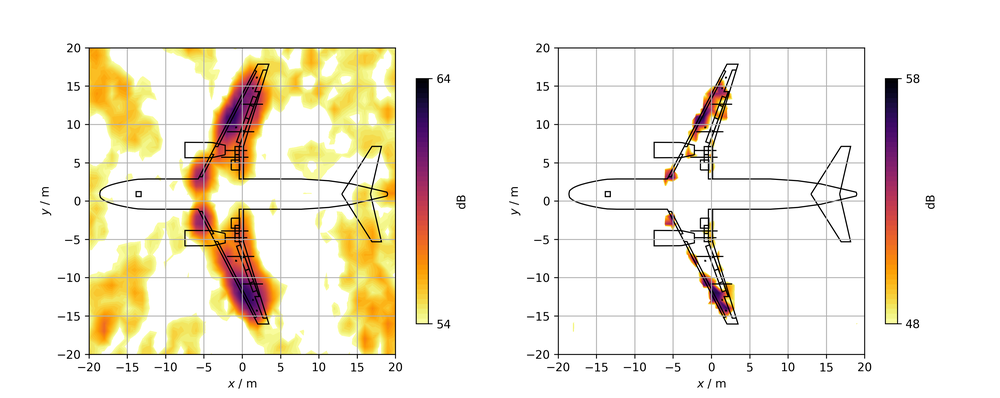
Results of flyover measurement: Comparison of the conventional delay-and-sum method with an unfolding method
Left: The conventional method for localizing sound sources provides the positions and strengths of the noise source, but these are distorted by the limited imaging properties of the array. Right: The method developed in LION improves the accuracy and dynamics of localization.
The calculation methods are compared with measurements taken using microphone arrays on aeroplanes and trains. Weather conditions such as ambient temperature, air pressure and wind also play an important role, as atmospheric conditions also influence human perception and the resulting noise pollution. The results of the research project should help to better understand the mechanisms of sound generation and thus lay the foundation for targeted noise reduction measures directly at the source.
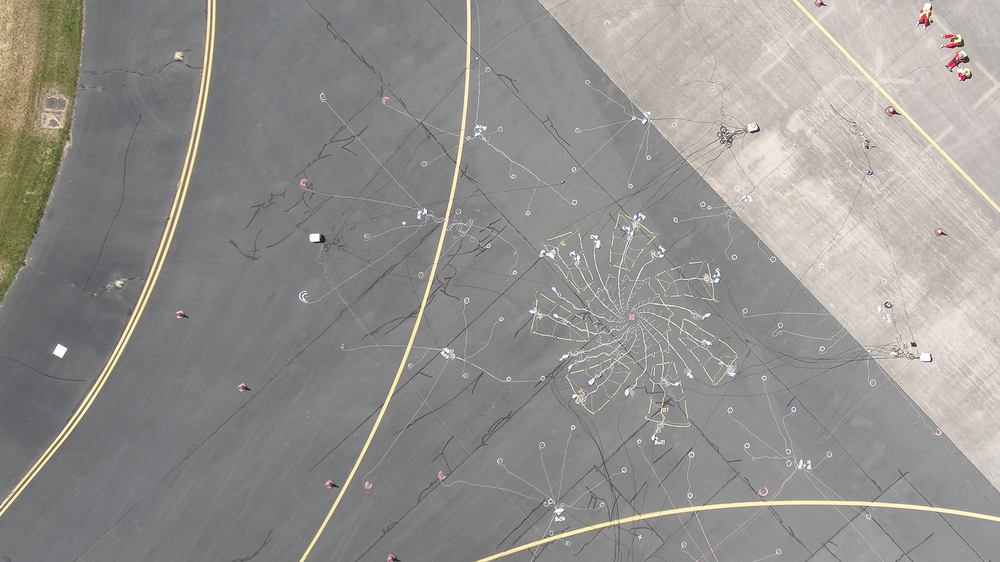
Experimental setup with microphone arrays for flyover measurements
The microphone array of the Department of Engine Acoustics at the Institute of Propulsion Technology is suitable for detecting sound sources on aircraft flyovers. Shown here during a measurement campaign at the DLR's National Test Center for Unmanned Aircraft Systems in Cochstedt.