
Your entry

Lea
Degree: Computer science
Jetzt: DLR Institute for AI Safety and Security
Conducting research, sharing knowledge, inspiring others – for our colleague Lea, these all go hand in hand. As a research associate at our Institute for AI Safety and Security, she researches artificial intelligence (AI) for autonomous, mobile and embedded systems. The computer scientist is also committed to inspiring girls and young women to pursue STEM (science, technology, engineering and mathematics) careers. For this commitment, Lea was awarded the DLR Prize for Contributions to Equal Opportunities by our Executive Board. In this interview, she gives insights into her research and explains why diverse perspectives matter in science and technology.
Lea, what’s your research about?
Lea: I work at the Institute for AI Safety and Security and have been enrolled as a doctoral student at Ulm University for almost a year now. My research mainly focuses on developing AI in a way that allows it to be deployed energy efficiently on hardware designed for that purpose – for example, in embedded systems and in robotics.
What skills are especially helpful for you?
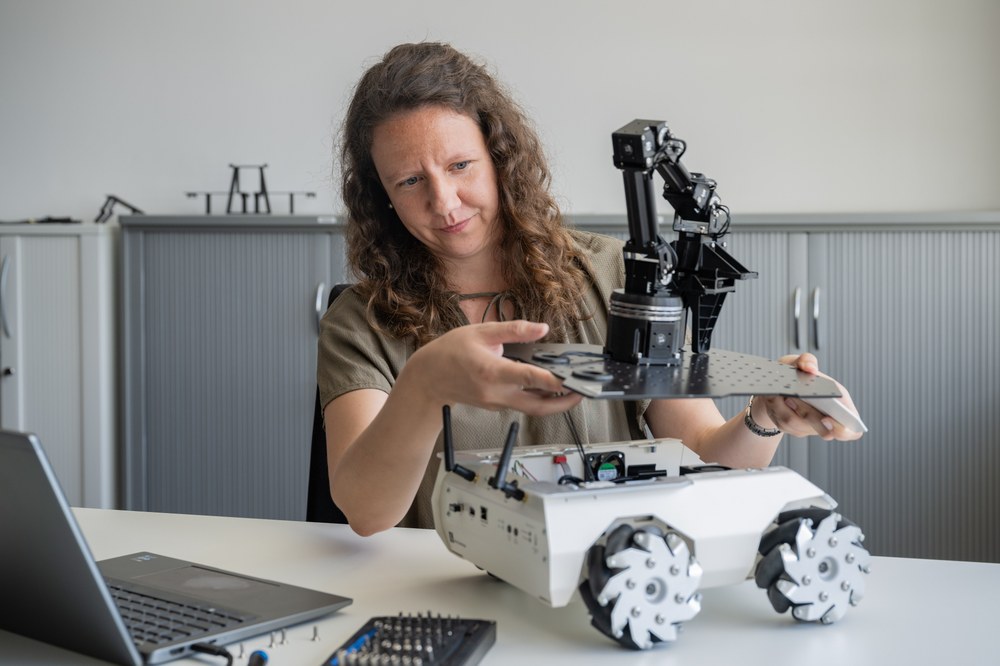
Lea: As a researcher, you need a lot of different skills. Sometimes you're an entertainer, explaining your own research in a way that's understandable to different audiences – from children to specialist experts. Sometimes you're a detective, when a simulation behaves differently from reality and you have to track down the error. Other times, it's all about tinkering and problem-solving. And sometimes you need really practical, hands-on skills, for example when a robot needs to be modified or a manipulator has to be attached or unscrewed.
“ To me, research is incredibly varied. One moment I’m an entertainer, the next a detective, then an inventor – and sometimes I have to get my hands dirty.”
What exactly are you investigating?
Lea: Among other things, I work on compressing AI models using tensor networks. Put simply, this involves shrinking AI models so that they require fewer resources and can work faster. In doing so, I investigate how much an AI model can be compressed, and at what point compression starts to compromise safety. I also compare classical AI approaches with quantum-based methods, to assess their potential for different hardware platforms.
How do you develop and test your models?
Lea: One technique I use is reinforcement learning, a method in which the AI learns through trial and error and feedback. I create different variants of an AI model and apply varying degrees of compression to them. First, I test the models in simulations. I then test them on actual hardware, such as a robotic arm. This allows me to compare how different levels of compression affect the AI’s behaviour and safety.
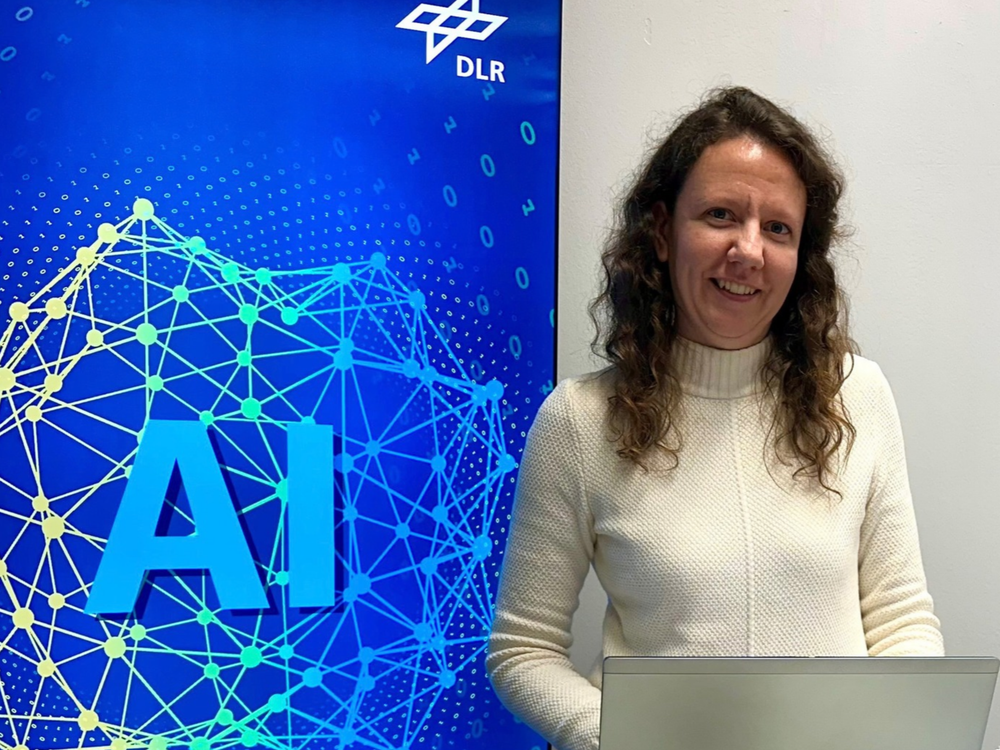

Lea inspires girls and young women to pursue STEM careers
In recognition of her commitment, our Board of Directors awarded the researcher the DLR Prize for Contributions to Equal Opportunities
Credit:
“I find it exciting to share knowledge, gain new perspectives and get others interested in AI. It’s particularly rewarding when initial scepticism gives way to genuine interest.”
You work on AI safety. What role does equal opportunity play in this?
Lea: AI needs data. Data forms the basis for pattern recognition and decision-making. If certain population groups are underrepresented or missing in this data, existing biases can be carried over into AI systems. A well-known example is Joy Buolamwini's work on facial recognition. Bias can also play a role in the STEM field, for instance in how candidates are selected during the application process. That's why it's important to include different perspectives – both in the development of AI and in its application.
As well as your research, you’re committed to inspiring girls and women to explore STEM subjects. What motivates you most in this work?
Lea: I'm involved with Soroptimist International, supporting education for young women in IT. The network brings together working women from a wide range of fields – from tradeswomen to doctors to lawyers. I've found role models here, and I can be a role model myself. I find it exciting to discover new topics together, share knowledge and discuss challenging issues. In the process, I gain new perspectives – and sometimes that leads to a completely new idea. It's especially rewarding when initial scepticism about AI turns into genuine interest and enthusiasm.
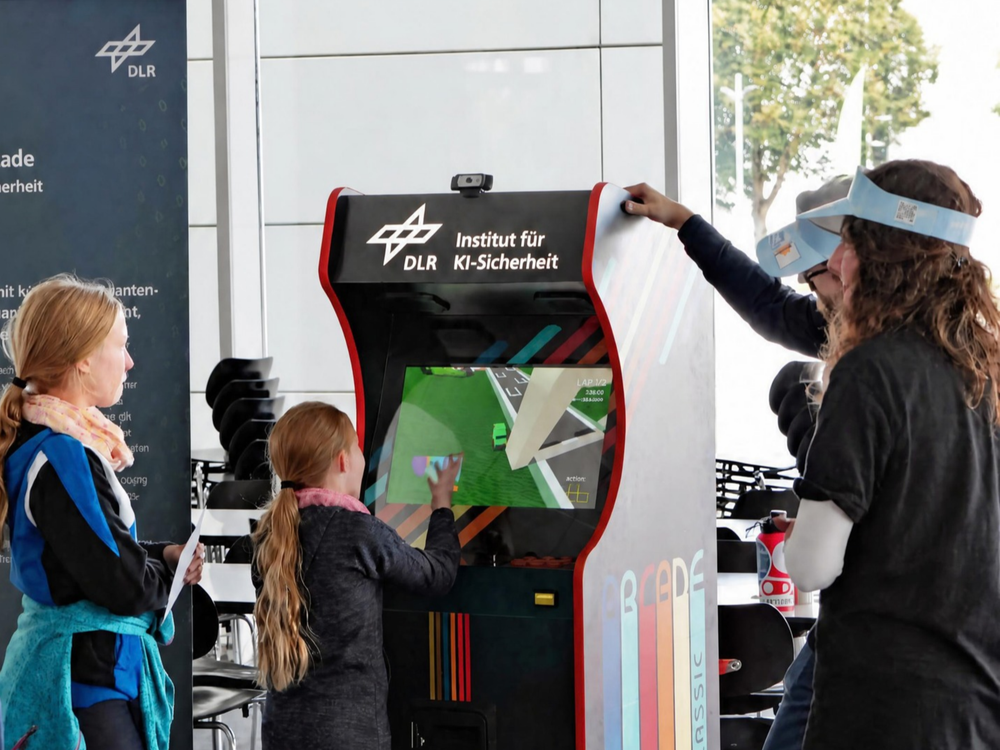
Hands-on research
At the first Girls’Day in Ulm, girls were able to discover the world of research in a fun and interactive way. Lea helped organise and coordinate the event.
Credit:
What do you hope to achieve through your involvement?
Lea: I want to open up new perspectives for schoolgirls and female students and support them in discovering their own abilities and strengths. If just one young talent subsequently starts thinking about training or studying in a STEM field, that's already a success for me. Through my involvement, I try to create an approach that combines curiosity with hands-on learning. Last year, I initiated and coordinated the first Girls'Day in Ulm, where girls could explore the digital world in a playful way. At informatica feminale Baden-Württemberg, a summer university for women in STEM, I give female students insights into my research area. As part of the Summer School at the University of Freiburg, I ran a workshop on AI and AI safety. This allowed me to pass on my enthusiasm for the topic and gain some initial teaching experience.
What advice would you give to girls interested in technology?
Lea: Try lots of things out and look for internships or student assistant positions to find out what excites you in STEM fields. And above all, don't give up if someone tells you you're not good enough!

