
ECATS 2026 – New models and methods for assessing and mitigating the climate impact of aviation

- Efficient emissions modelling
- Targeted use of sustainable aviation fuels at airports
- Simplified estimation of the climate effects of individual flights
- Operational procedures such as wake energy retrieval
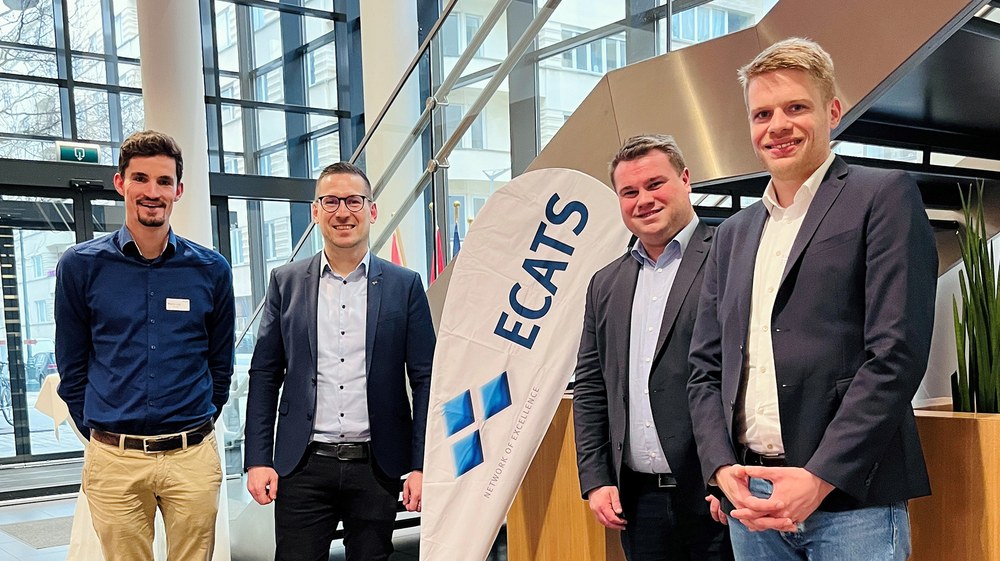
The Institute of Air Transport of the German Aerospace Center (DLR) was represented with numerous presentations and posters at the 5th ECATS Conference in Brussels. The three-day event organised by the ECATS International Association brought together research and practice to reduce the climate impact of aviation. In addition to presenting new scientific findings, discussions focused on practical solutions for airports, airlines and technology developers. The tools and analyses presented by the Institute provide a transparent basis for systematically assessing operational measures and technologies and for making aviation more sustainable in the long term.
Global emissions assessments
A key focus was the presentation of DLR modelling environments that enable the assessment of aviation climate mitigation measures. This requires a system-wide approach that models how the choice of technologies, fuels and operational concepts affects aviation emissions and what consequences this has for global temperature development. Global emissions and climate models are particularly computationally intensive. Fast surrogate models are therefore indispensable for evaluating and comparing different mitigation pathways. The approach presented uses the DLR models GRIDcast, OpenAirClim and the Digital Hangar.
GRIDcast is an efficient 3D emissions calculator developed by the DLR Institute of Air Transport that estimates the spatial and temporal evolution of global aviation emissions for future market and technology scenarios. GRIDcast is based on high-resolution, pre-calculated emissions inventories and simulates technology and demand developments by region, market and technology. This enables researchers to generate realistic scenarios up to 2050 in a short time without having to perform complex simulations for each individual flight route. GRIDcast is therefore a scalable and flexible response model that can estimate the temporal development of aviation emissions resulting from future decisions on technologies, fuels and operational concepts.1
Complementing this, the DLR Institute of Atmospheric Physics provides OpenAirClim, an open climate response model that calculates the impacts of aviation emissions from radiative forcing through to expected temperature changes. Such models are particularly important for quickly assessing the climate impact of non-CO2 effects, as these depend strongly on the location and timing of emissions and can only be reliably represented through non-linear relationships.
With the Digital Hangar, the DLR Institute of Systems Architectures in Aeronautics demonstrates what future aircraft might look like. The open aircraft database provides detailed descriptions of performance, systems and geometry data for potential configurations. In addition to evolutionary developments of existing designs, it also includes innovative concept aircraft with hydrogen or hybrid-electric propulsion.
Using the combined capabilities of GRIDcast, OpenAirClim and the Digital Hangar enables the temporal assessment of climate mitigation measures – from individual actions to complete mitigation pathways that take into account various operational, technological and regulatory developments.2
Targeted use of sustainable fuels
Another contribution focused on Sustainable Aviation Fuels (SAF). Analyses using Copenhagen Airport as a case study within the ALIGHT project show that targeted distribution of SAF to flights with particularly high climate impact can significantly reduce CO2-equivalent emissions while also being economically advantageous. The research emphasises that appropriate incentives for airports and airlines, as well as suitable infrastructure, are necessary for an efficient reduction of aviation’s climate impact.3
Simple estimation of the climate impact of individual flights
With FlightClim 2.0, the Institute presented a Python tool developed with the DLR Institute of Atmospheric Physics that simplifies the calculation of the climate impact of individual flights. It uses inputs such as departure and destination airports and aircraft weight to estimate both the climate impact of CO2 emissions and non-CO2 effects per flight and per passenger. The current version is based on a global dataset of actual flight trajectories from 2019, emissions inventories from the DLR project ELK, and derived climate impact estimates. It can be used in research, for monitoring climate footprints, and in travel planning to support more sustainable decisions.4
Reducing climate impact through innovative operational concepts
Another topic was the Wake Energy Retrieval (WER) procedure, also known as formation flight. In this concept, a following aircraft deliberately uses the upwash generated by the wake vortices of a leading aircraft to reduce its own fuel consumption. The study presented within the SESAR 3 JU project GEESE investigates possible WER operations involving two or three aircraft in European air traffic based on real traffic data. It considers not only the achievable savings in CO2 emissions, but also the effects of WER operations on non-CO2 effects such as nitrogen oxide emissions and contrail formation. Saturation effects lead to increased climate mitigation potential, particularly in formations of three aircraft. Such operational measures could make an important contribution to reducing the climate impact of aviation in the future. 5
1 Grunau, R., Lührs, B., Niklaß, M. “GRIDcast: Efficient Modeling of Aviation Emissions for Future Markets and Technology Scenarios”, 5th ECATS Conference 2026, Brussels, Belgium.
2 Niklaß, M., Dahlmann, K., Grunau, R., Lührs, B., Völk, S., Grewe, V. “Aviation Mitigation Pathways: Temperature Responses from Emissions Scenario Modeling”, 5th ECATS Conference 2026, Brussels, Belgium.
3 Müller, L., Kumar, S., Grimme, W., Maertens, S., Eichinger, R., Enderle, B., Weder, C., Dahlmann, K., Grewe, V., “Targeted Use of Sustainable Aviation Fuel at Airports for Climate Mitigation: A Cost-Benefit Perspective”, 5th ECATS Conference 2026, Brussels, Belgium.
4 Bruder, H., “Advancing the simplified estimation of per-flight climate effects: FlightClim 2.0”, 5th ECATS Conference 2026, Brussels, Belgium.
5 Marks, T., Dahlmann, K., “Comparative study on the climate impact of wake energy retrieval operations involving two and three aircraft”, 5th ECATS Conference 2026, Brussels, Belgium.