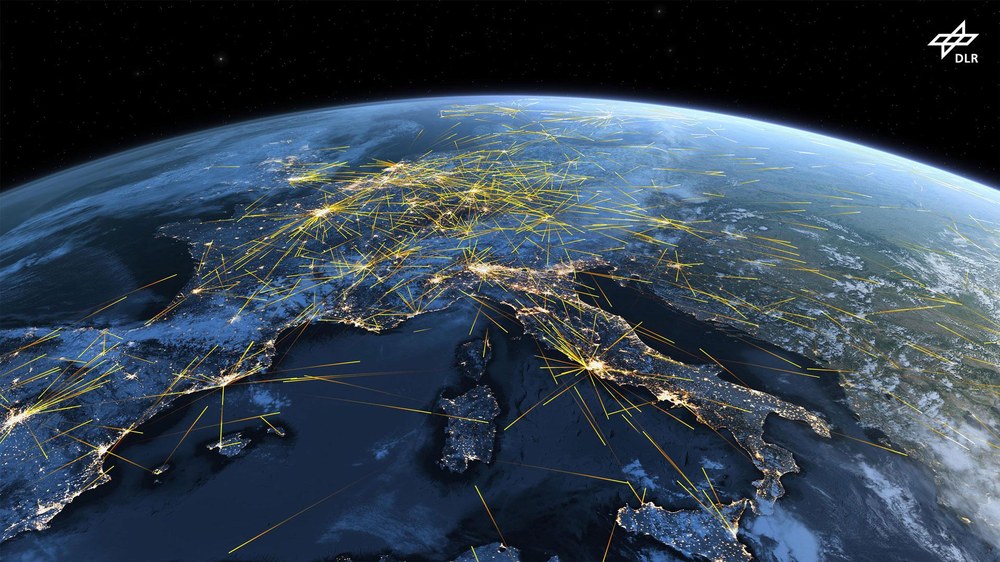
The world's airspace is full of aircraft travelling along predefined routes. DLR is developing various solutions that contribute to the sustainable development of air traffic.
At the DLR Institute of Air Transport, we investigate the complex interrelationships within the air transport system and its subsystems. Our work focuses on developing scenarios, conducting economic and business analyses, and modelling and simulating flight and fleet operations from an economic perspective.
Our aim is to develop solutions for sustainable and competitive air transport, ensuring that aviation can continue to make an important contribution to the mobility of people and goods in the future.
Research and system analysis in air transport
More than 60 colleagues forecast, shape and assess air transport as part of the wider transport system, contributing to the climate compatibility and performance of the air transport system.
The institute’s activities include:
Analysing and forecasting development pathways and drivers of the air transport system at local, national and global level
Modelling and assessing the air transport system as well as transport policy, operational and technological measures
Conducting economic and business analyses across the entire air transport value chain
Deriving evidence-based recommendations for policymakers, industry and society to improve the sustainability and performance of the air transport system
At the institute, we bring together the environmental, economic, technological and social aspects of air transport. Within DLR, we combine expertise in analysing air transport markets and assessing air transport value chains and their interfaces with other modes of transport, particularly maritime and land transport. This positions the institute as a competent partner for industry, society and policymakers.
Organisation and locations: Hamburg, Cologne and European networks
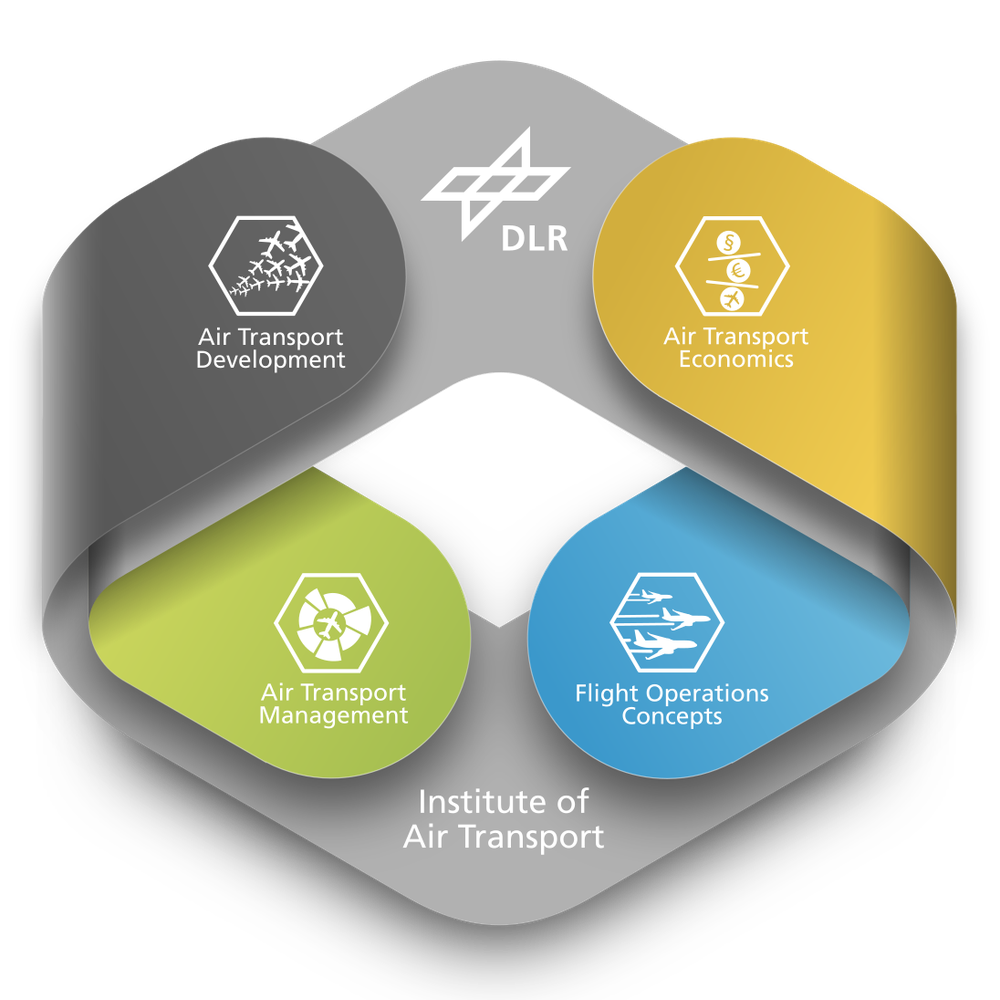
With its four departments:
Air Transport Development
Air Transport Economics
Air Transport Management
Flight Operations Concepts
the institute provides a holistic view of the air transport system and complements DLR’s extensive technological portfolio with operational, economic and regulatory expertise.
DLR Institute of Air Transport
The four departments of the DLR Institute of Air Transport
Our departments are based at the two air transport locations Hamburg and Cologne, in close proximity to airports, airlines, regulatory authorities, aircraft manufacturers and service providers, as well as aviation networks. The institute also has strong links to Berlin and Brussels, providing connections to policymakers, other stakeholders in the aviation industry and industry associations.
Hamburg is the world’s third-largest location for the civil aviation industry, a leading international centre for climate research and logistics, a model region for urban air mobility and for the industrial production and use of green hydrogen, and a pioneer in smart mobility.
Selected research topics: Trends, climate impact and systems
How will air transport, its key drivers and its transport-related, economic, environmental and social impacts develop over the next 50 years?
What potential for development does the German airport landscape have?
How will the competitiveness of the air transport sector in Germany and Europe develop in comparison with global markets?
How can the resilience of the air transport system be strengthened in response to crises, geopolitical changes and fluctuations in demand?
How will capacity constraints at airports or bilateral air transport agreements affect future fleet and traffic structures?
Which (new) operational concepts and technologies will be viable and future-proof from both an environmental and economic perspective?
Which strategies can aircraft operators adopt to implement efficient flight operations within the required environmental and regulatory frameworks?
Which operational measures can reduce disruptions to air transport and their consequences for passengers and other stakeholders?
Which technological and policy and regulatory measures can effectively and efficiently reduce the climate impact of the air transport system?
What interactions arise between sustainable aviation fuels (SAF), flight operations concepts and cost structures in air transport?
What impact would a tightening of the EU Emissions Trading System (EU ETS) have on costs, prices and competition?
How can non-CO2 effects such as contrails be integrated into and managed within flight operations and existing emissions trading systems in an operationally and economically viable way?
What role can Innovative Air Mobility (IAM) and new mobility concepts play in the future transport system?
Broadening the perspective: Maritime transport and global transport chains
Against the backdrop of increasingly integrated global transport chains, the institute is expanding its transport economics research to include maritime transport. Air and maritime transport are closely interconnected, and their economic, environmental and systemic interactions are becoming increasingly important.
We analyse these interfaces and develop data-driven approaches to assess market changes, supply chain disruptions and dynamics in international freight transport.
Contact
Dr. Florian Linke
Institute Director
German Aerospace Center (DLR)
DLR Institute of Air Transport
Blohmstraße 20, 21079 Hamburg
Dr. Sven Maertens
Deputy Institute Director and Head of Department (Acting)