Framework conditions for the future of air transport
Between competition and regulation
Air transport is shaped by complex market mechanisms and regulatory frameworks. Our research analyses their interdependencies, evaluates policy measures, and develops a robust foundation for efficient, sustainable and competitive air transport systems.
The air transport market as part of a complex transport system
Air transport operates within a dynamic global environment shaped by economic developments, technological innovations and political objectives. Markets emerge through the interaction with regulatory interventions and societal expectations. Analysing markets and regulation is essential for understanding the air transport system and its effects on efficiency, competition and sustainability. It helps capture the interplay between supply and demand, policy frameworks and societal needs, and provides a sound basis for decision-making for policymakers, industry and the public.
Why regulation plays a central role
Government intervention is pervasive in air transport—from technical standards to measures that directly influence market processes. It is particularly important where markets alone fail to deliver efficient or socially desirable outcomes, for example in the case of monopolistic infrastructure or environmental impacts not reflected in market activity. Regulation aims to safeguard competition, internalise external effects and achieve overarching objectives such as environmental protection or connectivity.
Regulatory interventions influence competition, market access, as well as prices and service offerings. Various objectives are involved, such as efficiency, environmental impact, accessibility and fair competition, which may partly conflict with one another. Our assessments therefore consider both intended effects and side effects in order to evaluate implications for market structures and the overall system.
Limits of regulation
At the same time, regulation itself is part of the system and can create new incentives, but also trade-offs or inefficiencies. These include high transaction costs, unintended side effects or distortions caused by strategic behaviour of market participants. Regulation thus operates in a field of tension between necessary intervention and potential adverse effects. Our research highlights these dynamics in order to evaluate and further develop regulatory approaches.
How air transport markets function
Air transport markets are characterised by complex competitive relationships. Different business models, cost structures and demand profiles result in a wide variety of market forms. Prices, capacities and networks emerge from the interaction of strategic decisions and demand developments. Economic conditions, policy requirements and societal trends further influence growth and market structure. Our analysis of these relationships makes pricing mechanisms, the intensity of competition and market behaviour transparent.
Study on Location Costs in German Air Transport
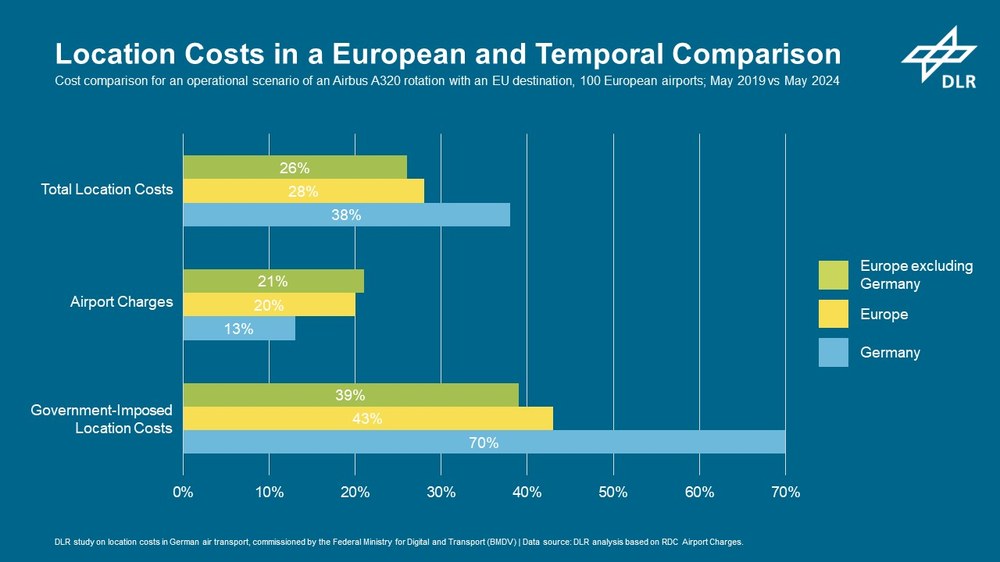
A report by the DLR Institute of Air Transport, prepared for the Federal Ministry for Digital and Transport (BMDV), shows that air transport in Germany is recovering more slowly from the COVID-19 crisis than in the rest of Europe. The main reasons are high and sharply rising location costs (+38% since 2019), as well as a weak economy, changing travel behaviour (e.g. increased use of rail), growing reliance on video conferencing, market shifts, and factors such as the conflict in Ukraine, skilled labour shortages and supply bottlenecks for aircraft.
Defining market boundaries is a key prerequisite for assessing competition and regulation. It determines which actors compete with each other and how measures take effect. We therefore differentiate markets by transport segments, geographic areas and time horizons, as well as by travel purposes and business models. This structured approach allows us to identify market mechanisms and highlight differences between individual sub-markets.
Relevance for the air transport system
Through analysing markets and regulation, the DLR Institute of Air Transport makes a significant contribution to understanding the air transport system. We help evaluate developments and policy measures and better understand their effects on market structures and societal goals. On this basis, we also develop new regulatory approaches, for example in relation to environmental issues, market access rules or the organisation of air traffic control.
This provides a robust foundation and actionable options—for policymakers, industry stakeholders and society—and supports the further development of air transport towards more efficient, sustainable and balanced structures.