News from robotics: DLR provides insights at automatica sprint 2021
From 22 to 24 June 2021, the German Aerospace Center (DLR) will be presenting highlights from its robotics research at automatica sprint, the new digital format of the leading trade fair for intelligent automation and robotics. On the virtual trade fair platform, trade visitors and media representatives can find out about our institute's current projects and talk to the experts. In addition, a 360-degree tour provides special insights into the research laboratories at the Oberpfaffenhofen site.
This year, DLR will be focussing on technologies relating to "Industry 4.0". Projects and new developments from the fields of space robotics, assistance robotics and medical robotics round off the trade fair presentation. The high-tech summit "munich i" will take place for the first time parallel to and in addition to automatica sprint. Institute Director Prof. Dr Alin Albu-Schäffer will lead a session at the virtual congress for robotics and artificial intelligence: the expert discussion "Beyond human spaces" will take place on 22 June from 14:05 to 15:43 and is free for trade fair ticket holders.
Highlight-theme: Industry 4.0
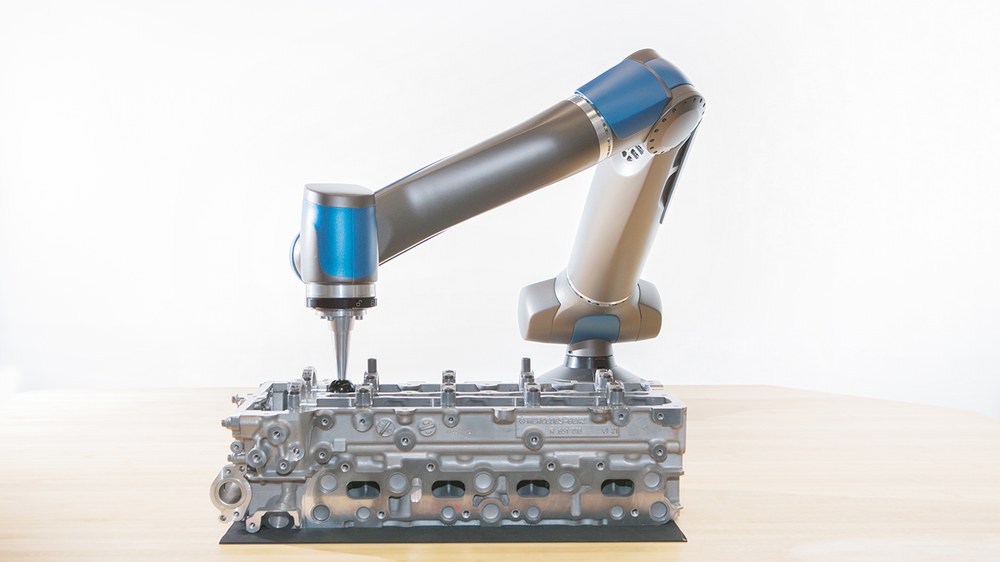
Scientists from a total of ten DLR institutes and facilities are working together to develop new methods and technologies for the factory of the future. With the help of digital images and intelligent planning algorithms, the systems configure themselves independently with little manual effort. This enables the efficient manufacture of customised products. The aim is to realise flexible, versatile and sustainable production. Autonomous industrial assistants such as the SARA robot system are used alongside humans. At automatica sprint 2021, our institute will be demonstrating what the individual systems, their interaction and human-machine interaction could look like in the future in the form of video clips and image galleries.
The SwarmRail project team is presenting an innovative solution for overhead work in manufacturing processes. Possible fields of application range from industry and logistics to vertical farming. For this purpose, robot arms or transport boxes are mounted on mobile units that travel along a rail network above the ground. In contrast to existing solutions, the setup enables the interaction of an entire swarm of robots. As the video on the trade fair portal shows, the basic concepts have already been successfully tested. The developers are currently working on an extended demonstrator.
Fruit, vegetables, tinned food - a video from the DLR trade fair presentation shows how the DLR hand CLASH (Compliant Low-cost Antagonistic Servo Hand) reliably grips food of various shapes, sizes, hardness and weights. The robotic hand operates fully automatically and will provide valuable assistance in online supermarkets in the future. CLASH was presented for the first time at the previous automatica 2018. New features now include a gripping planner to pick objects out of full crates and a finger position planner that makes better use of free spaces between objects. The CLASH fingertips can now also be exchanged for literally more "fingertip sensitivity", with tactile and optical sensors for slip detection and optimum gripping force.
Space research and assistance on earth
With "David", the DLR Institute of Robotics and Mechatronics is presenting its hand-arm system, which was developed based on a human model and is comparable to the "original", particularly in terms of dynamics, dexterity and robustness. The team is currently developing methods for self-awareness so that the robot can independently calculate its position and orientation in advance using computer vision. David makes it possible to develop new strategies for planning and executing increasingly complex tasks. In this way, the researchers from Oberpfaffenhofen are gaining crucial technologies for space and service robotics.
Another exhibit in the virtual showroom is ARDEA, a multicopter that was originally developed for the exploration of planetary surfaces. It can localise without navigation aids such as GPS and perform a wide range of tasks autonomously. In addition, the small aircraft has a unique stereo camera system with a very high field of view, which is particularly suitable for mapping interiors and complex outdoor areas. The DLR aerial robotics experts have also optimised ARDEA for hazardous areas on Earth, in particular to support rescue teams in disaster zones.
Visitors to the trade fair can also explore new technologies for people around the DLR project SMiLE (service robotics for people in life situations with disabilities). The SMiLE "ecosystem" for robotic care assistance consists of various robotic systems such as the humanoid robot Rollin' Justin and the wheelchair robot EDAN. In addition to the further development of the robots' autonomous capabilities, the SMiLE2gether research project is currently investigating how a control centre can expand the robots' range of applications by providing remote support. To this end, an initial prototype for a control centre has now been set up from which the DLR robot systems can be remotely controlled using haptic teleoperation, among other things.
The virtual DLR trade fair presentation will also lead visitors to the MIRO Innovation Lab, the competence centre for medical robotics. Here, medical technology manufacturers, especially small and medium-sized companies, receive expertise in the development of new robotic systems. This also includes access to the institute's own MIRO research platform with various robotic arms for surgical procedures. As an interface between industry, research and clinical partners, the Innovaton Lab team is available to answer questions and discuss product developments as part of automatica sprint 2021.