
DLR presents robotics highlights at automatica 2025
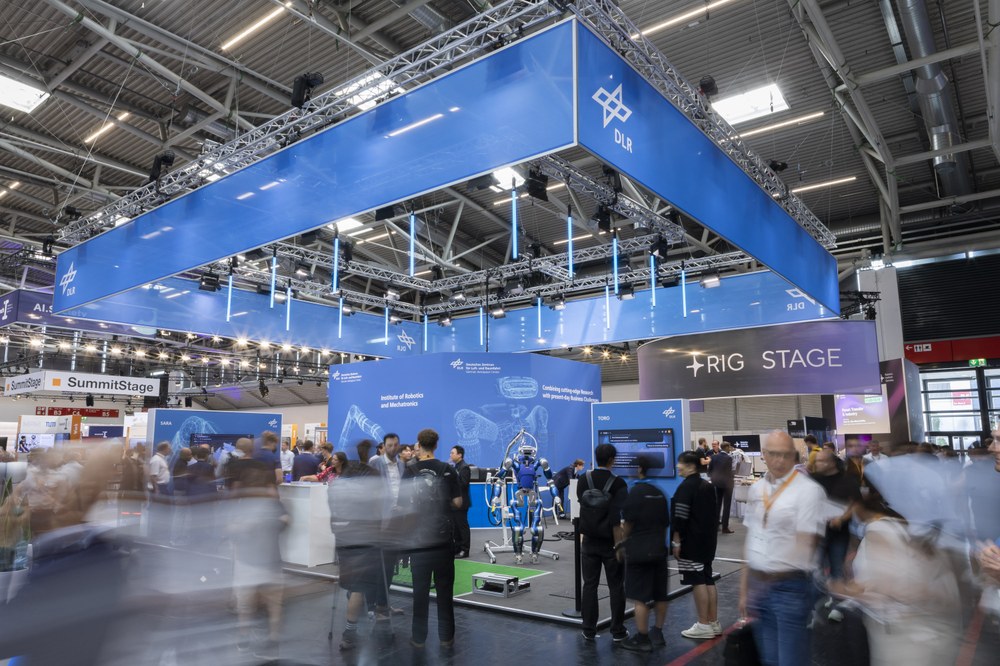

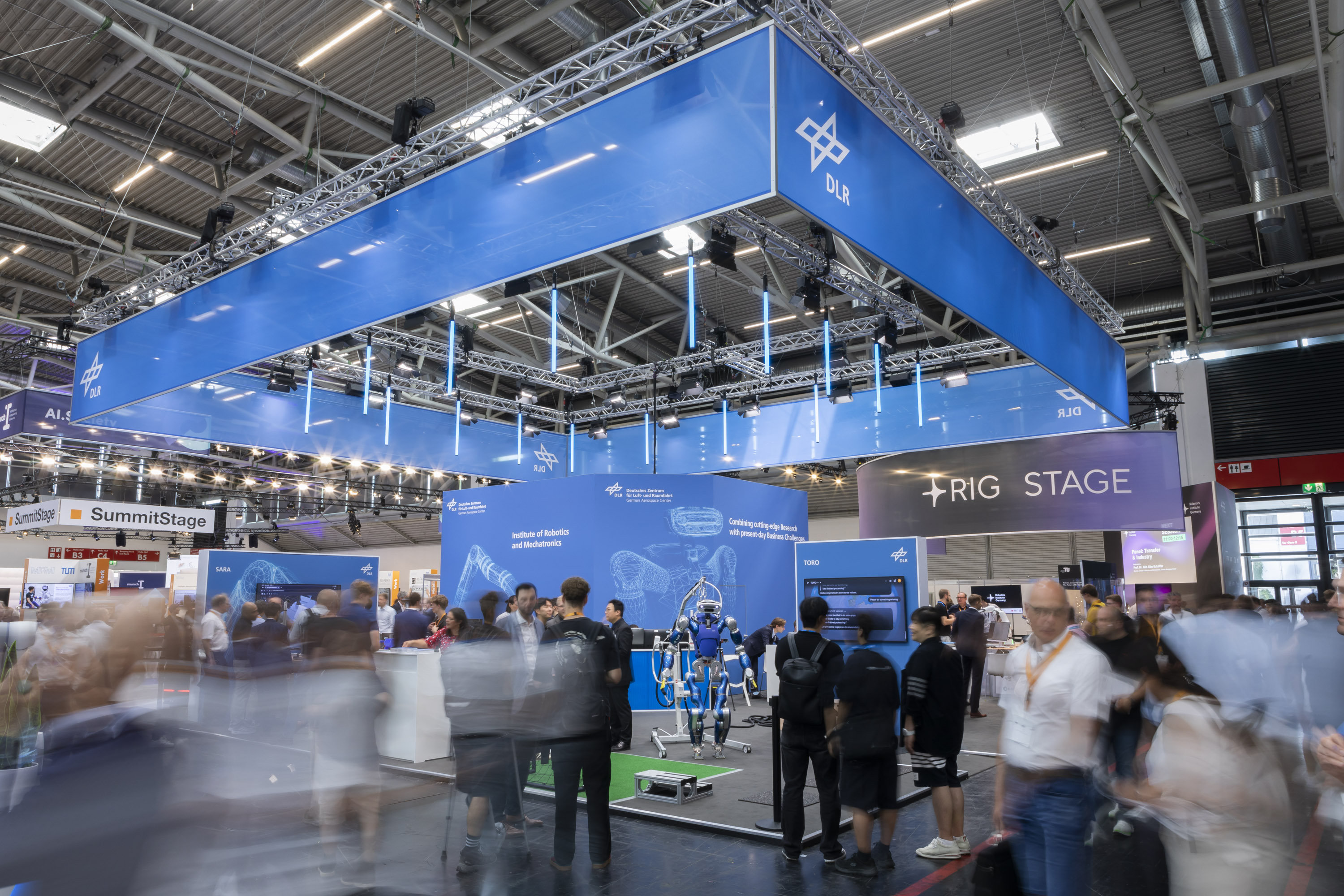
From 24 to 27 June 2025, the German Aerospace Center (DLR) will be presenting its robotics highlights at automatica in Munich, the leading trade fair for intelligent automation and robotics. The focus will be on the topics of production of the future, assistance robotics, medical robotics and technologies that enable robots to perceive and interact with their environment. The European Cluster of Excellence euROBIN will also be represented at the DLR stand (Hall B4, Stand 321/324) of the Institute of Robotics and Mechatronics. With a special networking event for female experts, DLR, in cooperation with the international network "Women in AI and Robotics", is also specifically targeting the female specialist audience.
"Robotics is a key technology for Germany as a centre of technology and business. automatica was brought to Munich by DLR in 2004 and has developed into the leading international robotics trade fair. This year we are presenting innovations from the aerospace industry that are being further developed specifically for use on earth. A particular highlight is the combination of humanoid robots and artificial intelligence. In order to bring our research results quickly and practically into application, we attach particular importance to cooperation with industry and other research institutions," explains Prof. Alin Albu-Schäffer, Director of the DLR Institute of Robotics and Mechatronics.
Humanoid robot with intelligent perception
TORO (Torque-controlled humanoid robot) has evolved since 2013 from a two-legged walking robot into a 1.74 metre tall all-purpose humanoid robot. Its joints are flexibly controlled so that it can interact safely with humans, walk sturdily and climb stairs. Now the robot can also see, feel and "recognise" its surroundings. A new process developed at the institute enables TORO to intelligently interpret the data from its camera "eyes" with the help of AI and react accordingly.
The robot is able to recognise its surroundings and assess the situation. This gives it the ability to solve tasks autonomously in the future. This ability is important for robots that are intended to help in the household or in care. At automatica, TORO will be demonstrating how it combines its dynamic capabilities with new AI functions by performing compliant movements, balancing in yoga poses and playing football. Situation assessment based on machine vision and a large language model (LLM) is integrated. This allows TORO to perceive its surroundings more comprehensively, react to them in a targeted manner and adapt its movements even more precisely.
Future spin-off with prototype for assistance robotics
The Re-enabling Robotics team will be presenting their newly developed robotic arm exclusively at automatica 2025. This new assistance robot is specially designed for use on the wheelchair and is the first prototype for the future product of the development team, which is currently being spun off. The semi-autonomously controllable robotic arm is designed to make everyday life easier for people with severe physical limitations. For example, it is designed to help them pick up a bottle, pour a drink or open doors. The kinematics have been specially adapted for use on a wheelchair so that the robotic arm integrates well with the wheelchair. It loses neither its precision nor its performance and can be operated intuitively. Certified joints from the DLR spin-off SensoDrive also ensure safe use.
MIRO: Ultrasound diagnostics and tissue examination
From the field of medical and surgical robotics, the MIRO Innovation Lab presents its latest research results from robot-assisted ultrasound diagnostics. In the MIRO robotic system, based on a remotely controllable robotam, the ultrasound mode has been fused with other imaging modalities. The combination and integration of the different sensors is unique. Another highlight is the automatic examination of tissue using the MIRO robotic arms: the robotic system guides the sensors precisely to the area to be examined so that high-quality data can be obtained from the tissue.
Production of the future
In the factory of the future, humans and autonomous robotic systems will work closely together and adapt quickly to new tasks. DLR is therefore developing technologies that enable economical, sustainable and efficient production in any quantity. The Institute of Robotics and Mechatronics is showcasing the exhibits SARA, AIMM and the Digital Twin.
SARA
The variable workstation with the DLR lightweight robot SARA (Safe Autonomous Robotic Assistant) forms the central component for a work cell that can be flexibly reconfigured. This allows the system to be quickly adapted to new products and individual orders. In an interactive grinding application from the LEROSH project, the DLR team demonstrates how SARA can perform grinding tasks quickly and precisely with the help of 3D point clouds and an intuitive interface. Bearing rings are measured as a further application example. SARA is programmed through natural interaction with humans and language models.
AIMM
The DLR robotic system AIMM (Autonomous Industrial Mobile Manipulator) specialises in handling and transporting objects in partially unstructured environments. AIMM consists of a robot arm that is integrated on a mobile platform. The flexible robot is suitable for use in production and for automation tasks in laboratories, for example. AIMM is not only capable of carrying out complex manipulation tasks, but can also fulfil tasks completely independently. To do this, the robot combines intelligent methods for perception, data processing and path planning. At the DLR stand, visitors can see how AIMM can be used to flexibly and autonomously complete complex tasks in laboratories using robotic systems.
Digital twin
The concept of the digital twin combines all product-relevant information. The institute presents a multi-physical digital twin that incorporates dynamic behaviour models in particular. These include, for example, mechanical motion sequences, contact forces and energy flows. With the help of specially developed Modelica libraries – including for assembly, robot dynamics and thermodynamics – the digital twin can be used to simulate and optimise complex processes. This enables faster and more efficient commissioning of robot systems and production facilities and also reduces their operating costs. The DLR development team will be presenting applications from various fields, including its new modular industrial robot controller MoRC.
Intelligent gripping
One skill that robots need in industrial environments as well as in the home is the ability to grasp and handle objects safely. A circuit board, a coffee cup or a mango must be gripped in different ways and with different forces. The DLR Institute of Robotics and Mechatronics is presenting the IntelliMan and SoftEnable projects.
The IntelliMan project uses the Learning from Demonstration (LfD) method to develop a robust, reactive gripping strategy. By combining special sets of rules with learning and model-based computer vision techniques, the robot can dynamically adapt its behaviour to the changing environment and reliably grasp a variety of known objects. This technology can be used in many areas – from picking objects from a conveyor belt in logistics to interactions between humans and robots.
The SoftEnable project introduces a novel approach to handling delicate, deformable objects such as food. The demonstrator features an innovative fingertip gripper to slide under objects, a compliant palm to stabilise the objects and integrated sensors to ensure precise and reliable control. At the DLR stand, the robot system demonstrates how this works by gripping and placing soft fish dummies. In the future, the technology could be used in the automation of food processing, medical handling and other sensitive applications.