German Aerospace Center is a member of the Energy Transition Campus Amsterdam
November 11, 2025
German Aerospace Center is a member of the Energy Transition Campus Amsterdam
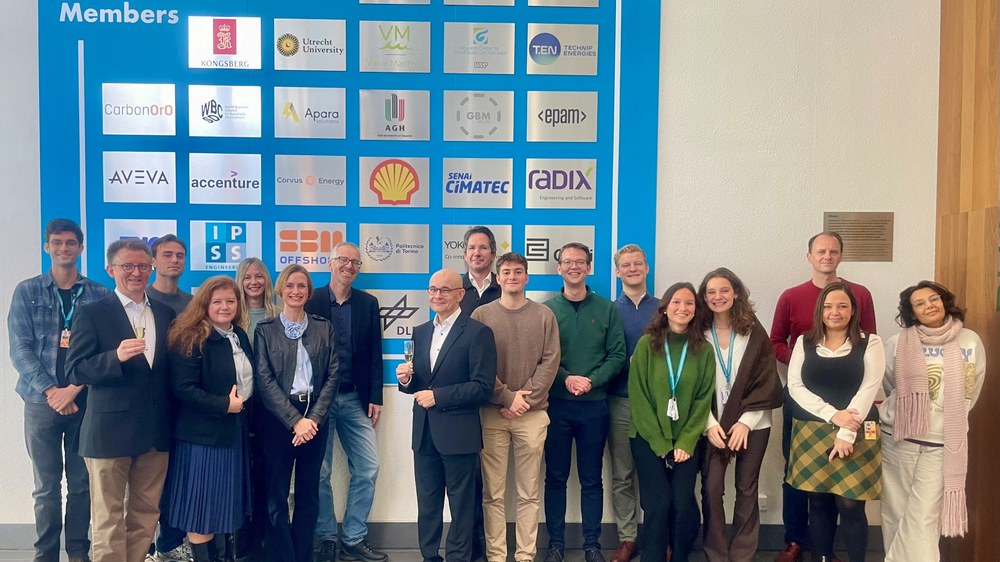
Energy Transition Campus Amsterdam Member Wall
During a small ceremony, the DLR signet was attached to the Member Wall.
Credit:
ETCA
The Energy Transition Campus Amsterdam (ETCA) is an innovative campus where a collaborative community comes together to tackle the world’s biggest energy challenges.
The German Aerospace Center is now a member of ETCA.
This collaboration offers great opportunities for working together on alternative and sustainable fuels and commodities.
The German Aerospace Center (DLR) and the Energy Transition Campus Amsterdam (ETCA) have signed a Letter of Intent – a foundation for long-term cooperation. Together, they want to research innovations for the energy transition. Because, the energy transition needs many collaborations to solve complex challenges, to advance the research and development of new technologies and to scale up existing and new technologies for various industrial and consumer applications.
That is why ETCA is set up by Shell to create a collaborative community housed in a state-of-the-art, sustainable building that reflects the common ambition to offer innovative solutions for the energy transition. Built on innovative ideas, a depth of experience, broad research and forward thinking, the technology centre is well positioned to help successfully navigate and stimulate the energy transition.
Interdisciplinary collaboration
Shell and DLR believe breakthrough technology can only be achieved through extensive collaborations. The parties expect that by collaborating under ETCA’s roof, over time, together with a broader ecosystem, close collaboration infrastructures are enabled that will help to accelerate the upscaling of fundamental research to industrial scale, integrated with industrial systems.
Energy Transition Campus Amsterdam
ETCA Campus director Sarah Street with Mathias Sperl from the Institute for Frontier Materials on Earth and in Space and Martin Roeb from the Institute of Future Fuels.
Credit:
ETCA
It is ETCA’s specific intention to create a rich, open innovation environment involving research institutes, academics, and companies from start-up scale all the way to large corporates to collaborate on impactful innovation to accelerate the energy transition to a low/zero carbon future.
The DLR and in particular the Institute of Future Fuels contributes expertise in the development of solutions for the cost-effective production of hydrogen and fuels on an industrial scale from the raw materials water, CO2 and nitrogen using renewable energies.