Schoolgirls visit High-Flux Solar Furnace in Cologne on Girls'Day
April 27, 2026
Schoolgirls visit High-Flux Solar Furnace in Cologne on Girls'Day
Girls'Day 2026
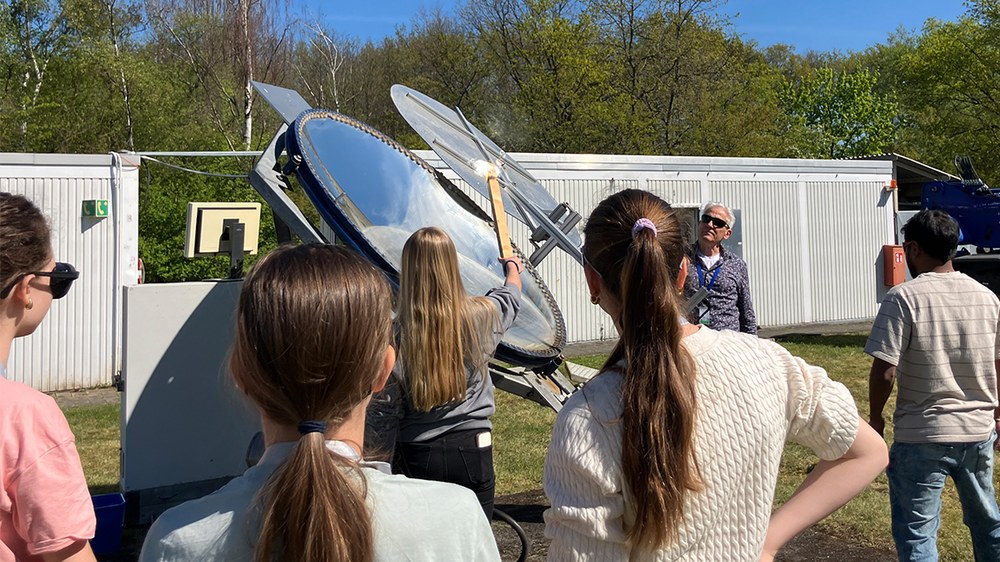
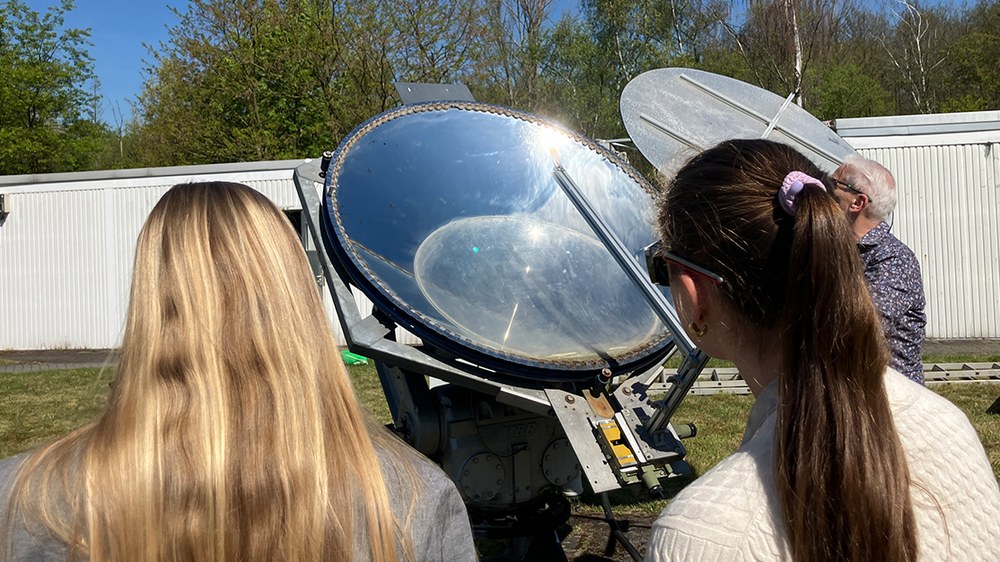
Schoolgirls visited the High-Flux Solar Furnace in Cologne on Girls' Day and carried out experiments together with researchers. How quickly does the wood in the focal point of a discus mirror start to burn?
Schoolgirls from years five to nine visited the High-Flux Solar Furnace at the German Aerospace Center in Cologne as part of Girls'Day.
Together with researchers from the institute, they carried out experiments that illustrate the power of the sun.
An insight into science and research at the Institute of Future Fuels
What power does the sun have and how can we utilise the sun's energy on earth? Schoolgirls got to the bottom of these questions during a visit to the DLR's High-Flux Solar Furnace in Cologne-Porz as part of Girls'Day. With the help of experiments and illustrative videos, it quickly became clear that the sun has a lot of power – you just have to know how to capture it.
How can we focus the sun's rays?
Even a magnifying glass makes it clear: If you hold it up to the sun and place a piece of paper on the floor – all you have to do is align the magnifying glass correctly and the paper starts to burn. In this case, correct alignment means that the so-called focal point hits the paper. The focal point is the point at which the solar radiation is concentrated many times over due to the curvature of the glass. This means that the individual rays that hit the width of the magnifying glass are all directed to a single point. The research facilities at the Institute of Future Fuels, as well as the High-Flux Solar Furnace, work according to precisely this principle.
Girls'Day 2026
It becomes bright at the focal point as soon as a hole is burnt in the 5 cent coin.
The curvature of the glass concentrates the sun on the paper by a factor of 50 to 1,000, depending on the magnifying glass. Depending on the type of paper, it starts to burn at around 180 to 360 degrees Celsius. A large, convex mirror, known as a discus mirror, will concentrate the sun 10,000 times. A piece of wood starts to burn quickly at the focal point, requiring over 250 degrees Celsius. Stainless steel, on the other hand, melts at around 1,200 degrees Celsius – but even this is not a problem at the focal point; an irradiated 5 cent coin will have a hole in it after a short time.
Can this also be enlarged?
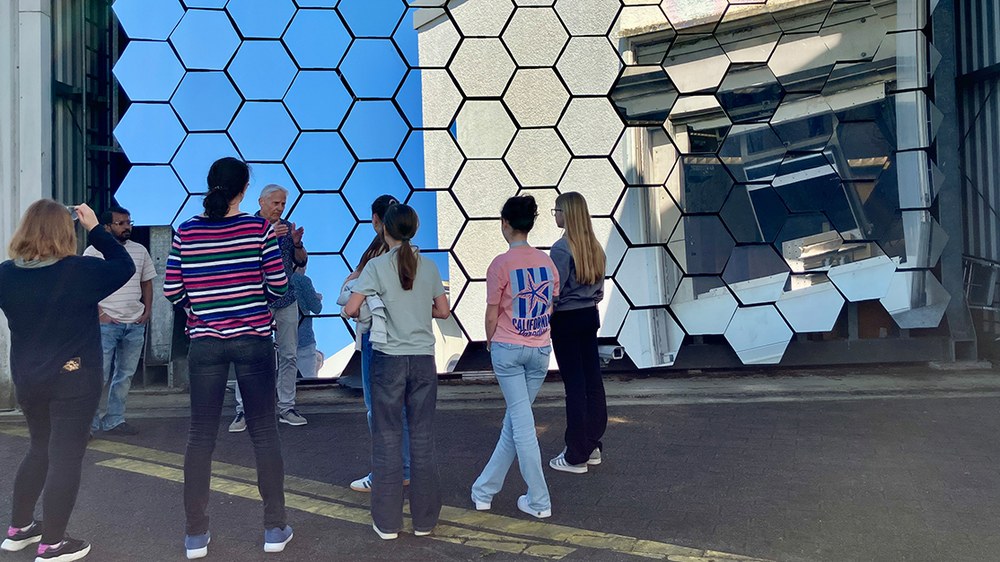
The larger the concentrator, i.e. the surface that focuses the light, such as the mirror or magnifying glass, the more energy can be focussed and the larger the focal point. In the High-Flux Solar Furnace, a 57 square metre mirror directs the sunlight onto 159 smaller hexagonal mirrors, which are arranged in a honeycomb pattern on a vertical, square surface. Each of these mirrors directs the sunlight onto a point in the building. This focal point is about the size of a 1-euro coin. Experiments can be carried out there at temperatures of up to 2,500 degrees Celsius.
Girls'Day 2026
Things get really hot at the High-Flux Solar Furnace: researchers can carry out experiments here at temperatures of up to 2,500 degrees Celsius.
Many industrial processes require a great deal of energy, which is usually obtained by burning fossil fuels. This results in CO2 emissions that are bad for our climate. The high temperatures achieved with solar energy can be used, for example, to make these processes independent of fossil fuels. In addition, hydrogen and alternative fuels can be produced, which also reduce dependence on fossil fuels. The use of solar energy will also soon be crucial on the moon. For example, the sun's energy could be used to bake small bricks for lunar habitats from moon dust.
Metaphor of science
While the pupils carried out the experiments together with researchers from the institute, they experienced how science works. Not everything works at the first attempt; everyone has to persevere and keep trying until it finally works. Just like with the big research experiments.
Contact
Dr.-Ing. Gerd Dibowski
Head of large-scale research facility Solar Furnace