The SolarFuels project offers an alternative for producing synthesis gas (or syngas) in a climate-friendly and resilient way. As a versatile intermediate product, synthesis gas forms the material basis for a large number of important chemical processes. It consists of hydrogen (H2) and carbon monoxide (CO) and can be used to synthesise methanol, for example, or converted into synthetic crude oil in a Fischer-Tropsch plant. Synthetic crude oil, in turn, can be processed into liquid fuels such as kerosene in industrially established processes.
Since the middle of the last century, synthesis gas has mainly been produced through the catalytic conversion of natural gas – with methane (CH4) as the main component – and water vapour (H2O). This requires high temperatures and pressures. As this process uses natural gas as a raw material and usually also as an energy source to achieve the high operating temperatures required, considerable amounts of carbon dioxide (CO2) are emitted and fossil resources are also consumed.
Solar reforming of biogas
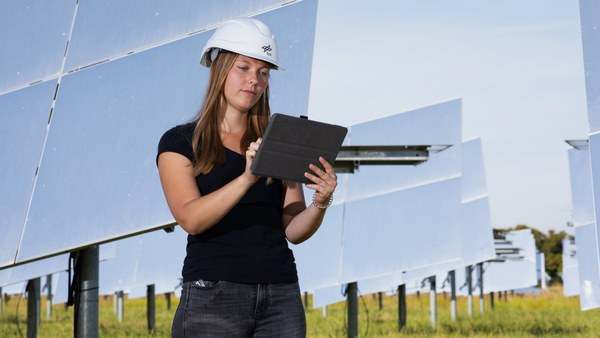
A renewable approach to produce synthesis gas, on the other hand, is the use of biogas as a source material in combination with concentrated sunlight to provide heat. In a solar tower system, sunlight is concentrated onto a receiver via biaxial sun-tracking mirrors (heliostats). The CO2 present in the biogas takes part in the reaction and is thus utilised.
This solar reforming of biogas – with the main components CH4 and CO2 – offers the possibility of producing synthesis gas using H2O in a climate-friendly way and chemically storing fluctuating solar energy in the process. The solar, synthetic fuels obtained in this way after further process steps are an environmentally friendly alternative to conventional fossil fuels and can make an important contribution to reducing climate-impacting emissions, particularly in areas of the transport sector that are difficult to electrify, such as aviation (as SAF – sustainable aviation fuels) and heavy goods transport.
Further development of main components and demonstration on an industrial scale
The aim of the SolarFuels project is to demonstrate the entire solar-based technology chain from the source materials to synthetic crude oil in an optimised, integrated overall system on an industrially relevant scale. The project team is developing three main components for the utilisation of high-temperature solar heat and qualifying them for use under practical conditions in the overall system:
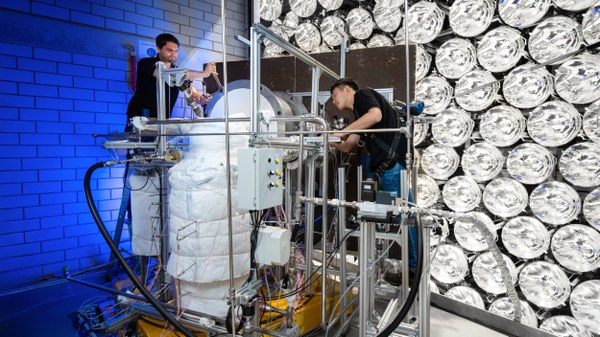
A solar-absorbing gas receiver that receives concentrated solar radiation from the mirrors of a solar field on the top of a solar tower and heats steam to temperatures of more than 1200°C
A reforming reactor that uses the energy contained in the hot vapour to efficiently produce synthesis gas with a suitable composition for the downstream Fischer-Tropsch plant from CO2, H2O and CH4 on a catalyst
A thermal storage unit that is charged via the hot steam during sunny periods and supplies heat for the reforming reactor during periods with little sunshine
The development of a control system suitable for industrial use for controlling the heliostat field is also part of the project. Preparatory tests for operating a receiver under concentrated solar radiation took place on the DLR Multifocus Tower in Jülich.
DAWN plant
Synhelion's DAWN plant for the production of solar fuels on an industrial scale.
Credit:
Synhelion
The DAWN pilot plant, the world's first sun-to-liquid plant on an industrial scale, was built by the company Synhelion at Brainergy Park Jülich and inaugurated in summer 2024. All components are integrated and operated together in the DAWN plant. This demonstration of the entire process for the production of synthetic crude oil represents an important milestone on the way to defossilising the transport sector.
The chemistry matters
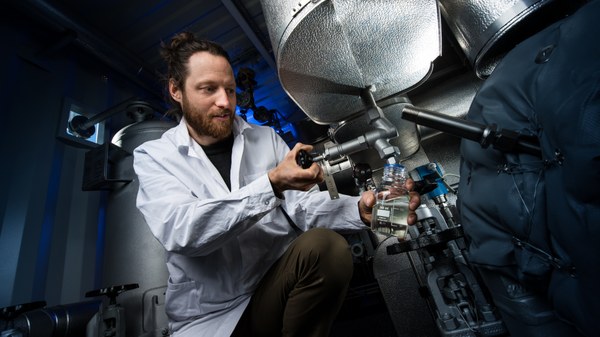
As part of the project, the DLR Institute of Future Fuels is taking on the task of analysing commercially available catalysts in a specially developed test stand under practical conditions. Researchers pass defined mixtures of CO2, H2O and CH4 at pressures of up to 5 barabs through a heated catalyst bed at temperatures of up to 1000°C and analyse the resulting product gases. The size of the catalyst bed is aimed at the conditions of industrial use. However, the test stand offers measurement options with laboratory-typical precision and is therefore suitable as an interface between the laboratory and large-scale industrial applications.
In addition to temperature and pressure, the composition of the introduced gas mixture, the residence time and the performance of the catalyst influence the composition of the product gas, which must ultimately be suitable for the use of the synthesis gas in a Fischer-Tropsch plant. The researchers develop reaction kinetic models – i.e. descriptions of how the chemical reactions take place over time depending on the influencing factors – and prepare these for use in reactor and system models.
One focus is on assessing the risk of unwanted carbon deposits, which can lead to deactivation of the catalyst. Higher CO2 fractions and reduced water fractions in the gas mixture introduced should be aimed for in terms of process technology in order to enable a suitable H2/CO ratio for the downstream Fischer-Tropsch unit, but increase the risk of carbon deposits. Corresponding operating limits must be identified on a catalyst-specific basis.
The work at DLR forms an important basis for understanding relevant chemical phenomena on the catalyst and for optimising reforming reactors and their operating conditions.