
Porotherm-Solar


Unsplash/Andrey Grinkevich
Efficient heat storage technology for a controllable, CO2-free energy supply of the future
Duration: 1.10.2023 – 30.9.2026
The energy transition needs flexible solutions to provide electricity when it is needed. Solar thermal power plants can convert solar energy into heat and thus supply electricity even when it is dark. Powerful heat storage systems are crucial for this. The Porotherm-Solar project is researching new types of storage materials that can absorb and release heat more efficiently.
The project team is using redox-active materials for this purpose. These are chemical substances that can absorb (reduction) or release (oxidation) electrons in a reaction. In the case of metal oxides, this reduction and oxidation are often accompanied by the release and absorption of oxygen as well as the storage and release of energy in the form of heat. This is intended to make energy storage more flexible, reliable and climate-friendly – an important step towards a sustainable and stable energy supply for the future.
Heat storage made from perovskite
In the Porotherm-Solar project, researchers from the German Aerospace Center (DLR) are working together with companies from industry to develop innovative, open-pored perovskite structures as thermochemical heat storage modules. Perovskite refers not only to the commonly occurring mineral consisting of calcium titanium oxide, but also to an entire class of materials with a variety of possible compositions that have the same crystal structure as the perovskite mineral. The newly developed materials can chemically store and release heat – a key technology for utilising solar energy flexibly and independently of the time of day or weather.
First, suitable metal oxides are identified, synthesised and tested in the laboratory for their stability and reactivity. These materials are then used to create monolithic storage structures, i.e. structures that consist of a single piece. They are produced using two processes: Extrusion and 3D printing. The project team characterises the modules in terms of their thermal, mechanical and chemical properties and examines their suitability for use in solar thermal power plants.
Development and testing of the demonstrator
The researchers are building a demonstrator in the laboratories of the DLR Institute of Future Fuels in Cologne. Here they are testing the developed storage modules under realistic conditions. The aim is to analyse the charging and discharging behaviour and evaluate the performance of the materials.
In this way, the team is verifying how efficiently the new heat storage systems can be used in practice and what contribution they can make to a climate-friendly energy supply.

DLR / Porotherm-Solar
Cooperation with industry
The project consortium combines research and industry in order to ensure the transfer of technology into practice. In addition to DLR as coordinator, the following companies are participating in the project:
- ExoMatter – Selection and screening of suitable metal oxides using digital material databases
- ECT-KEMA – Development and production of open-pored structures using extrusion
- KI Keramik-Institut – Material characterisation and optimisation of extruded structures
- WZR Ceramic Solutions – Production of complex perovskite structures using 3D printing
- Kraftblock – design and construction of the demonstrator
This close collaboration makes it possible to transfer the developed storage technology directly into industrial applications – for example for CSP power plants or for utilising industrial waste heat.
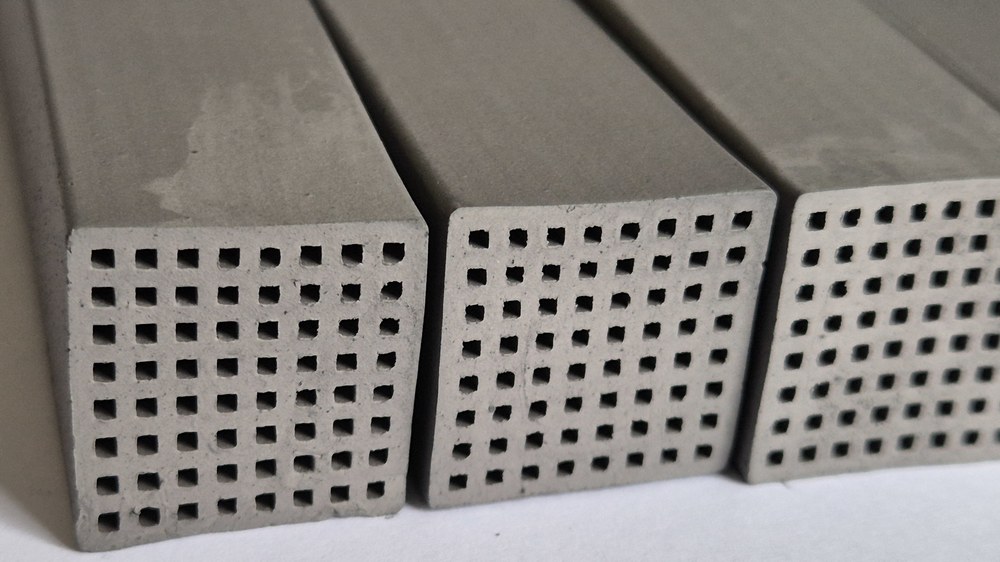
KI Keramik-Institut / Porotherm-Solar
Reactor tests and scaling
The experiments and functional tests take place at the DLR site in Cologne. The demonstrator is set up, operated and analysed here. The knowledge gained forms the basis for further development into larger pilot plants and industrial heat storage systems.
Thermochemical storage for application
The materials and processes developed in the Porotherm-Solar project are intended to create a new generation of high-performance, cost-efficient heat storage systems that can be used flexibly in solar thermal power plants and industrial processes. The technology offers industry the opportunity to utilise energy more efficiently, balance load peaks and significantly reduce CO2 emissions.
By combining innovative perovskite materials, additive manufacturing and practical demonstrations, the project is taking an important step towards market-ready thermochemical storage solutions. The knowledge gained creates the basis for the construction of larger pilot plants and opens up new fields of application – from industrial waste heat utilisation to flexible electricity and heat generation. The Porotherm-Solar project thus makes a significant contribution to a sustainable energy future and at the same time strengthens the technological competitiveness of Germany as a business location.
Project | Porotherm-Solar |
|---|---|
Duration | 1.10.2023 – 30.9.2026 |
Project participants |
|
Funding |
Contact
Dr. rer. nat. Martin Roeb