CO₂-neutral fuels | Recycling economy | Low-emission base material production | Process evaluation
Photon-NRW
Chemical industry
In the Photon-NRW project, the important intermediate and target products carbon monoxide and methane are to be produced with the help of an innovative photoreactor.
Credit:
Jan van der Wolf
Solar production of basic chemicals in an innovative photoreactor
Duration: 4.6.2024 - 31.12.2027
In order to achieve the goals of the 2015 UN Climate Change Conference in Paris, it is necessary to drastically reduce greenhouse gas emissions and reach complete greenhouse gas neutrality in the long term. In particular, processes must be developed for the chemical industry and the transport sector that ensure a sustainable and reliable supply of carbon-based basic chemicals as well as synthetic fuels.
The Photon-NRW project aims at using solar energy in a novel photoreactor to produce the important intermediate and end products carbon monoxide and methane, thereby helping to close the carbon cycle. This approach does not rely on fossil feedstocks and thus has the potential to increase the resilience of supply systems.
Sustainable production of carbon monoxide and methane
The Photon-NRW project aspires to further developing, validating and demonstrating a process for the sustainable production of carbon monoxide and methane from carbon dioxide and renewable hydrogen. Alongside hydrogen, carbon monoxide is an essential component of synthesis gas, from which liquid fuels (such as aviation fuels) and basic chemicals (such as methanol) can be produced in further process steps. Methane is an established fuel and a feedstock for numerous chemical syntheses.
The project team aims at designing an innovative photoreactor in which suitable photoactive materials absorb the incident light and on which the chemical reactions for producing the desired products can proceed efficiently. The light, or photons, can originate from natural and/or artificial solar radiation.
The researchers strive for achieving high efficiency and long service life for the innovative photoreactor, whilst avoiding or minimising the use of critical materials and integrating bespoke measurement technology.
Three steps to the goal
The Photon-NRW project is divided into three main phases. In the first phase of the project, the researchers analyse the requirements that the photoactive materials must meet for this application before they can identify promising candidates using models and experiments. The project team then investigates how these materials can be applied to suitable carrier structures.
In this phase of the project, the researchers also develop and validate measurement technology to accurately record the irradiance, reaction temperature and pressure as key factors influencing the reaction process. The scientists elaborate various solar reactor concepts and evaluate them in the context of material, measurement technology and process-related constraints. The selection of a suitable reactor concept, including photoactive materials and measurement technology, marks the conclusion of the first phase.
The High-Flux Solar Simulator in Cologne-Porz
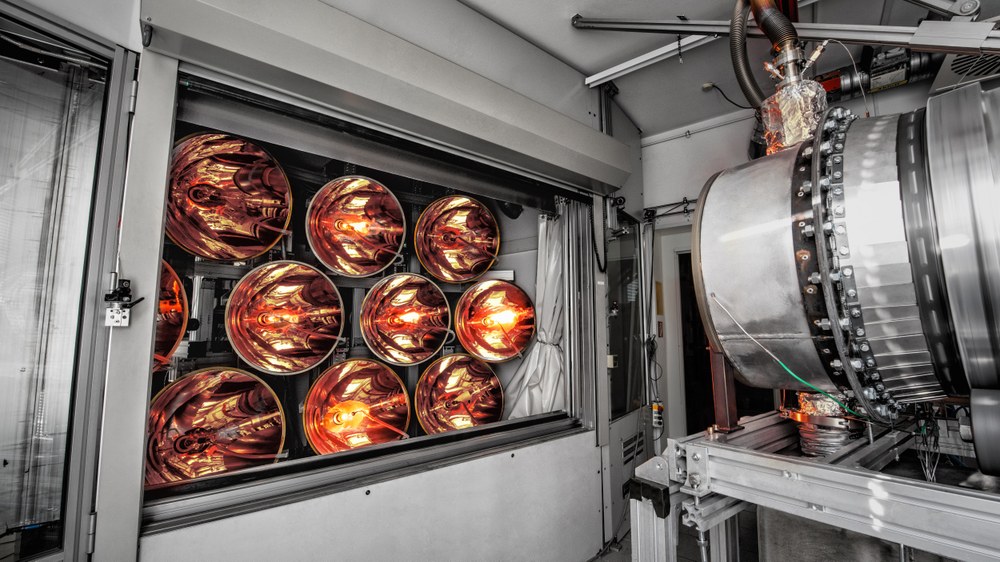
The innovative photoreactor currently under development is to be tested under real-world conditions – such as in the High-Flux Solar Simulator in Cologne-Porz.
In the subsequent second phase, the project team refines the selected reactor concept and optimises the design with regard to the utilisation of incident photons and flow characteristics, in conjunction with the measurement technology. The researchers test the constructed photoreactor under realistic conditions. To do this, they integrate it into a suitable test environment and irradiate it with (concentrated) natural and/or artificial light (for example, in the High-Flux Solar Simulator in Cologne-Porz). Once the team has successfully demonstrated operation and evaluated the test series under varying operating conditions, the second phase ends.
In the final phase of the project, the focus is on conducting simulations of the entire system and techno-economic analyses to further develop the process and assess the technology’s potential.
Complementary expertise from Germany and Europe
The project brings together the expertise of various German stakeholders from academia and industry and covers a wide range of areas, from materials development to process demonstration and technology assessment. In addition to the German Aerospace Center (DLR) with its Institute of Future Fuels and Institute of Solar Research, the project involves a) ExoMatter, a DLR spin-off and operator of a high-performance platform for materials development, b) GKD, a family-run business specialising in technical meshes with 800 employees, and c) Luna Innovations Germany, the German subsidiary of a world-leading supplier of fibre-optic temperature, strain and acoustic sensors. Furthermore, two renowned associated partners contribute expertise from other European countries to the project: TNO, a research organisation from the Netherlands (development and characterisation of photoactive materials), and Solifos AG from Switzerland (fibre-optic sensor technology).
The findings obtained will form an important basis for improving alternative, sustainable processes for the production of basic chemicals and fuels. Potentially, the project can make a significant contribution to reducing net emissions of greenhouse gases in the chemical industry and the transport sector at national and European level, as well as increasing resilience. The project promotes establishing new fields of application for companies, particularly those in North Rhine-Westphalia, which is undergoing structural change, but also across Germany and Europe.
This project is funded by the European Union and the state of North Rhine-Westphalia as part of the ERDF/JTF programme NRW 2021-2027. (Funding reference EFRE-20800368)