Short-term thermal energy storage systems are used to balance short-term fluctuations between heat supply and demand. They store excess heat, for example during the day, and make it available again in the evening and at night or on the following day. This improves the utilisation of a heat source and increases security of supply.
Pressurised water storage
In a pressurised water storage system, water is heated to temperatures of up to approximately 200 degrees Celsius in a pressure-resistant vessel. During discharge, the stored heat is made available, for example, via heat exchangers or by directly drawing off the hot water.
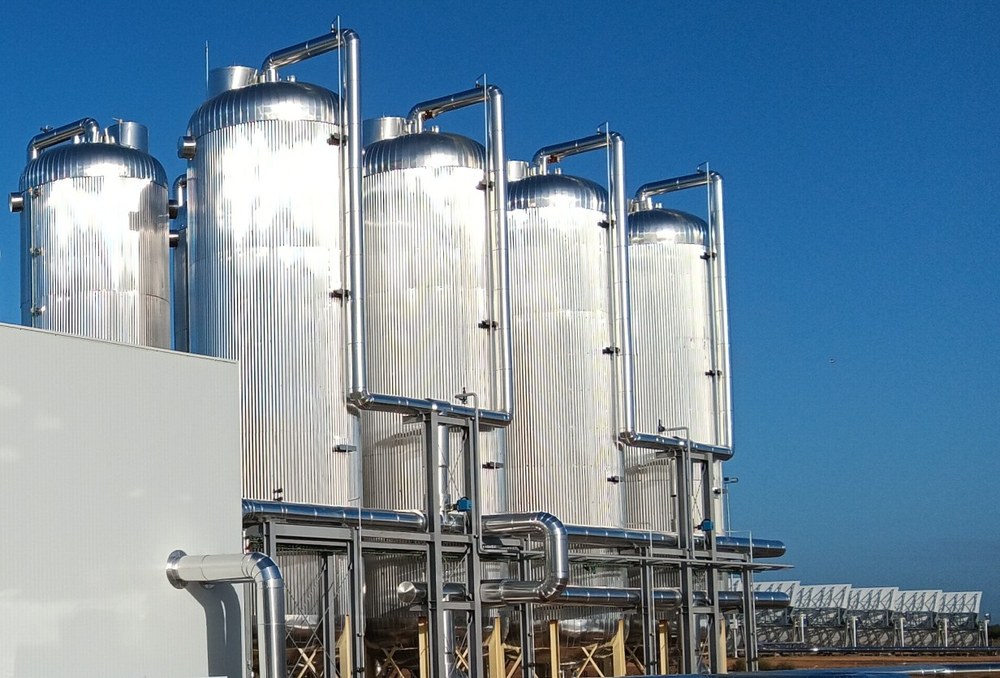
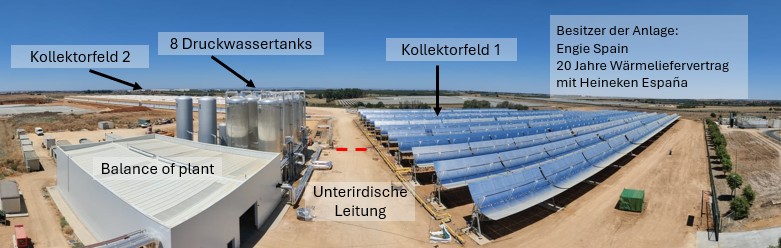
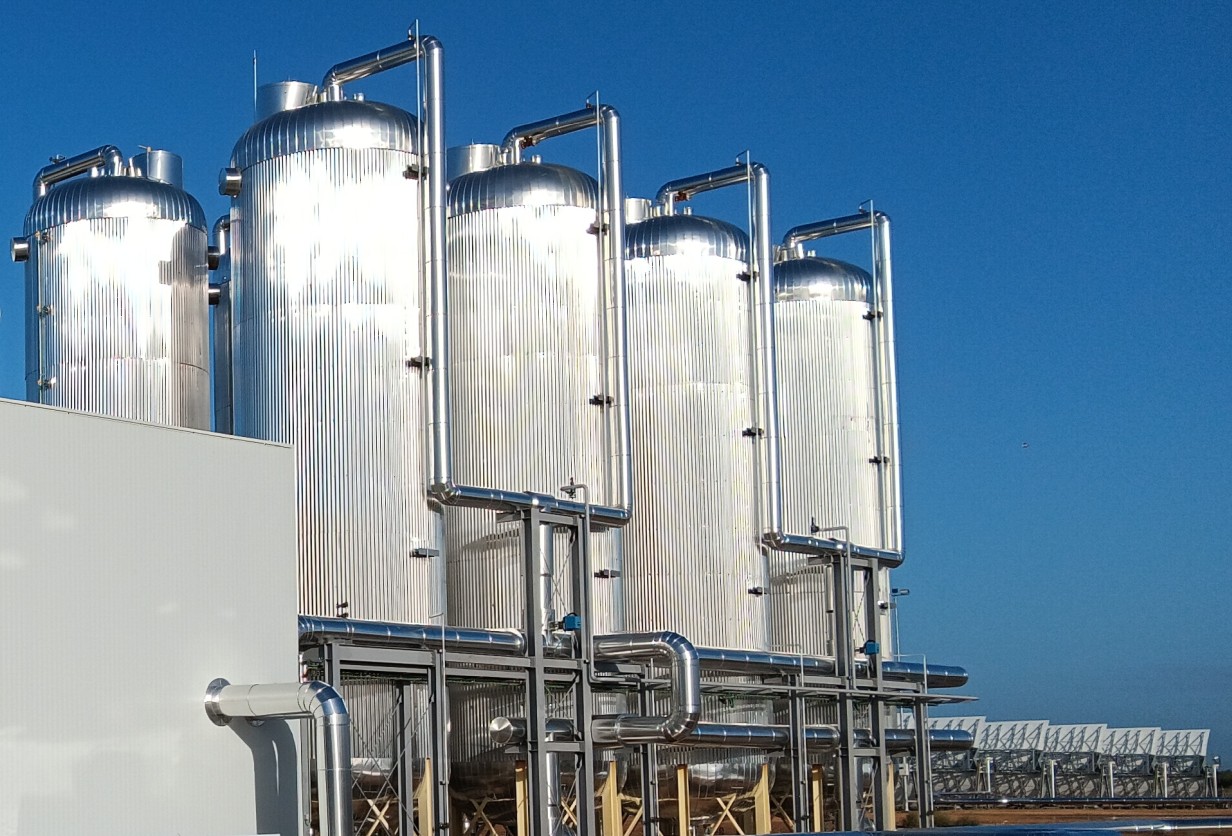
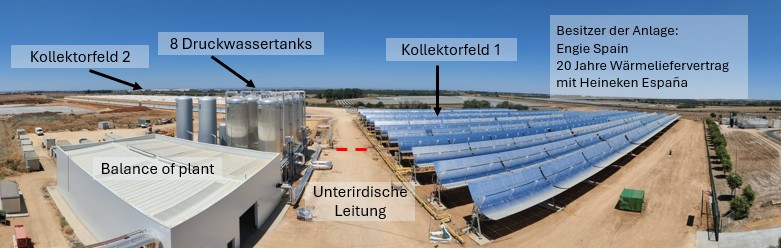
An example of a pressurised water storage system is found at the Heineken brewery in Seville, where it is integrated with a parabolic trough collector field. The storage system has a capacity of 70 megawatt-hours, enabling approximately 50 percent of the brewery’s annual heat demand to be met.
Solar thermal process heat system with pressurised water storage
View of the solar thermal process heat system at the Heineken brewery site in Seville, Spain, with the pressurised water storage tanks and the balance of plant on the left and one of the two parabolic trough collector fields on the right.
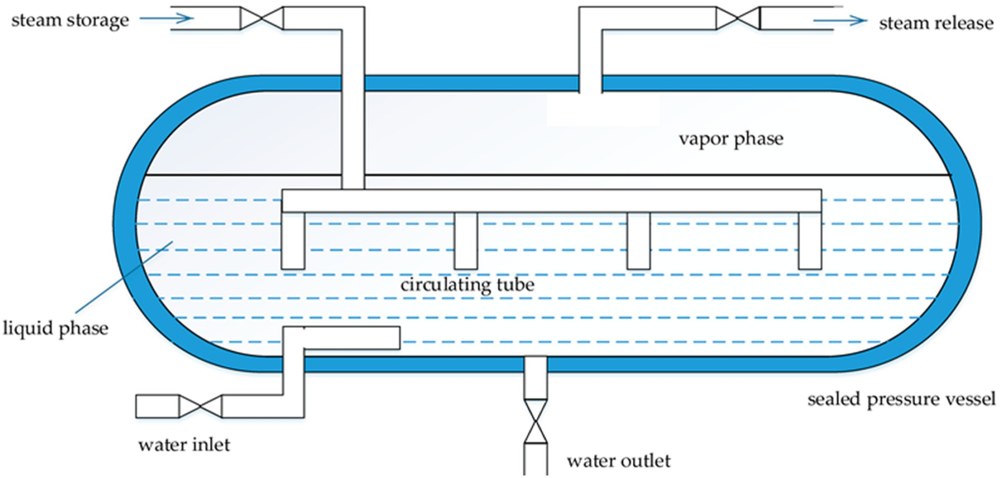
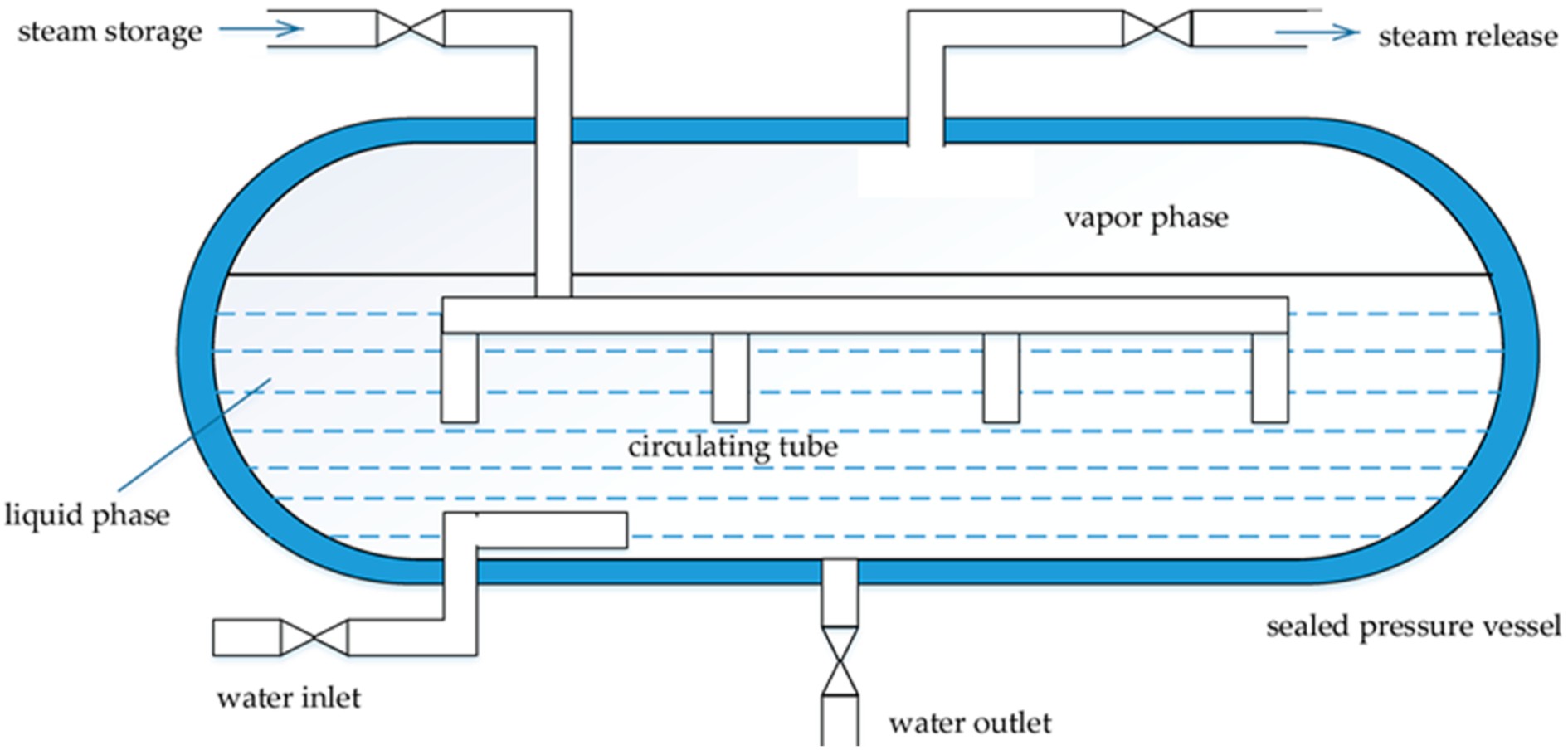
The Ruths steam storage system is a type of phase-change storage system. Its operating principle is based on the storage of heat through the reversible phase change between liquid water and water vapour. During charging, steam is introduced into the storage vessel, increasing the pressure and, consequently, the boiling temperature of the water. Some of the steam condenses in the process. The steam and the boiling water are in thermodynamic equilibrium. When the pressure inside the vessel changes as steam is introduced or withdrawn, a new equilibrium is established. During charging, the increase in pressure promotes the condensation of steam. During discharging, steam is withdrawn from the storage vessel, causing the pressure to decrease and some of the water to evaporate again. The latent heat of vaporisation required for this process is extracted from the water, allowing the stored thermal energy to be released in the form of steam.
It is used, for example, in a solar power plant in Seville, Spain, with a storage capacity of 20 megawatt-hours, and is designed to operate at a temperature of 250 degrees Celsius and a pressure of 40 bar. Ruths steam accumulators enable highly dynamic charging and discharging at high rates and with high thermal power output. They are particularly suitable for processes requiring relatively low storage capacities and are used in the textile industry, glass processing and metal production.
The thermal energy storage system of a concrete storage unit is specifically designed to store large amounts of heat temporarily. Heat exchanger columns, for example, are located at the centre of the storage unit. During charging, a hot heat transfer fluid flows through pipes and transfers its heat to the concrete. During discharging, the heat transfer fluid flows through the modules at a lower temperature, while the concrete releases its stored heat. Thanks to the modular design of these storage systems, the overall system size can be flexibly adapted to storage requirements by connecting and stacking individual cassettes, similar to a modular construction system.
Molten salt storage
Molten salt storage systems are sensible heat storage systems that use molten salt mixtures. To prevent the salts from solidifying, these systems are suitable for operating temperatures starting at approximately 150 degrees Celsius. Salt mixtures are used as heat transfer fluids because mixtures of two or more salts have lower melting points than pure salts, as is the case with nitrate salt mixtures, for example. They are used in concentrated solar power applications because they have a high volumetric heat capacity, a high boiling point, high thermal stability and very low vapour pressure.
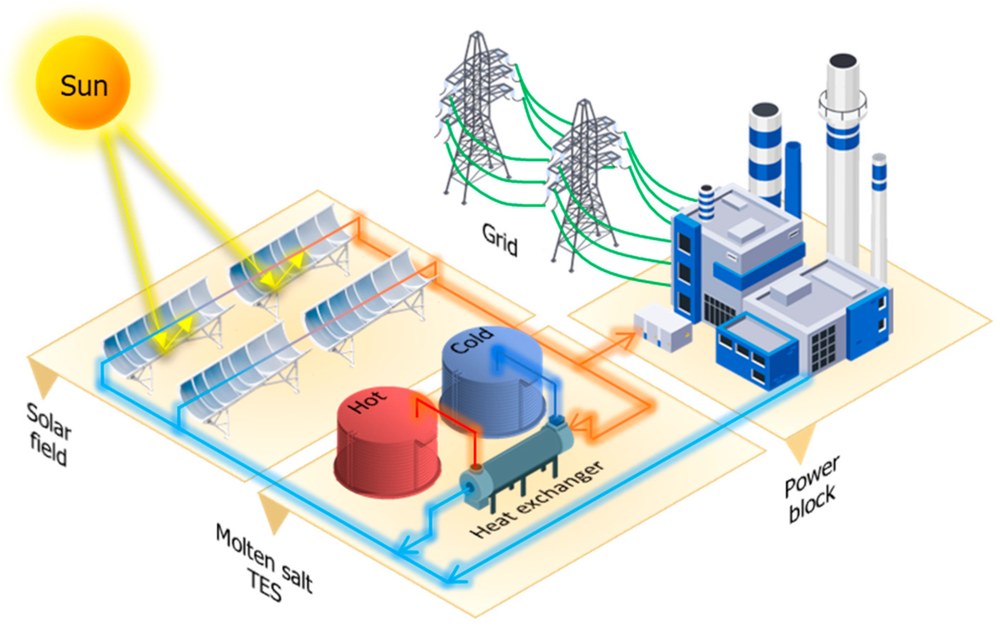
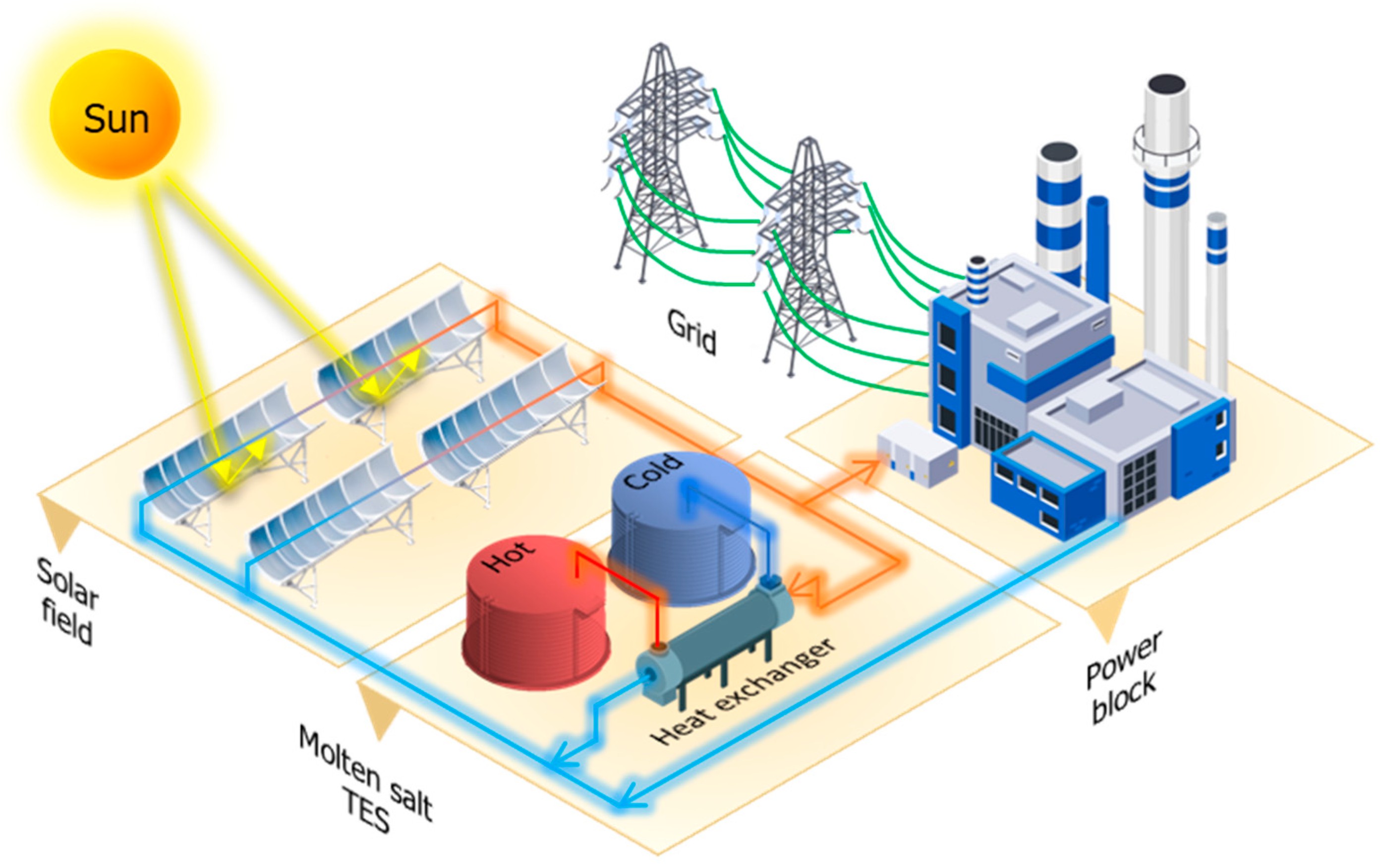
When combined with a solar thermal plant, for example one equipped with parabolic trough collectors, the salt is pumped from the cold tank through the solar field, where it is heated. The heated molten salt is then transferred to the hot tank. Depending on demand, this tank can be charged or discharged using a heat exchanger.
Molten salt thermal energy storage
Schematic of a CSP plant with parabolic trough collectors (PTCs) and a molten salt thermal energy storage (TES) system.