
New "Sonnenfänger" statue symbolises the focus of research at the DLR site in Jülich
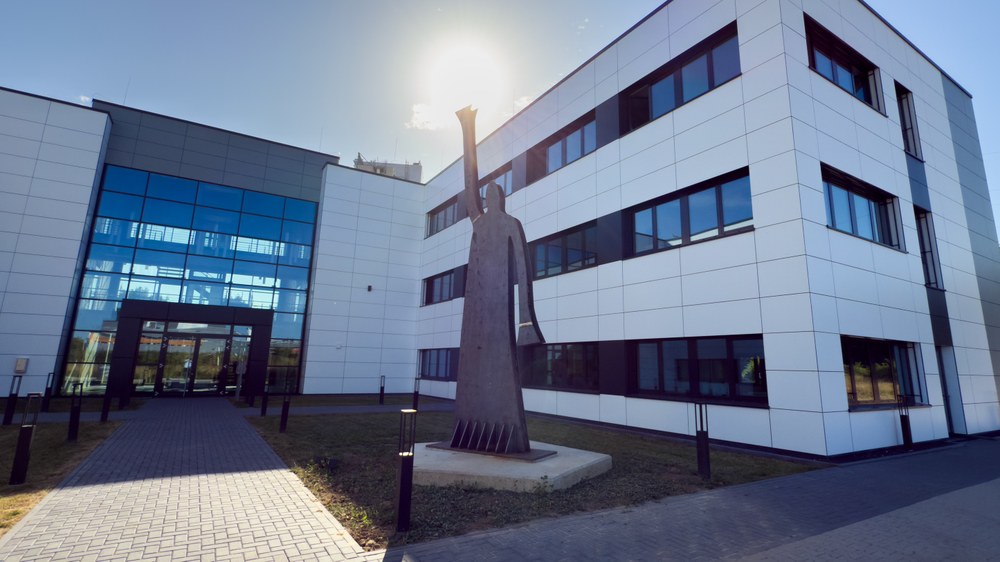

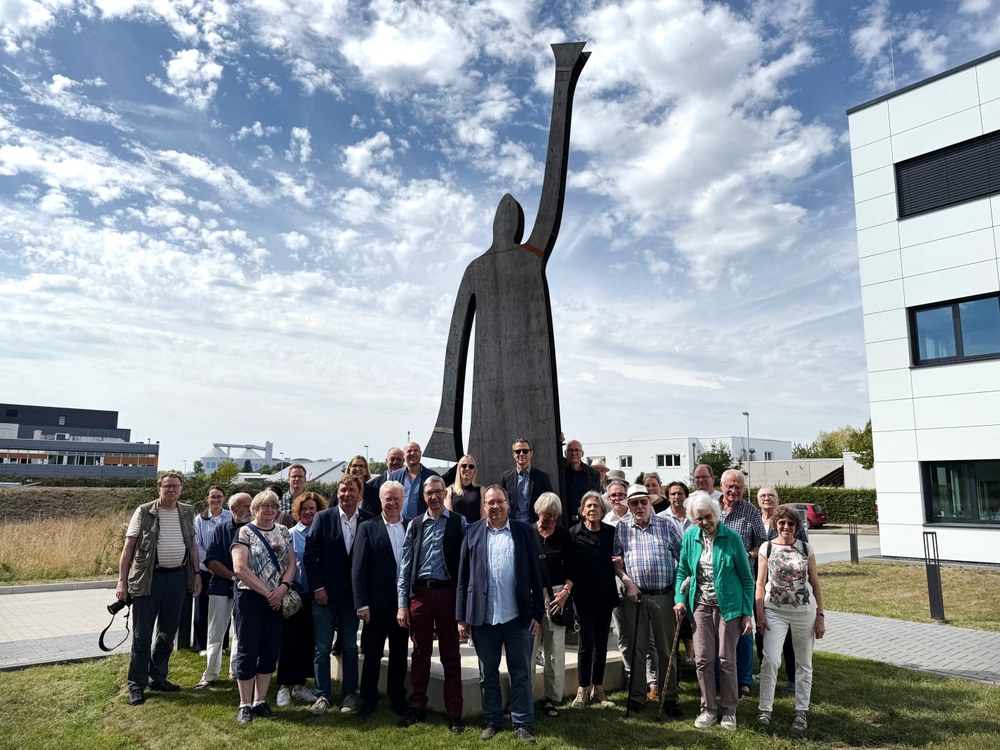
- On 26 August, the "Sonnenfänger" was officially inaugurated by the "Neue Kunst im öffentlichen Raum" initiative group in the presence of Jülich Mayor Axel Fuchs.
- The Jülich artist Rudolf Vaasen designed the figure inspired by the work of the Institutes of Future Fuels and Solar Research.
- The statue is intended as a symbol of bringing solar energy down to earth, analogous to over 2,000 heliostats on the neighbouring solar field.
The "Sonnenfänger" literally reaches for the sun: Jülich artist Rudolf Vaasen was inspired by science and has visualised the research focuses of the DLR Institutes of Solar Research and Future Fuels at the site.
The mirror surface in front of the solar towers with over 2,000 heliostats is also known as the sun catcher: It reflects and focuses the sunlight onto the top of the 60 metre high solar tower. There, the concentrated sunlight generates high temperatures in a receiver, which are used to convert water into vapour inside the system and drive a turbine to generate electricity. The sculpture is intended to visualise this solar research with the aim of making science accessible through art.
Presenting history and science through art
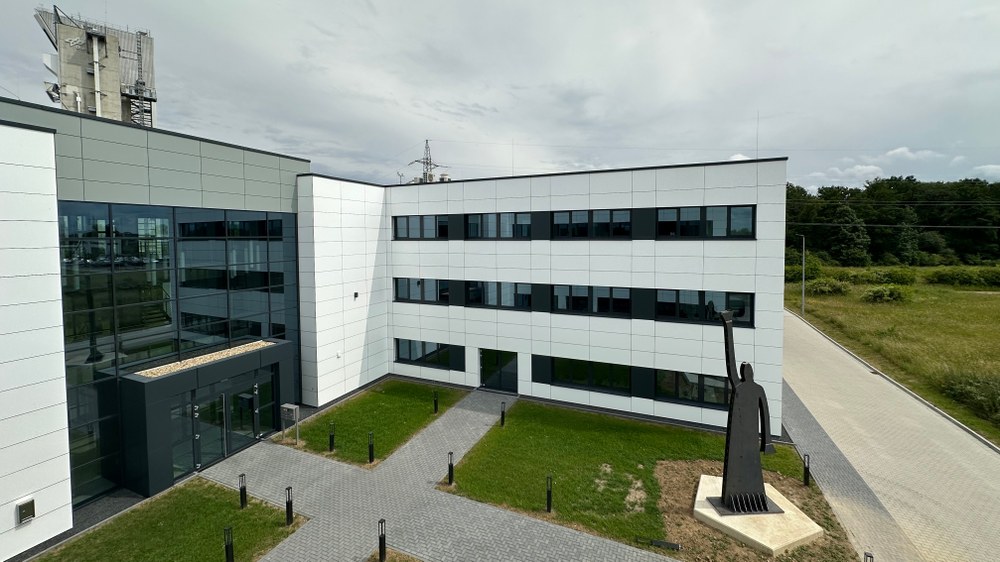
The Corten steel statue now towers six metres high in front of the DLR building. It is to be one of five sculptures in Jülich that are part of the "Wege zu Geschichte und Forschung" project. "The first ideas for the sculpture trail date back ten years," says Rüdiger Urban, Chairman of the "Festung Zitadelle Jülich" support association.
Peter Schmitz, a committed local politician and former deputy mayor of Jülich, had the idea of installing works of art by Jülich artists in the city. The "Neue Kunst im öffentlichen Raum" initiative group was founded in 2019 to realise this idea. The group is made up of the "Festung Zitadelle Jülich" support association, the Jülicher Geschichtsverein 1923 and the Kunstverein Jülich.
The aim of the project is to raise awareness of the city's two unique selling points as a historic fortress town and modern research city. "It is an attempt to portray history and contemporary development through art," says Urban.
The initiative has so far selected five works of art from various proposals by Jülich artists, which are to be realised at selected locations in close cooperation with the city of Jülich and sponsors – completely financed by donations.
Deviation from the first draft of the "Sonnenfänger"
These include an abstract depiction of Napoleon, a reduced sculptural form by master builder Alessandro Pasqualini – and the "Sonnenfänger". "The Sonnenfänger at the DLR Solar Tower in Jülich marks the end of an artistic path from the Rur through Jülich to the Solar Tower and symbolises the connection between art and science," says Bernhard Hoffschmidt, Director of the Institute of Solar Research. "As Michelangelo once did, creativity and the pursuit of knowledge merge here in a joint search for the essential. With elements such as stone, water and the sun, the work builds a bridge from the Renaissance to the future." The statue invites us to understand light not only as a source of energy, but also as a symbol of inspiration and knowledge.
According to the first design by Rudolf Vaasen, the sculpture looked somewhat different. Due to the statics, a second steel plate had to be added.
The project team also decided against the figure holding a sun in its hand. "In that case, the whole thing would represent a fusion," says Rüdiger Urban, "but we want to show an attempt to capture radiation."
In contrast, a pentagonal foundation has been added. This is intended to "represent the idealised city layout of Jülich", says project manager Norbert Freudenberg, who is also involved in the "Festung Zitadelle Jülich" support association. This emphasises the connection to Jülich as a modern research location. In future, a plaque will indicate the donors of the statue.
Ceremonial inauguration with the mayor of Jülich
The 3.6 tonne sculpture was created in collaboration between the Institute of Technology and Engineering at Forschungszentrum Jülich (FZJ) and the Stolberg-based company Kerschgens. The steel trader manufactured the steel plates and FZJ employees welded them into shape. In the end, fine-tuning the structure in front of the building became a challenge. But in the third attempt, the metre-high steel figure has found its anchor points and can now capture the sun's rays and direct them towards the earth and Jülich in the spirit of solar research.
On Tuesday, 26 August, the statue was officially inaugurated by the initiative group in the presence of Jülich's mayor Axel Fuchs, the director of the Institute of Solar Research Bernhard Hoffschmidt and the representative of the site management Verena Müller. "Jülich and research into the utilisation of solar energy simply belong together," says Christian Sattler, Director of the Institute of Future Fuels. "The Sonnenfänger is the perfect symbol for this. It will demonstrate the importance of the sun to everyone who visits DLR in Jülich."