
What does pizza have to do with kerosene? Anika Weber at the RWTH MINT Science Slam
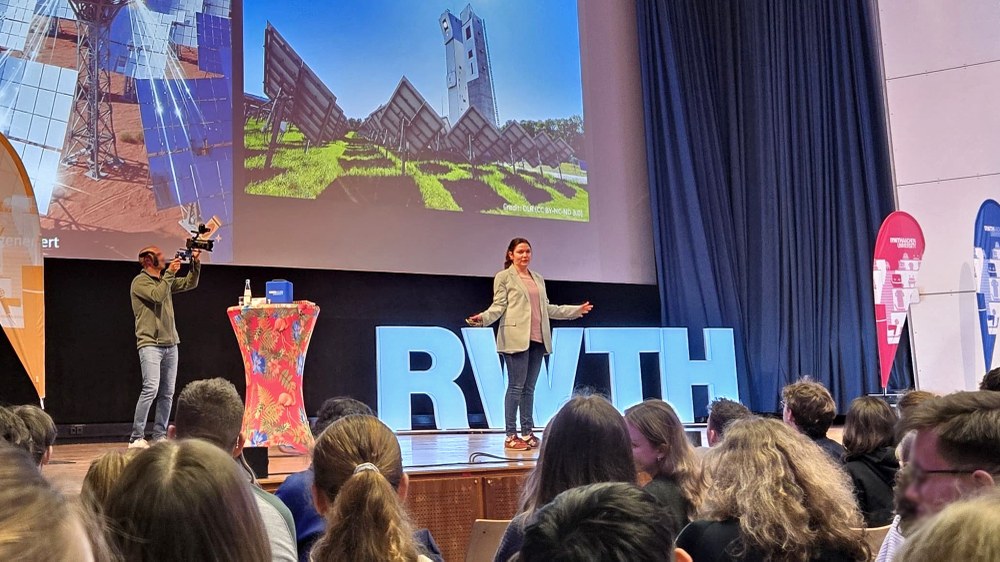

- DLR ambassador Anika Weber performed at the MINT Science Slam at RWTH Aachen University
- Six slammers provided entertaining and amusing insights into their research during the competition
- Pupils gained inspiration for a career in science
The auditorium at RWTH Aachen University was packed to capacity, with around 600 school pupils in the audience watching the stage with curiosity and excitement. On Friday, 23 January, six researchers presented their work in an entertaining, understandable and inspiring way as part of the RWTH MINT Science Slam, with the aim of conveying the fascination of scientific work to a new generation. DLR Ambassador Anika Weber entered the competition on behalf of the DLR Institute of Future Fuels. She brought a cardboard box to her slam and asked the bold but exciting question: "What does pizza have to do with kerosene?"
The answer follows.
In her slam, which was peppered with vivid examples and GIFs, Anika Weber first explained in youthful language that solar radiation provides us with more than enough energy to use it in concentrated form as a heat source, for example for large ovens. Not only could pizza ovens at around 400 degrees Celsius theoretically be irradiated and heated with it, but also, in practical terms, thermochemical reactors at over 1,500 degrees Celsius, as is the case at the DLR Solar Towers in Jülich. And here, the DLR is not baking dough, but heating chemicals for sustainable and CO2-neutral fuels, such as kerosene, for long-distance travel with less flight shame.
Cer and oxygen in a situationship
But how exactly does it work? The starting point: cerium oxide granules are heated in the reactor using solar energy. The granules consist of two substances, in a kind of situational relationship, explained Anika Weber – that is, an undefined, loose romantic connection that is more than just a fling but less than a committed relationship: the element cerium and oxygen. Anika Weber continued: when heated, they quickly become stressed and separate from each other, with the oxygen leaving the cerium. However, when the situation is cooled down again, the cerium craves oxygen again. If water and CO2 are then added, the oxygen splits off from these substances. What remains is a synthesis gas that is used to produce kerosene. The on-off relationship between cerium and oxygen can then start all over again, Anika Weber concluded the cycle.
"The first industrial companies to cooperate with DLR, such as Synhelion in Jülich, are already using this process and supplying the first airlines with CO2-neutral kerosene," she continued, concluding: "This is a meaningful and sustainable application of modern science that offers many career opportunities for young people."
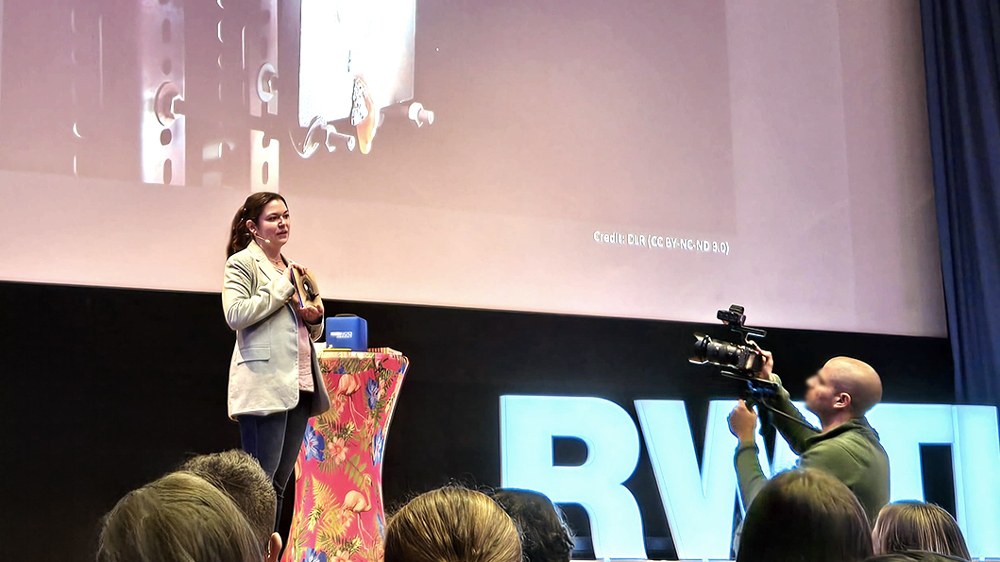
She reported that her daily routine as a scientist is varied: it includes wiring practical experimental setups with sensors, measuring air flows and conducting irradiation experiments, but also computer simulations and exciting theoretical considerations.
At the end of the day, she often feels positively exhausted, and sometimes she is faced with scientific problems that require a great deal of perseverance and creativity. But she encouraged the pupils:
"What I've learned so far and what I definitely want to pass on to you is that you have to stick with it. You mustn't give up and you should never feel too stupid for anything. It's absolutely normal not to understand everything straight away."
Why this evening was not only an experience for pupils
Science slams are a unique opportunity to gain insights into research and everyday research life. The audience does not just listen, but is also actively involved. Whether through questions from the floor, small live experiments or voting on the best performance, the audience becomes an active part of science.
Although the MINT Science Slam at RWTH Aachen University was aimed particularly at upper secondary school pupils interested in mathematics, computer science, natural sciences or technology, teachers also benefited from it. They experienced how complex topics can be conveyed in a lively and humorous way.
In an interview after the slam, in which she came third, Anika Weber shared some very personal insights:
"For example, I didn't even dare to choose physics as an advanced course, and I actually only switched to the advanced course after a few weeks in the basic maths course because I felt something was missing. You don't have to have had good grades at school to be a successful student. I myself had almost a five in maths in year seven, and now here I am today. You just have to dare to do it and get started, then it will work out. It's a great feeling to solve problems!"