Developing and evaluating sustainable fuels using the sun’s heat
Duration: 1.1.2026 - 31.12.2028
The transport sector and the chemical industry’s independence from fossil raw materials is becoming increasingly important in terms of climate protection and security of supply. As the direct follow-up project to the SOLHYKO project, HELIX is therefore continuing to develop innovative processes for the sustainable production of synthetic fuels, such as kerosene and marine diesel, using solar energy. In addition, the process can be used to produce basic chemical feedstocks that can be utilised in the manufacture of plastics, paints, solvents and other industrial products. The research focuses on two processes for utilising high-temperature solar heat: the thermochemical cycle using redox materials, and the solar reforming of biogas.
In both processes, solar radiation is concentrated to use thermal energy to break down steam (H2O) and carbon dioxide (CO2) into synthesis gas, a mixture of hydrogen (H2) and carbon monoxide (CO). This synthesis gas serves, for example, as an intermediate product in the manufacture of synthetic fuels, whose hydrocarbon chains largely correspond to those of today’s fuels and can therefore replace them. Furthermore, synthesis gas can be used as a basis for any chemical feedstocks that are currently derived from fossil hydrocarbons.
If, in addition to heat and water, the CO2 is also obtained from sustainable sources – for example, from the ambient air or biogenic sources – the result is sustainable fuels which, when combusted, release only the amount of CO2 that was previously captured from the atmosphere.
The direct use of solar heat for the cracking process offers advantages, as the need for electricity infrastructure can be reduced to a minimum compared with competing processes. HELIX is testing the new reactors in the unique large-scale concentrated solar radiation facilities of the German Aerospace Center (DLR).
From the laboratory to an industrial-scale plant
In the HELIX research project, the project team is investigating solar thermal processes for the production of solar fuels using laboratory experiments and model-based simulations. In doing so, the researchers are gaining new insights into plant design, operational behaviour, material ageing and energy efficiency in order to prepare the necessary development steps leading up to industrial readiness.
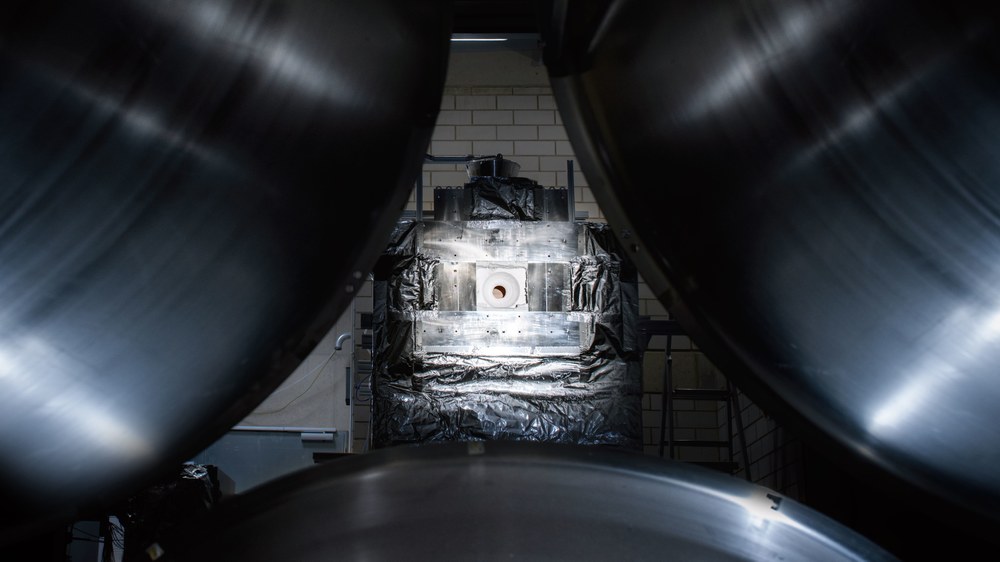
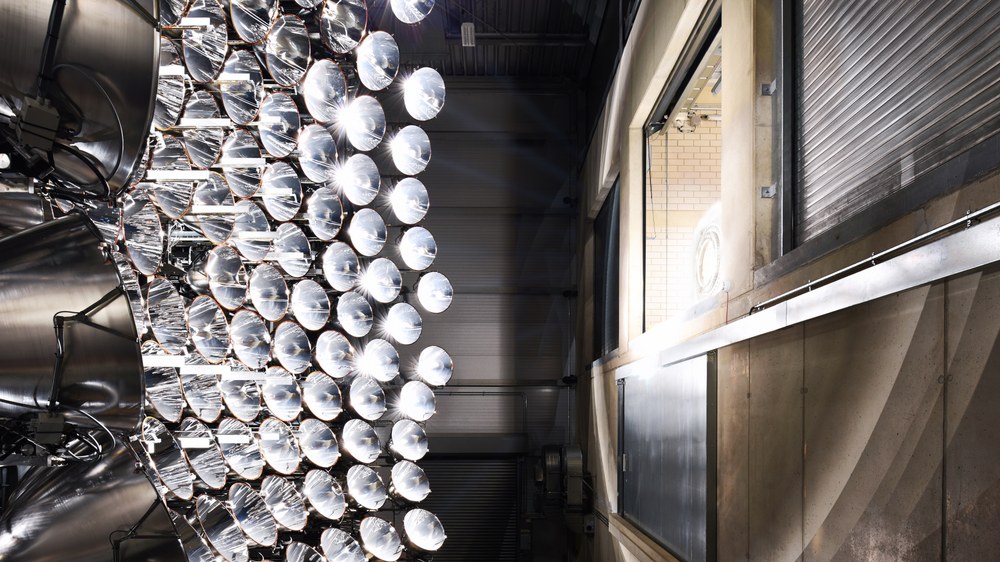
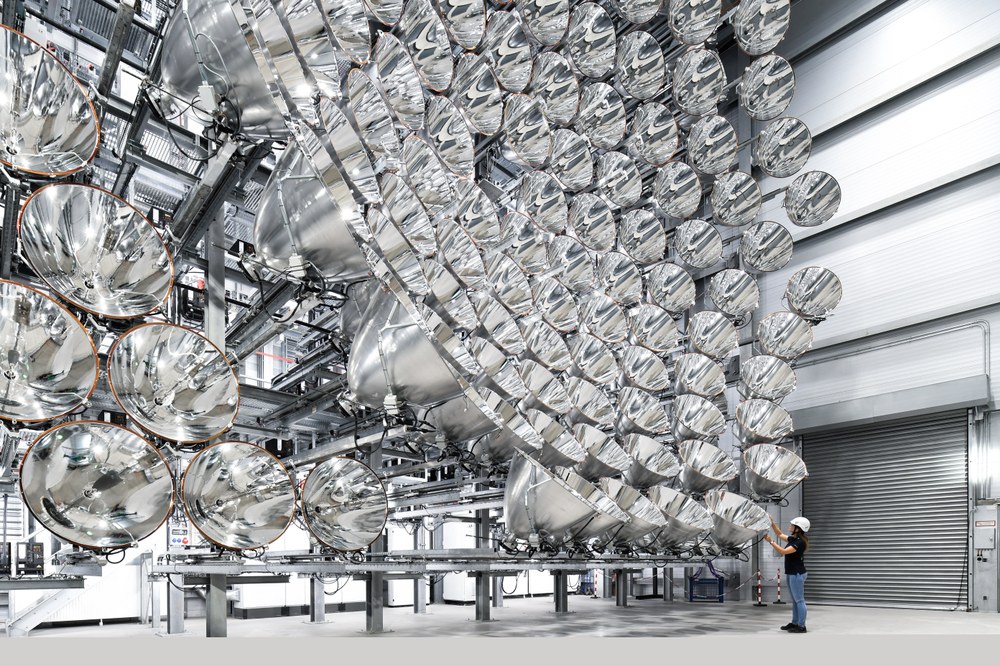
The focus is on key components such as solar receivers, which convert concentrated solar radiation into high-temperature heat, and the reactors in which the chemical reaction takes place. To test the processes under constant conditions, the project team is conducting the experiments under artificial sunlight in the DLR’s Synlight, the world’s largest High-flux solar simulator.
Synlight in action
The project team will test the processes developed in HELIX in the High-flux solar simulator Synlight at the German Aerospace Center – the world’s largest artificial sun.
To produce synthesis gas using a redox cycle, concentrated solar radiation triggers chemical reactions in special materials known as redox materials. At temperatures above 1,400 degrees Celsius, oxygen is released by the redox material (reduction). In a second step, the oxygen-depleted material is cooled and, in the process, reabsorbs oxygen to compensate for this deficiency (oxidation).
To achieve this, it is brought into contact with H2O and CO2 and extracts oxygen atoms from both substances. This produces a mixture of H2 and CO – the desired synthesis gas. This serves as a feedstock for the further production of synthetic fuels and basic materials. This cyclic process utilises only water, CO2 and thermal energy from concentrated solar radiation.
Illustration of a thermochemical cycle
Production of synthesis gas via a thermochemical cycle.
Credit:
Inspired by Net-Zero Web-Atlas (atlas.netto-null.org)
In the predecessor project SOLHYKO, the splitting of H2O into H2 and oxygen was investigated. HELIX is now taking this a step further and developing the simultaneous splitting of H2O and CO2 to produce synthesis gas directly in a single process step. This significantly simplifies the process chain compared with many competing methods – such as those involving the intermediate step of water electrolysis.
Solar reforming of biogas
Biogas consists largely of methane (CH4) and CO2 and is therefore ideally suited for the production of synthesis gas. The high-temperature heat required is provided by concentrated solar radiation, which is used to heat the biogas and additional water vapour. Through contact with a catalyst, the reactants undergo a chemical reaction, ultimately producing a mixture of H2 and CO – once again, the desired synthesis gas.
Illustration of Solar Reforming
Production of synthesis gas by solar reforming.
Credit:
Inspired by Net-Zero Web-Atlas (atlas.netto-null.org)
One process that is already established on an industrial scale is the conventional reforming of natural gas. In this process, both the feedstocks and the process heat required are derived from fossil resources. Solar reforming of biogas therefore has the potential to significantly reduce greenhouse gas emissions and dependence on fossil natural gas.
Many steps towards the goal within the HELIX project
HELIX is further developing both the processes for the solar-thermal redox cycle – in monolithic and particle-based designs – and the solar reforming of biogas, building on the findings of the predecessor project SOLHYKO. To this end, the project team is further developing previously identified redox and catalyst materials and optimising their manufacturing processes.
Due to the high process temperatures, improving heat transfer and heat storage is also of crucial importance for developing efficient reactor systems. To supply heat for the reforming process, an innovative air receiver is being developed that can provide solar process heat at over 1,000 degrees Celsius. The researchers are designing new test benches for all the production processes under investigation and demonstrating these on a laboratory scale.
In addition, the project team is developing detailed mathematical simulation models to enable the evaluation of different process designs and operating conditions during the initial development phases. The models provide insights into the behaviour of the reactors and their interaction with other components of fuel production. Particular focus is placed on the intelligent utilisation of high-temperature waste heat in adjacent process steps, as well as on the development of predictive operating strategies to increase overall efficiency. Furthermore, the researchers are investigating the scaling of the reactor systems to industrial scale in order to lay the groundwork for a subsequent market launch.
Synlight - The largest artificial sun in the world
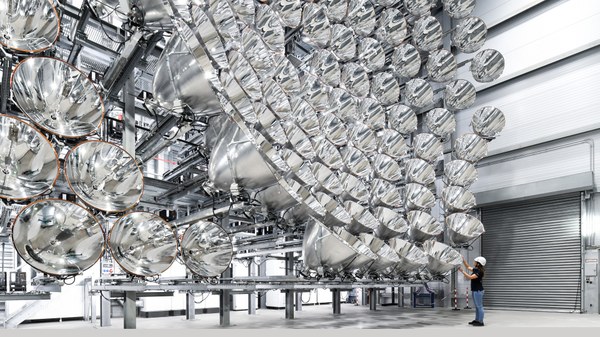
In an 18-meter-high hall, 149 high-power radiators form a 14 x 16-meter wall of light. With their help, scientific experiments can be irradiated with 10,000 times the natural solar radiation.
In parallel, the project team is assessing the processes in terms of their economic, environmental and socio-economic impacts. Particular emphasis is placed on reducing future fuel costs and analysing the environmental and societal impacts throughout the plant’s entire life cycle. Finally, the researchers are examining both the importance of policy incentives and the potential of international supply chains for solar fuels, with a view to linking suitable production sites with off-take markets.
Market demand as a guiding principle
The need to diversify future sources of sustainable base fuels and transport fuels is becoming increasingly apparent in order to meet the rapidly growing demand for climate-friendly alternatives in the industrial and transport sectors. This demand is defined in concrete terms, amongst other things, by European targets for the coming decades. For example, the FuelEU Maritime Regulation (2023) stipulates a reduction in greenhouse gas intensity of 14.5 per cent by 2035 and 80 per cent by 2050 for ships with a gross tonnage of more than 5,000 tonnes. These targets are to be achieved in particular through the use of sustainable fuels and efficiency improvements.
Requirements in the aviation sector are also rising significantly: by 2050, sustainable aviation fuels are set to account for 70 per cent of European kerosene consumption, with at least 35 per cent to be met by synthetic fuels. At the same time, the chemical industry requires large quantities of sustainably produced hydrocarbons, such as methanol, to reduce greenhouse gas emissions and the consumption of fossil resources in the manufacture of plastics, solvents and base materials. The demand for renewable fuels and chemicals will therefore increase sharply in the coming decades and gradually replace parts of today’s fossil-based markets.
The HELIX project makes an important contribution to this by driving forward the technological development of solar production processes for sustainable fuels and basic materials right up to industrial scale. To this end, several DLR institutes with internationally recognised expertise in the fields of solar energy, materials and systems research are working closely together.
Ongoing dialogue with companies in the fields of concentrating solar power technology, plant engineering, the chemical industry and the energy sector ensures that the research is tailored to the current challenges and requirements of industry. In this way, HELIX not only promotes technological development but also facilitates the transfer of knowledge between research and application.
Project
HELIX
Duration
1.1.2026 - 31.12.2028
Project participants
DLR Institute of Future Fuels
DLR Institute of Solar Research
DLR Institute for Frontier Materials on Earth and in Space