
Challenges of introducing 100% SPK-SAF at German airports

jaromirchalabala - Magnific.com
- Study on the introduction of 100% SPK-SAF in aviation published
- Focus on infrastructure, logistics, regulation and economic viability
- Concentrating supply at a limited number of airports could be advantageous
- Study commissioned by the InnoFuels research consortium
The DLR Institute of Air Transport has carried out a study on the potential introduction of Synthetic Paraffinic Kerosene Sustainable Aviation Fuel (SPK-SAF) at German airports. Entitled "Technical, logistical and economic challenges associated with the practical introduction and implementation of 100% SPK-SAF in aviation"1, the study examines the requirements and challenges involved in using aromatic-free aviation fuels.
The study was commissioned by the InnoFuels research consortium, funded by the German Federal Ministry for Transport (BMV). Coordinated by the Karlsruhe Institute of Technology (KIT), the consortium brings together stakeholders from research, industry and aviation to develop sustainable fuel solutions. Within the aviation application innovation area, CENA Hessen, Condor and, on behalf of DLR, the DLR Institute of Combustion Technology are collaborating on solutions to accelerate the market uptake of Sustainable Aviation Fuels (SAF). The DLR Institute of Air Transport was commissioned to prepare the present study.
The study involved stakeholders from the aviation sector, industry, regulatory authorities and academia. In addition, workshops and expert discussions were held at Cologne Bonn Airport, providing valuable insights into the airport's fuel storage infrastructure.
SPK-SAF and the non-CO2 effects of aviation
The study focuses on how aromatic-free synthetic aviation fuels could be deployed in future air transport.
Alongside CO2 emissions, the non-CO2 climate impacts of aviation are receiving increasing attention in research, particularly contrails, whose formation is influenced by soot particles. Sustainable aviation fuels can reduce these particulate emissions and thereby lessen aviation's climate impact.
The aromatic content of aviation fuel plays an important role in this context. Aromatic compounds promote soot formation and, consequently, contrail formation. Synthetic aviation fuels can be produced with virtually no aromatic content and therefore have the potential to reduce aviation's non-CO2 climate effects. However, today's aircraft and fuel infrastructure are not yet designed for fully aromatic-free fuels.
Infrastructure, logistics and future scenarios
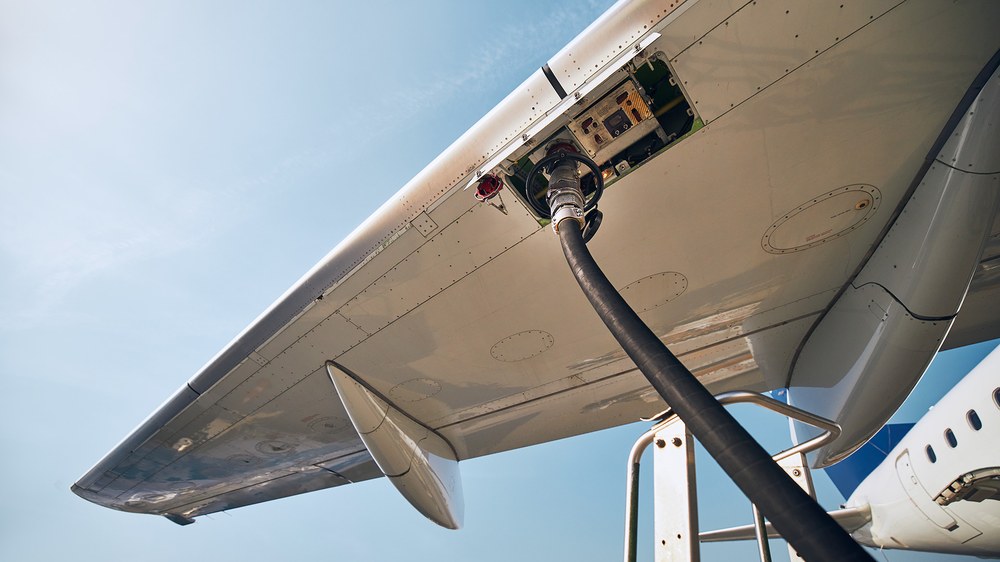
The study examines the entire fuel supply chain, from production and distribution to aircraft refuelling. The analyses show that the separate handling of 100% SPK-SAF and conventional Jet A-1 fuel would have significant implications for fuel storage facilities, pipeline systems and refuelling operations.
To assess possible transition pathways, the research team developed several future scenarios. The modelling indicates that a comprehensive retrofit of the existing aircraft fleet may not necessarily be required. Instead, fleet renewal combined with continued growth in air transport could result in a large share of flights being operated by SPK-SAF-compatible aircraft only a few years after the introduction of newly certified aircraft.
Focusing on a limited number of airports could be beneficial
One of the study's key findings concerns the geographical distribution of aviation's climate impact. Analyses using the DLR tool FlightClim show that a large proportion of non-CO2 effects is associated with departures from only a few major airports, particularly Frankfurt/Main and Munich, where most long-haul services originate.
Against this background, providing 100% SPK-SAF at selected airports could be environmentally, economically and logistically more effective than expanding the required infrastructure nationwide. In this context, the study also examines concepts such as Book-and-Claim systems2.
Estimating the economic benefits
The economic assessment of avoided non-CO2 effects indicates substantial potential benefits, depending on both the level of deployment of 100% SPK-SAF and the assumed carbon price. Assuming that 100% SPK-SAF is distributed evenly across 50% of departures from German airports, and based on a carbon price of €100 per tonne of CO2, the annual monetary benefit compared with the use of conventional kerosene is estimated at approximately €880 million.
Regulatory and economic framework conditions
In addition to technical aspects, the study identifies economic and regulatory issues as key challenges. Sustainable Aviation Fuels remain significantly more expensive than conventional fossil kerosene, while dedicated incentive mechanisms for the use of 100% SPK-SAF are not yet in place.
The study therefore highlights the need for further action regarding market mechanisms, certification standards and regulatory frameworks. Successfully introducing 100% SPK-SAF will require close cooperation between airports, airlines, industry, policymakers and the research community.
The full study is now available via the InnoFuels website.
Further links
1 Grimme, W., Müller, L., Kumar, S. Technical, logistical and economic challenges associated with the practical introduction and implementation of 100% SPK-SAF in aviation. Prepared on behalf of the InnoFuels research consortium. German Aerospace Center (DLR), Hamburg/Cologne. Available online at https://www.innofuels.de/img/DLR_Praktische_Einfuehrung_SAF100.pdf.
2 A Book-and-Claim system allows sustainability certificates ("claims") to be traded independently of the physical fuel. This enables an organisation to claim the environmental benefits of sustainable fuel production without necessarily receiving or using the physical fuel itself.