
DLR Air Transport Research at EASN 2026

- Economic and environmental consequences of supply shortages of critical materials
- Climate impacts and costs of different regulatory approaches to contrail mitigation
- Meteorological operating limitations and the reliability of regional air transport networks
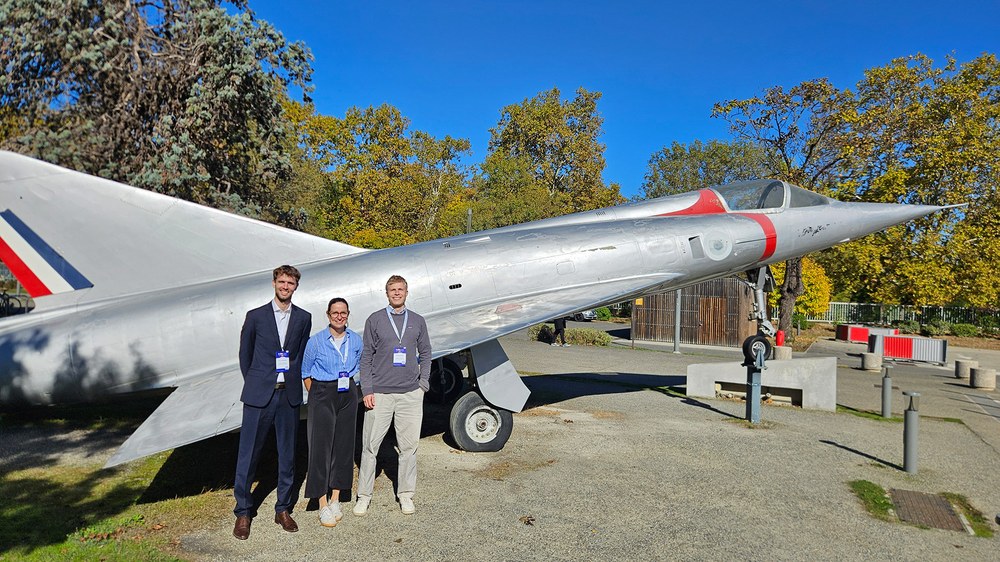
What are the costs of material shortages in aircraft production? Which regulatory approaches can help reduce aviation's climate impact, and how reliably can regional air services operate under given weather conditions? Researchers from the DLR Institute of Air Transport presented findings addressing these questions at the 16th EASN International Conference, held in Toulouse, France, at the end of October 2026. The annual conference of the European Aerospace Science Network (EASN) brought together researchers from across the European aerospace community. Under the theme 'Innovation in Aviation & Space towards sustainability today and tomorrow', the event focused on current scientific approaches and technological developments.
When critical materials are in short supply: the cost of supply disruptions in aircraft production
A study presented by the DLR Institute of Air Transport and Politecnico di Milano analyses the economic and environmental consequences of potential supply shortages of critical materials used in aircraft production. It focuses on nickel and titanium alloys, which are essential to the manufacture of commercial aircraft. Against the backdrop of a global backlog of around 16,000 commercial aircraft in 2025, the study examines the costs that could arise from delayed deliveries following a supply shock. To do so, material flows are modelled using a simulation in AnyLogic.
Initial calculations for a scenario involving the loss of Russian titanium forgings indicate additional environmental costs of €970,000 over a period of three months following the introduction of sanctions. These costs result from delayed deliveries of more fuel-efficient aircraft*. Airlines also face a particularly significant challenge in the form of rising maintenance costs as aircraft age, which can be up to 70 percent higher in the A320ceo/neo case.
The findings show that supply shortages not only delay aircraft production but can also generate additional environmental costs. When more efficient aircraft are delivered later than planned, the potential fuel savings are also postponed. The study highlights the importance of reliable supplies of critical materials.1
Implications of accounting for non-CO2 effects in the EU Emissions Trading System (EU ETS)
Since 2025, non-CO2 effects have been systematically recorded, monitored and documented in the EU under the Monitoring, Reporting and Verification (EU MRV) scheme. How these effects might be incorporated into future regulation is subject to further assessment by the EU. A joint study by the DLR Institute of Air Transport and Delft University of Technology conducted within the EU project Better Contrail Mitigation (BECOM), examines the effectiveness of different regulatory approaches to accounting for non-CO2 effects in European aviation.
Using European air traffic data and actual weather data from 2018, the researchers compared two potential scenarios on a large scale for the first time:
- Targeted flight route optimisation, in which the estimated non-CO2 climate impact of contrails is priced using CO2 equivalents (CO2e).
- Targeted avoidance of areas where persistent contrails are expected to form (climate-sensitive areas).
The results show that both approaches can effectively reduce aviation's overall climate impact. However, avoiding climate-sensitive areas is associated with greater increases in operating costs than CO2e pricing.
Building on these findings, researchers at the DLR Institute of Air Transport are investigating further mitigation approaches, operational constraints and the influence of uncertainties on optimisation in the SESAR projects FairSky, REDUCT and F4EClim.2
Meteorological operating limitations of regional air transport networks
A study by the Institute of Air Transport on Regional Air Mobility (RAM) analyses how weather conditions affect the operation of a potential regional air transport network based at Aachen-Merzbrück airfield. The study draws on an exploratory demand analysis based on the German Transport Forecast for 2040, as well as historical weather data from 2016 to 2025. The demand analysis considers potential shifts from surface transport to air services where these could offer travel time savings. The scenario presented is intended to explore potential network structures and should not be interpreted as a traffic forecast.
The findings highlight that the feasibility of regional air mobility depends not only on new propulsion technologies. Suitable flight procedures and the available infrastructure at the participating airfields are also key factors.3
Further information
- F4EClim: Leveraging Weather and Climate Data for Greener Flight Trajectories
- SESAR Joint Undertaking | FairSky - Framework for Airspace Incentives and Routing toward Sustainable Sky
- SESAR Joint Undertaking | REDUCT - Reducing Uncertainties in Contrail Impact and Climate-optimized Traffic Flow Modelling in Aviation
* The difference in damage costs refers to the case of an airline replacing its fleet on a direct one-for-one basis. In our example, growth in long-haul passenger numbers was taken into account only through the use of larger widebody aircraft (A330ceo replaced by A350).
1 Plesch, D., Berardi, A. "Modelling the Economic Cost of a Supply Shock on Key Aerospace Materials", 16th EASN International Conference 2026, Toulouse, France.
2 Zengerling, Z. L., Castino, F., Niklaß, M., Yin, F. "Impacts of Contrail Accounting in the EU ETS: A Large-Scale Analysis of European Operations in 2018", 16th EASN International Conference 2026, Toulouse, France.
3 Schunkert, T., Flüthmann, N., Asmer, L., Grimme, W., Leipold, A., Gelhausen, M. "Meteorological Operating Limitations for a Regional Air Mobility Network", 16th EASN International Conference 2026, Toulouse, France.