Successful PhD on the climate impact of operational measures in aviation
April 10, 2026
Successful PhD on the climate impact of operational measures in aviation
Dr. Zarah Zengerling completes PhD on the comparative analysis of measures to reduce the climate impact of aviation
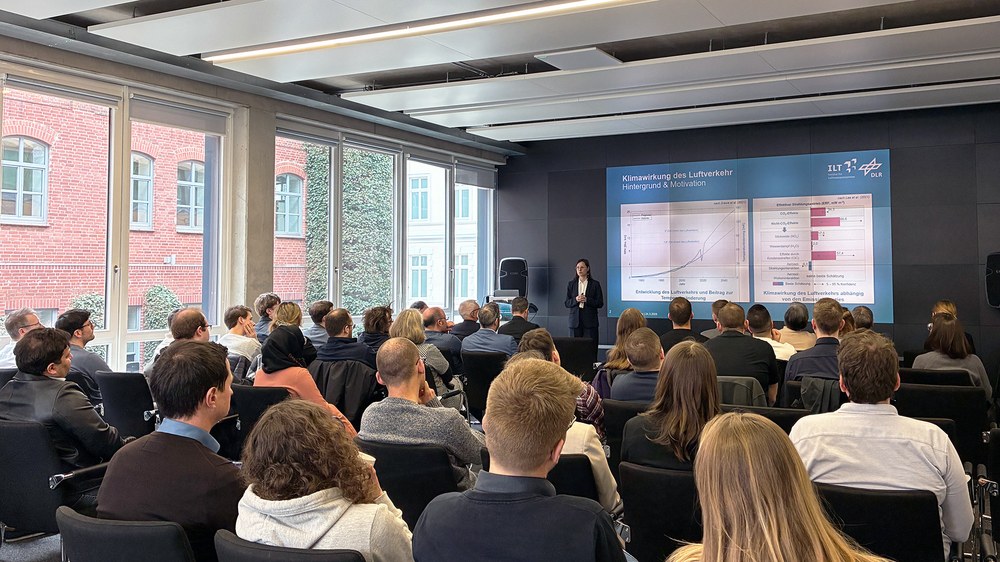
Dr. Zarah Zengerling from the DLR Institute of Air Transport has successfully defended her doctoral thesis with distinction. In her work, she systematically compares operational measures for reducing the climate impact of aviation for the first time, based on a uniform simulation environment. Her research provides important insights into the effective and efficient design of more climate-compatible aviation.
Dr. Zarah Zengerling completes PhD on the comparative analysis of measures to reduce the climate impact of aviation
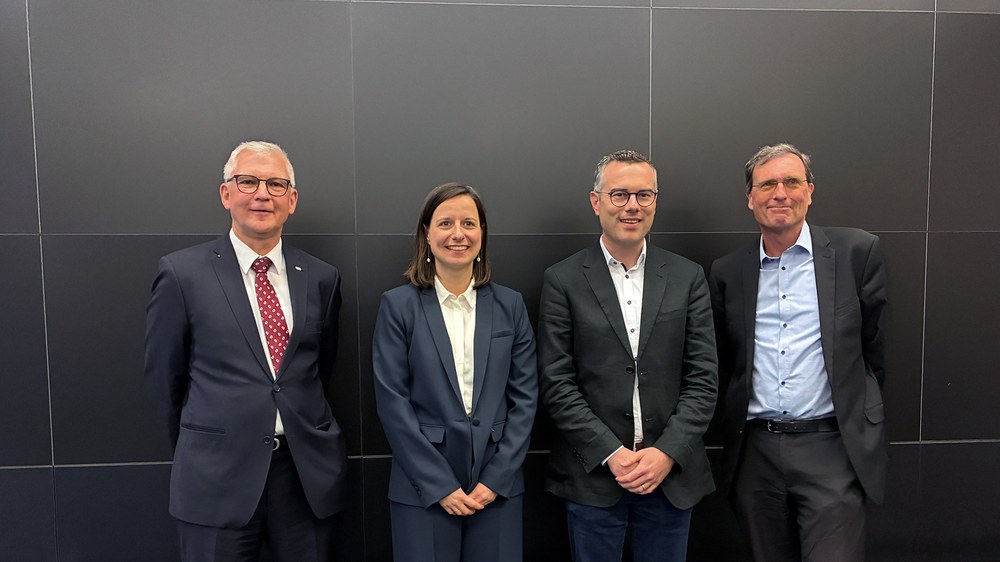
In the image, from left to right: Prof. Dr. Volker Gollnick (Hamburg University of Technology), Dr. Zarah Zengerling (DLR Institute of Air Transport), Prof. Dr. Alexander Schlaich (Hamburg University of Technology) and Prof. Dr. Volker Grewe (Delft University of Technology, DLR Institute of Atmospheric Physics).
Doctoral thesis on reducing the climate impact of aviation
Development of a model chain for comparative assessments
Identification and evaluation of effective measures to reduce non-CO2 effects
Contribution of operational measures to the climate impact of aviation
Reducing the climate impact of aviation is a key challenge on the path towards greater sustainability. In addition to technological innovations and regulatory approaches, operational measures in particular are gaining importance. These can be implemented in the short term and specifically address so-called non-CO2 effects, which contribute significantly to the overall climate impact of aviation.
Comparability as a key research gap
In her dissertation entitled “Operational Measures to Reduce the Climate Impact of Air Transport – A Comparative Study”, Dr. Zarah Zengerling addresses a previously unresolved issue: the comparability of operational measures. Previous studies are based on differing assumptions and frameworks, making direct comparison difficult. The aim of her work is therefore to establish a methodological foundation that allows different approaches to be assessed under identical conditions.
Development of a comprehensive model chain
The basis of the work is the development of a detailed simulation chain that represents the entire evaluation process – from flight trajectory simulation and emissions calculation to climate assessment and analysis of impacts on different stakeholder groups. Thanks to its modular structure, different conditions can be flexibly incorporated. The methodology is complemented by a scaling approach that also enables simplified comparability of existing studies.
The methodological design and further development of this model chain were carried out under the academic supervision of Prof. Dr. Volker Gollnick as first reviewer. The Hamburg University of Technology provided the institutional framework for the doctoral project.
Evaluation and comparison of operational measures
The developed model chain is used to systematically investigate various operational measures. These include, among others, adjustments to flight altitude and speed, lateral route shifts, and climate-optimised multi-stage operations with stopovers. The results show that no single measure is universally the most effective – rather, their effectiveness depends on mission-specific factors such as flight distance, aircraft type and meteorological conditions.
Particularly noteworthy is the high efficiency of adjusting flight altitude and speed, while combined approaches such as multi-stage operations offer substantial overall mitigation potential. By strategically combining different measures, a climate mitigation potential of up to 30 per cent can be achieved in European long-haul aviation. Adjustments to flight altitude and speed in long-haul operations can furthermore reduce the climate impact of global aviation by up to 13 per cent. Overall, the results demonstrate that operational measures – when applied and combined in a targeted manner – can make significant contributions to reducing climate impact.
Perspectives for research and application
The work not only provides new scientific insights but also offers a transferable methodology for future analyses. It enables the assessment of measures at European and global levels and their integration into scenarios for achieving climate targets. At the same time, uncertainties remain, particularly in the quantification of non-CO2 effects. Further limitations arise from the chosen application framework and with regard to transferability into regulatory contexts.
Congratulations to Dr. Zarah Zengerling on the successful completion of her PhD and on this important contribution to more climate-compatible aviation.