
What Drives Air Transport – and What Weighs It Down

The design of policy frameworks influences air transport at various levels. It affects the competitiveness of airlines and airports, shapes investment incentives for new technologies and changes the economic conditions in individual markets. The research papers presented by the DLR Institute of Air Transport at this year's European Aviation Conference (EAC26) demonstrated the different ways in which these relationships can play out.
Economic perspectives on airports
What functions do regional airports fulfil beyond traditional scheduled services, and under what conditions can they remain economically viable in the long term? A study examining the significance and potential of regional airports in Germany considered their economic and societal functions, as well as their role in connectivity and crisis resilience. At the same time, it analysed the financial and regulatory challenges facing these airports. The focus was on potential approaches to strengthening their economic viability, including diversifying revenue streams and integrating new mobility concepts and technologies.1
A quantitative analysis of 252 European airports provided a complementary perspective on their economic positioning. Based on the market segments they serve – including hub transfer traffic, hub feeder traffic, low-cost traffic and air freight – different types of business models were identified. In total, the analysis distinguished 19 established and emerging types, which could be grouped into five overarching categories. The findings illustrate the different strategic positions adopted by airports and the opportunities for diversification and specialisation, both for smaller regional airports and for major airports in metropolitan areas.2
Policy frameworks for hydrogen in aviation
What regulatory conditions need to be in place for hydrogen to be used in aviation in the future? A study conducted as part of the DLR research project CLEANLIEST analysed existing policy instruments designed to promote hydrogen in aviation and assessed the extent to which they address the key barriers to market introduction and the subsequent scaling-up of the technology.
The analysis shows that many existing funding and regulatory approaches have so far supported hydrogen primarily at a broader system level, while the specific requirements of aviation have only been partially addressed. Key challenges include the lack of sufficient infrastructure along the value chain and the associated costs, the high cost of producing green hydrogen, uncertain demand and investment signals, and regulatory uncertainty. This points to a need for more targeted policy measures, for example to support the development of airport-specific infrastructure, provide more reliable economic incentives and ensure that the necessary skilled workforce is available.3
Taxes and charges: effects on competition and air transport demand
Three further research papers examined how policy decisions on taxes and charges affect competitive conditions in the air transport sector.
One study explored the potential effects of a sustainable aviation fuel (SAF) levy on the distribution of the additional costs arising from the European ReFuelEU Aviation Regulation. The regulation requires airlines to blend sustainable aviation fuels with conventional jet fuel. The resulting additional costs place European airlines at a particular disadvantage when competing with airlines from outside Europe. Using passenger and flight schedule data, the study analysed two proposed levy models and their effects on the costs incurred by different airlines, comparing them with the existing regulatory framework. The findings revealed significant differences depending on how the levy is designed.4
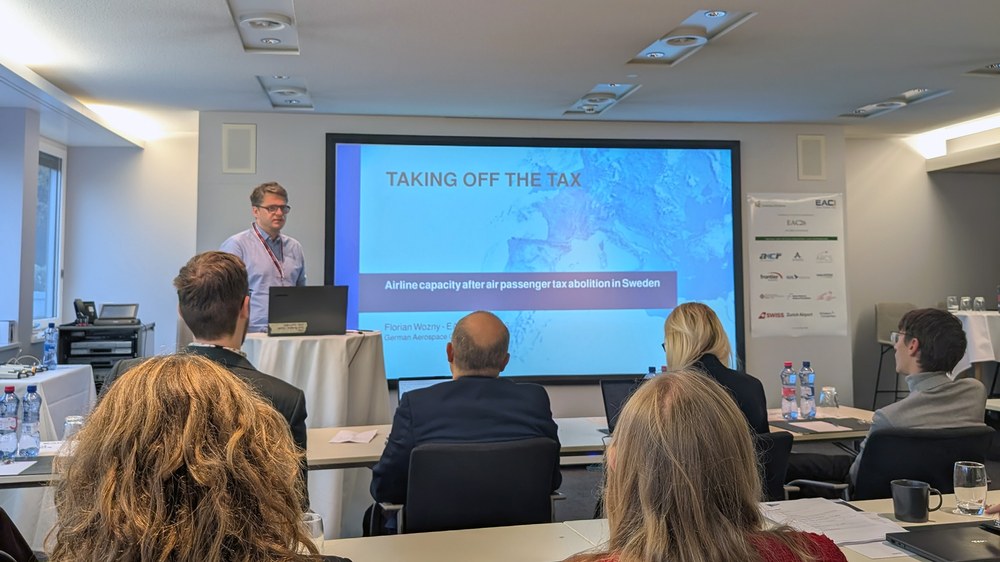
Another paper examined the effects of Sweden's abolition of its air passenger tax in 2025 on the country's international flight services. Using econometric methods, the study compared developments in available seat capacity and international departures. The findings suggest that the abolition has so far had no measurable effect on capacity.5
The effects of regulatory changes on air fares and passenger demand were the focus of a further study on the European Union Emissions Trading System (EU ETS). Using the DLR model EcoTraDy, the researchers analysed how a proposed change to the geographical scope of emissions trading could affect air fares and demand for air travel. Different geographical scopes were compared, including the proposed 5,000-kilometre rule. The analysis also took account of interactions with CORSIA and ReFuelEU Aviation. Particular attention was paid to differences between individual routes and markets, as well as potential shifts in passenger demand between European and non-European hubs. The study thus contributes to the assessment of competitive effects in the air transport sector.6
Further information
1 Timmer, M., Berster, P., Braune-Krickau, D., Claßen, A., Ennen, D. “Regional Airports in Germany: Significance and Potential in Economically and Geopolitically Challenging Times”, European Aviation Conference 2026 (EAC26), 4–6 November 2026, St. Gallen, Switzerland.
2 Ennen, D. “Airport business models: A typology based on served market segments”, European Aviation Conference 2026 (EAC26), 4–6 November 2026, St. Gallen, Switzerland.
3 Müller, L., Wirth, P. “Hydrogen in Aviation: A Review of Policy Instruments, Opportunities, and Barriers to Market Development”, European Aviation Conference 2026 (EAC26), 4–6 November 2026, St. Gallen, Switzerland. (CLEANLIEST research project)
4 Ehlers, T., Kölker, K., Lütjens, K. “SAF Levies in the European Air Transport – A step towards a level playing field?”, European Aviation Conference 2026 (EAC26), 4–6 November 2026, St. Gallen, Switzerland.
5 Wozny, F. “Taking Off the Tax: Airline Capacity after Sweden’s Air Passenger Tax Abolition”, European Aviation Conference 2026 (EAC26), 4–6 November 2026, St. Gallen, Switzerland.
6 Kölker, K., Lütjens, K., Ehlers, T. “Airfare and Passenger Demand Responses to the EU ETS under Proposed Geographical Scopes”, European Aviation Conference 2026 (EAC26), 4–6 November 2026, St. Gallen, Switzerland.