State of sustainability at universities and research institutes
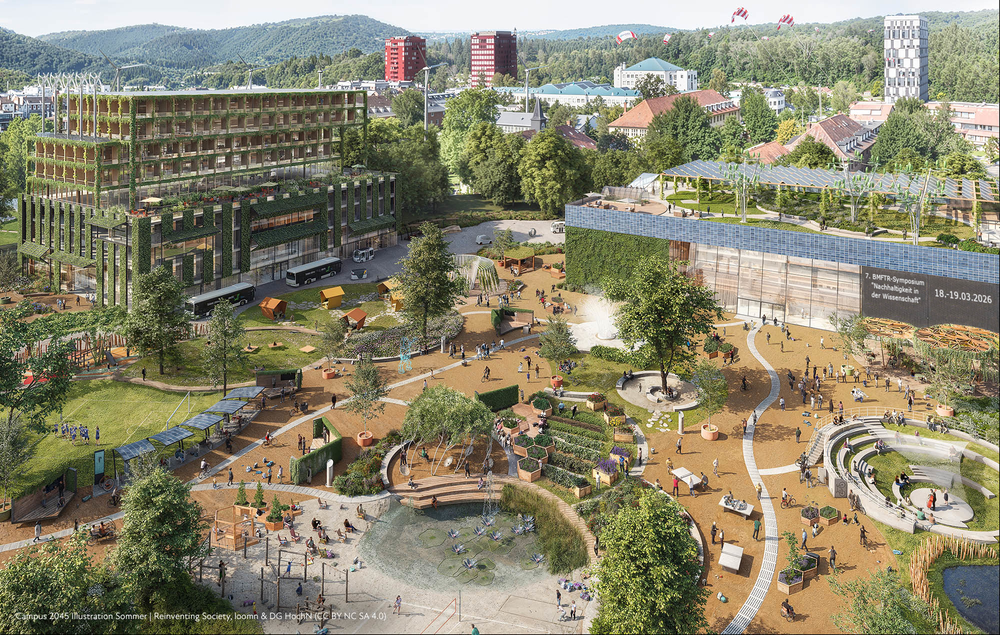

Campus 2045 summer illustration | Reinventing Society, loomn & DG HochN (CC BY NC SA 4.0), modified by DLR Projektträger
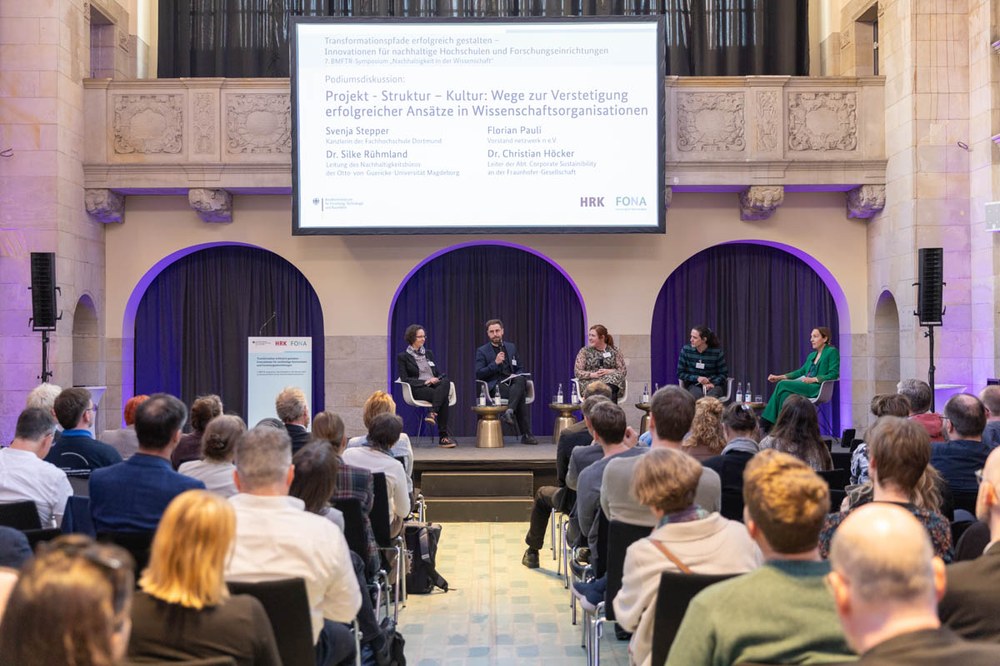
bundesfoto / Söhre Kurc
On 18 and 19 March 2026, approximately 270 staff members from universities, non-university research institutions and supporters from industry came together for the 7th symposium on 'Sustainability in Science'. For the third time, the event was organised by DLR Projektträger. The symposium was opened by Rolf Dieter Jungk, State Secretary of the Federal Ministry of Research, Technology and Space (BMFTR) and by Walter Rosenthal, President of the German Rectors' Conference.
The focus of this public event was the transfer of research findings into practice: through interdisciplinary project work, innovative, greenhouse-gas-neutral solutions are being developed and are now being shared with universities and research organisations. With this, DLR Projektträger also pools its many years of experience in research and transformation management and continues to support the BMFTR's 'Transformation pathways for sustainable universities' research initiative. One highlight of the event was the workshop 'Pathways to greenhouse-gas-neutral research in non-university research organisations – good practices and lessons learned', featuring a keynote presentation by the DLR Institute of Air Transport on the non-CO2 effects of aviation.
What's more, the Helmholtz Association, Fraunhofer Society and Leibniz Association presented strategic levers, concrete measures and cross-sectional opportunities for learning and collaboration:
- Sustainability as a guiding principle and governance structure – embedding sustainability in culture, operations and organisational development (routines, decisions, infrastructure)
- Strategic seed instruments – systematically promoting bottom-up approaches, providing guidance and documenting transferable best practices
- Building competence and resources – asking "How do we do this?" rather than "Who's paying?", providing targeted training and specialist resources
- Broad stakeholder involvement – actively involving individuals outside established sustainability communities (for example, through random selection)
- Highlighting and celebrating successes – sharing positive examples to boost motivation and acceptance
This raises questions about how to meet the requirements of ongoing work for all participants involved: How can the resource-efficient networking of relevant actors be organised on a permanent basis? How can the BMFTR remain actively engaged in dialogue with organisations and provide targeted support? How, at an institutional level, can innovation pathways be ensured in a long-lasting, reliable and resilient manner despite disruptive developments? The next 'Sustainability in Science' symposium in 2028 will provide an opportunity for evaluation.