Chance encounter in space: JANUS camera captures interstellar comet 3I/ATLAS
April 7, 2026 | JUICE Jupiter mission
Chance encounter in space: JANUS camera captures interstellar comet 3I/ATLAS
Comet 3I/ATLAS captured by the JANUS camera
Comet 3I/ATLAS as seen through the red and violet filters of JUICE's JANUS camera. In the red filter (shown here in orange), the bright centre of the coma appears more compact and two tails are visible – one pointing straight downwards and another, fainter tail extending downwards to the left. In the violet filter (shown here in blue), the coma appears larger but fainter, with only one tail clearly visible. These differences arise because different gas and dust particles emit or reflect light at different wavelengths.
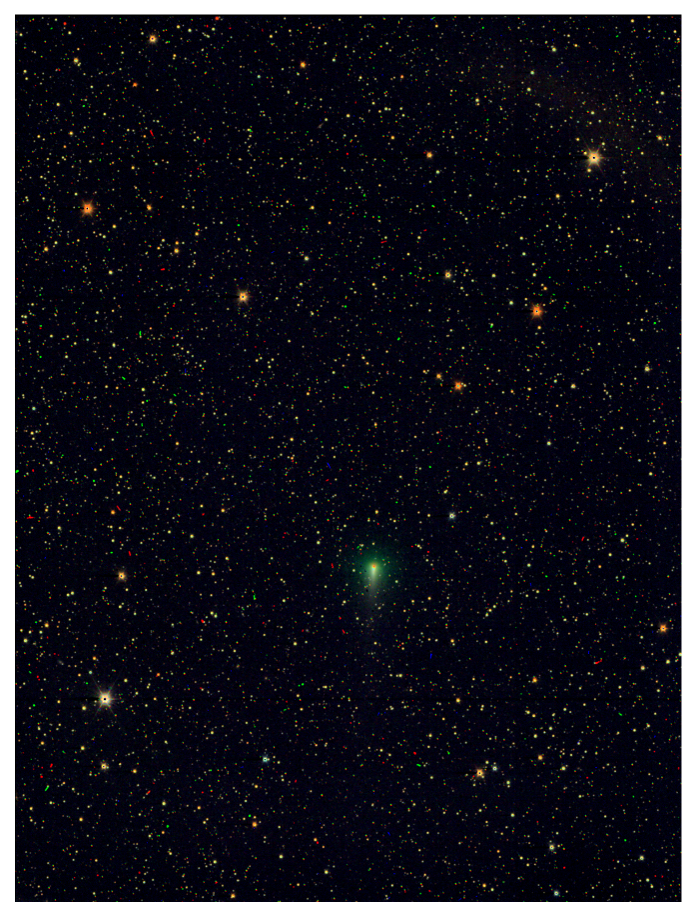
This image is a composite of red, green and blue filter images of 3I/ATLAS taken by the JANUS camera from a distance of more than 180 million kilometres. The comet appears to glow green because the gases surrounding the nucleus emit light in green wavelengths. Background stars appear in different colours depending on their temperature.
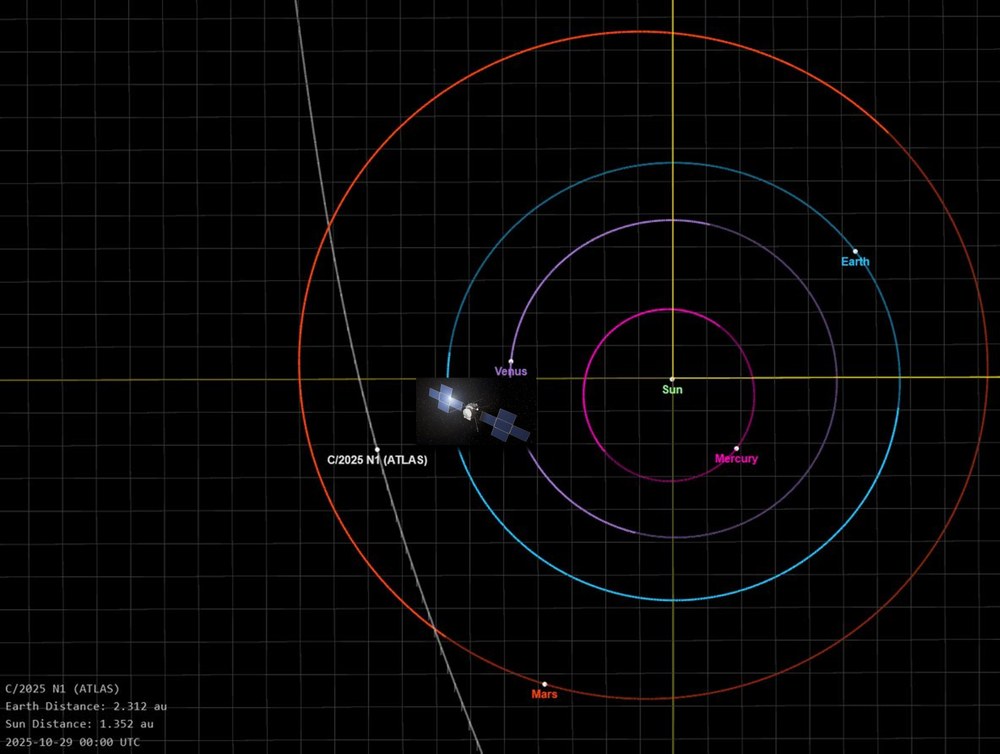
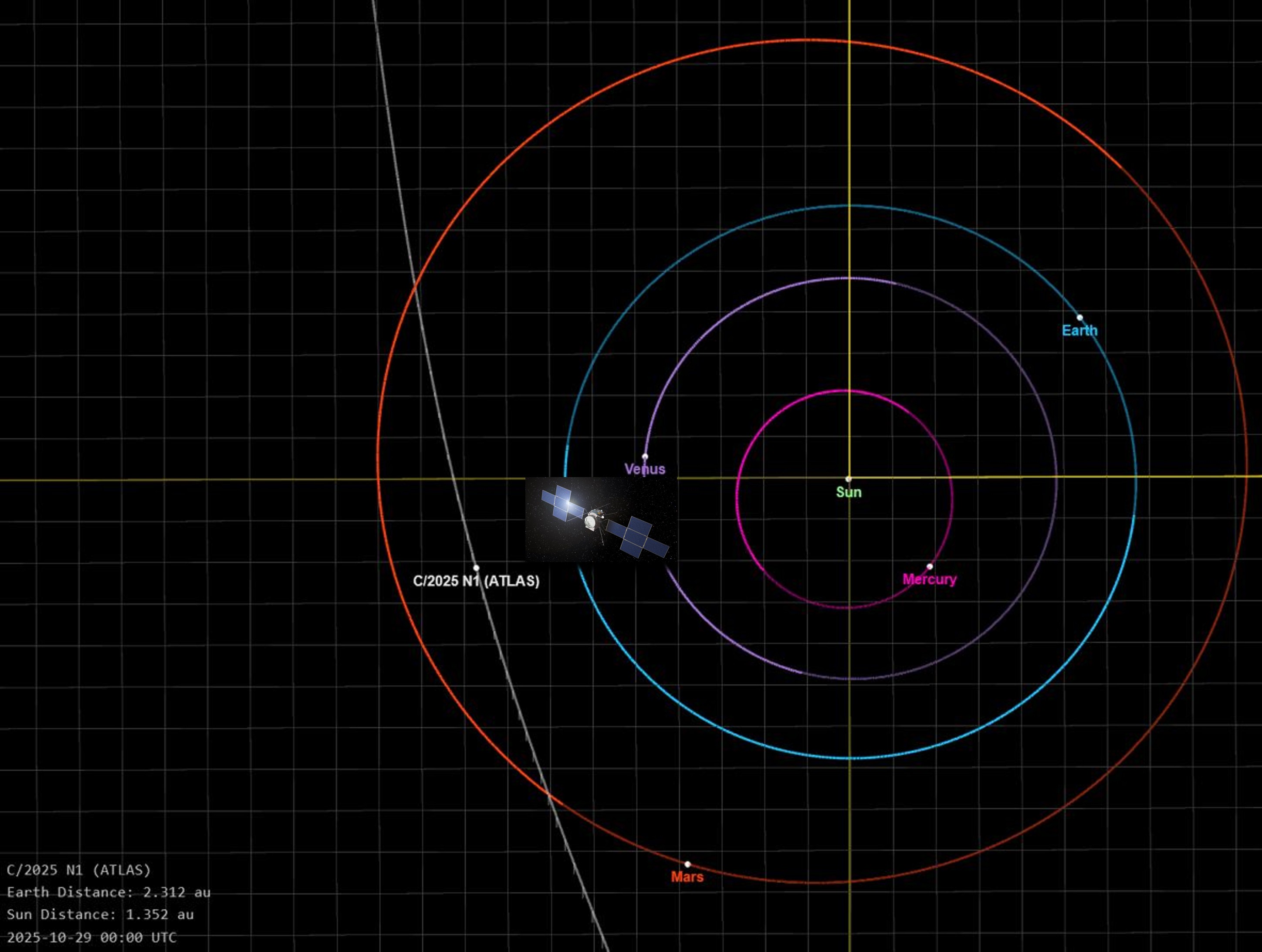
From autumn 2025 onwards, 3I/ATLAS could no longer be observed from Earth on its journey around the Sun – precisely during the comet's most active and scientifically interesting perihelion phase, near the Sun. However, the JUICE probe had a clear view of 3I/ATLAS from its position on the far side of the Sun, roughly aligned with Venus's orbit. JUICE's operational plan did not actually include any scientific activities during the interplanetary journey to the Jupiter system, but the project team was able to swiftly devise an observation campaign for various instruments on board, including the JANUS camera system.
ESA's Jupiter probe, JUICE, was unexpectedly perfectly lined up for observations of interstellar comet 3I/ATLAS.
The probe took advantage of this encounter and captured images and measurements from a distance of 63 million kilometres.
120 images recorded over several weeks reveal details of the comet's coma, tail and various jets and morphological features.
3I/ATLAS originates from deep interstellar space and will never pass through the Solar System again.
Focus: Space, exploration, comets
The Jupiter Icy Moons Explorer (JUICE) mission, en route to Jupiter on a journey lasting over seven years, was not originally scheduled to conduct scientific operations so early in its voyage. Then, in the summer of 2025, a comet was discovered: the interstellar visitor 3I/ATLAS, heading towards the inner Solar System. JUICE was perfectly positioned to observe the active comet as it approached the Sun. Among the instruments activated was the JANUS camera system, which captured 120 images of 3I/ATLAS and transmitted them back to Earth, revealing details of the comet's coma, as well as various outflows of gas and dust. The images also highlight the outstanding performance of the JANUS camera, to which the German Aerospace Center (Deutsches Zentrum für Luft- und Raumfahrt; DLR) made significant hardware contributions. JUICE is a mission of the European Space Agency (ESA).
Right place, right time
From autumn 2025 onwards, 3I/ATLAS became unobservable from Earth as it continued its journey around the Sun – precisely during the comet's most active and scientifically interesting phase. Fortunately, the JUICE probe, positioned on the far side of the Sun, near Venus's orbit, had a clear view of 3I/ATLAS. Although the JUICE mission's operational plan did not actually include any scientific activities during the interplanetary journey to the Jovian system, the project team swiftly devised an observation campaign.
Background – a short observation window for 3I/ATLAS
At the time of its discovery, 3I/ATLAS was located 4.5 astronomical units (AU) from the Sun. One astronomical unit is the distance from the Sun to Earth – approximately 150 million kilometres. Even at this considerable distance, 3I/ATLAS was already displaying clear comet-like activity, indicating a high proportion of volatile components such as hydrogen and ice. Following its discovery, major ground- and space-based observatories immediately launched observation campaigns to monitor and characterise the interstellar visitor. These continued until early October 2025, when the comet's elongation became too small for further observations from Earth. At this point, 3I/ATLAS was continuing its orbit on the far side of the Sun after perihelion – the point at which a comet is closest to the Sun. In the weeks around perihelion, comets typically reach peak activity, releasing particularly large amounts of gas and dust.
Among the instruments involved in this impromptu campaign was JANUS, the multispectral camera on board the JUICE spacecraft. Between 5 and 25 November 2025, the JANUS team designed and conducted a series of observations shortly after the comet's perihelion – the point at which a comet is closest to the Sun. JANUS captured more than 120 images using seven filters across a spectral range of 380 to 1015 nanometres (blue to near-infrared). The closest distance to the comet was 63 million kilometres.
"JANUS has delivered outstanding results much earlier than anticipated, revealing very faint structures in the comet's tail and providing precise radiometric data on the brighter coma near the nucleus," said Ganna Portyankina from the DLR Institute for Planetary Research in Berlin. Ganna is Co-Principal Investigator (PI) of JANUS and leads the instrument’s operations together with PI Pasquale Palumbo from the Institute for Space Astrophysics and Planetology in Rome.
Background – the JANUS multispectral camera
JANUS is an optical multispectral camera that, upon arrival in the Jovian system in 2031, will capture detailed, high-resolution images of Jupiter and its icy moons. It was developed by an industrial consortium led by Leonardo SpA (Italy), under the supervision of the Italian Space Agency (ASI) and in collaboration with the Italian National Institute for Astrophysics (INAF), the German Aerospace Center (DLR), IAA-CSIC in Granada (Spain) and the CEI (Centre for Electronic Imaging) at the Open University in Milton Keynes (UK). JANUS stands for 'Jovis, Amorum ac Natorum Undique Scrutator', which roughly translates as ‘Scrutiniser of Jupiter, his loves and descendants' – a reference to Jupiter's large Galilean moons: Io, Europa, Ganymede and Callisto, named after figures from ancient mythology.
Typical behaviour despite interstellar origins
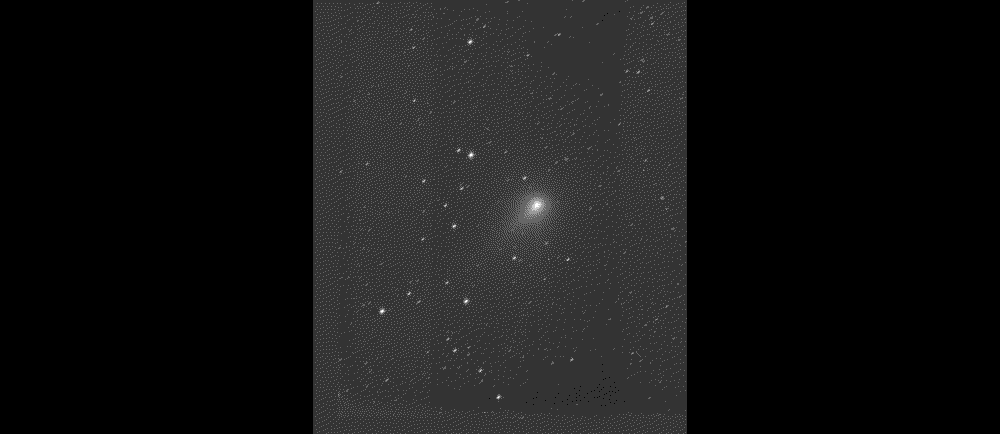
Due to the position of the JUICE spacecraft and the receiving antennas on Earth, the image dataset was not downloaded until 19 February 2026. The long wait was rewarded with outstanding images showing, for the first time, the comet's intense activity shortly after perihelion. 3I/ATLAS displayed an extensive coma, within which the comet's nucleus is 'hidden', as well as a tail and various morphological features such as jets, jet-like structures, streams, filaments and outgassing events. These were recorded in both panchromatic and composite colour images.
The video shows a selection of images captured over five periods between 5 and 25 November 2025. Over the observation period, both the stars in the background and the appearance of comet 3I/ATLAS change. This is due to the rapid shift in the comet's position relative to the JUICE spacecraft during these three weeks (the distance increased from 64 to 185 million kilometres – greater than the distance between Earth and the Sun). The comet's appearance also varies because the video combines images captured with different exposure settings and, above all, different filters and colours. Different filters generally highlight different components, from gas excited by the Sun's ultraviolet radiation to dust ejected from the cometary nucleus. The projected image size at the comet's distance ranges from 1.9 by 1.4 million kilometres (in the first images) to 5.5 by 4.2 million kilometres (in the final images). The comet's tail in the antisolar direction appears to be approximately 6 million kilometres. The direction of the Sun, projected onto the image plane, is upwards and was almost directly behind the spacecraft at the start of the sequence.
Video: Comet 3I/ATLAS captured by the JANUS camera system
Your consent to the storage of data ('cookies') is required for the playback of this video on Quickchannel.com. You can view and change your current data storage settings at any time under privacy.
Video: Comet 3I/ATLAS captured by the JANUS camera system
The video shows a selection of images captured over five periods between 5 and 25 November 2025. Over the observation period, both the stars in the background and the appearance of comet 3I/ATLAS change. This is due to the rapid shift in the comet's position relative to the JUICE spacecraft during these three weeks (the distance increased from 64 to 185 million kilometres – greater than the distance between Earth and the Sun). The comet's appearance also varies because the video combines images captured with different exposure settings and, above all, different filters and colours. Different filters generally highlight different components, from gas excited by the Sun's ultraviolet radiation to dust ejected from the cometary nucleus. The projected image size at the comet's distance ranges from 1.9 by 1.4 million kilometres (in the first images) to 5.5 by 4.2 million kilometres (in the final images). The comet's tail in the antisolar direction appears to be approximately 6 million kilometres. The direction of the Sun, projected onto the image plane, is upwards and was almost directly behind the spacecraft at the start of the sequence.
Credit:
JANUS/LucaPenasa
The observations indicate that, despite its interstellar origins, 3I/ATLAS behaves like a typical Solar System comet as it approaches the Sun. The dataset will enable detailed study of the morphological structures, photometric intensity and the evolution of the coma and tail on short and medium timescales. The coma – a cloud of dust and gas – surrounds the nucleus of 3I/ATLAS, which is thought to measure no more than five kilometres, and the two identified tails.
In addition to JANUS, four other JUICE instruments contributed to this campaign. Together, they gathered information that will shed light on the comet's behaviour and composition. The science teams are currently analysing spectrometry data to determine the comet's chemical composition, as well as measurements to characterise the physical properties of the emitted particles.
On 1 July 2025, the astronomical early warning system ATLAS (Asteroid Terrestrial-impact Last Alert System) made a surprising discovery. In four images captured by the El Sauce Observatory in Chile, a faint moving object had appeared at the outer edge of the asteroid belt, between the orbits of Mars and Jupiter. It was initially classified as a Near-Earth Object (NEO) – an asteroid that could potentially cross Earth's orbit. The object was then also identified in images captured two weeks earlier by telescopes in California, Chile, South Africa and Hawaii, allowing astronomers to determine its trajectory. The results showed that the object is travelling through the inner Solar System on a highly hyperbolic path, meaning its trajectory has two symmetrical branches extending to infinity. This confirmed beyond doubt that 3I/ATLAS is a visitor from interstellar space. It was designated with the letter 'I' for 'interstellar', instead of the usual 'P' for periodic comets. The number 3 indicates that this is the third interstellar object ever recorded, following 1I/'Oumuamua (discovered in 2017) and 2I/Borisov (2019). Calculations suggest that 3I/ATLAS likely originates from the 'thick disc' of the Milky Way and is older than the two previously observed interstellar objects.