Student experiments in microgravity – REXUS campaign 35/36 now complete
March 16, 2026 | Launch your own space project
Student experiments in microgravity – REXUS campaign 35/36 now complete
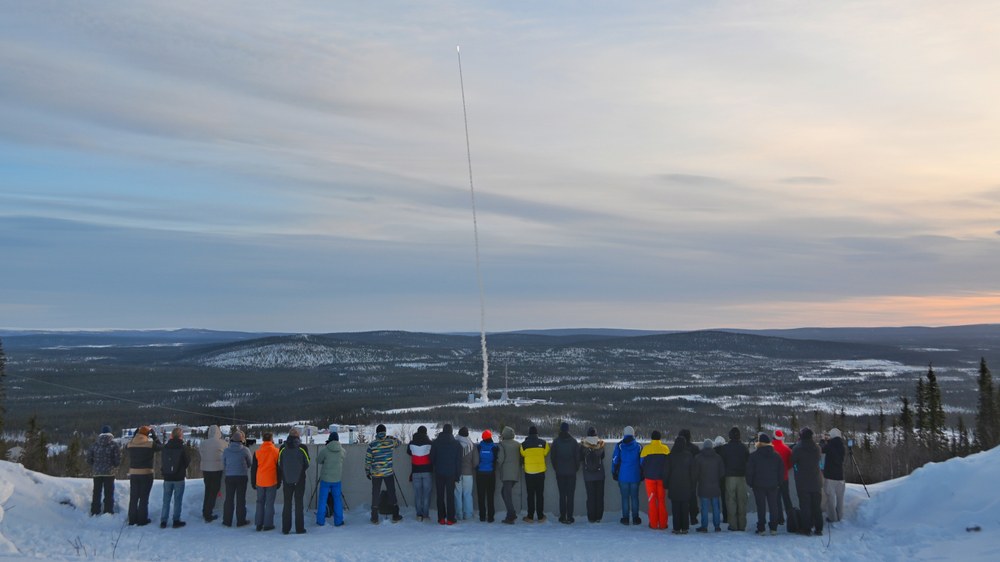
A REXUS rocket launches from the Esrange Space Center in Sweden
On 10 and 12 March 2026, the two sounding rockets REXUS 35 and REXUS 36 were launched from the Esrange Space Center in northern Sweden. REXUS is the student research programme run by the German Space Agency at DLR and the Swedish National Space Agency (SNSA). During the programme, students experienced the entire lifecycle of a real space project.
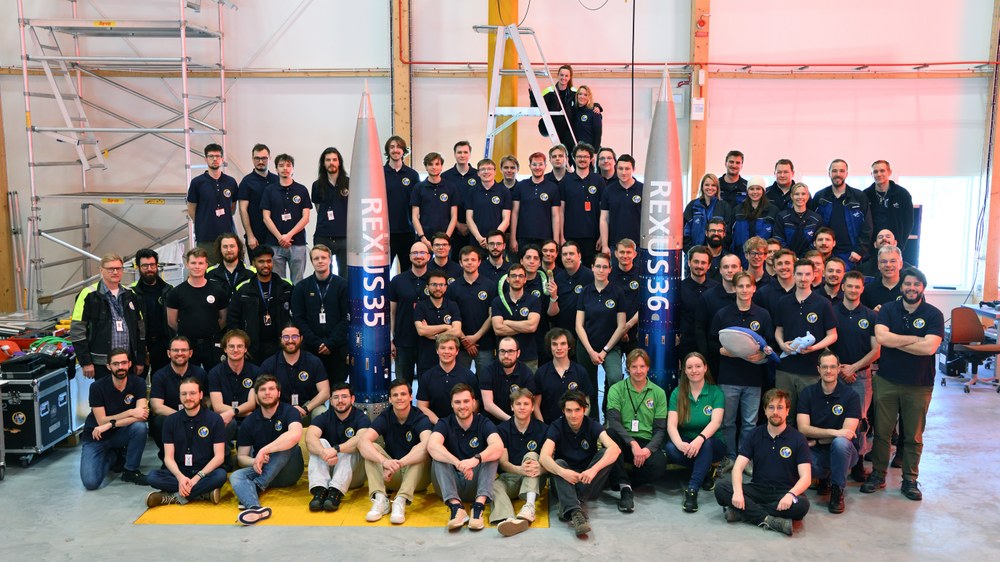
The student teams and organisers of the 2026 REXUS 35/36 double campaign
On 10 and 12 March 2026, the two sounding rockets REXUS 35 and REXUS 36 were launched from the Esrange Space Center in northern Sweden, carrying experiments on innovative heat shields, semiconductors and geysers to an altitude of nearly 80 kilometres. REXUS is the student research programme run by the German Space Agency at DLR and the Swedish National Space Agency (SNSA). During the programme, students experienced the entire lifecycle of a real space project.
REXUS is the research programme for students run by the German Space Agency at DLR and the Swedish National Space Agency (SNSA).
During the project, students worked through the entire lifecycle of a real space mission.
On board were five experiments from German universities.
Focus: Space, research under space conditions, research and knowledge transfer
After two years of preparation, the time had finally come again: on 10 and 12 March 2026, the two sounding rockets REXUS 35 and REXUS 36 launched from the Esrange Space Center in northern Sweden. REXUS (Rocket EXperiments for University Students) is the research programme for students jointly run by the German Space Agency at DLR (Deutsches Zentrum für Luft- und Raumfahrt; German Aerospace Center) and the Swedish National Space Agency (SNSA).
During the programme, students experience every stage of a space project's lifecycle, supported by space experts from Germany and across Europe. The flight of a single-stage REXUS rocket, measuring almost six metres in length and 36 centimetres in diameter, lasts approximately seven minutes. During this time, it carries experiments to an altitude of up to 90 kilometres. If required, experiments can be conducted in near-weightlessness for up to two minutes, and objects fitted with measuring instruments can be ejected. Experiments mounted outside the rocket are also possible. Eight teams secured a place in the programme, with five of them from German universities.
Innovative heat shields, semiconductors and geysers
Spacecraft require heat shields to re-enter Earth’s atmosphere. To date, these have been very high maintenance and usually designed for single-use. The TRACER experiment (TRAnspiration Cooling Experiment Revisited) from RWTH Aachen is testing a novel heat shield. It works on the principle of transpiration cooling, where gas is channelled through the outer wall of the shield. The experiment tests several cooling systems using different gases.
Semiconductors form the basis of all electronic devices. The chemical element germanium plays a key role in their production, and one experiment – GOOSE (Germanium Orbital Optical Semiconductor Experiment), from various Munich universities – investigates germanium's melting behaviour in microgravity. The findings are expected to provide new insights into semiconductor manufacturing.
Geysers are not only found on Earth but also on other planets. On Saturn's icy moon Enceladus, for example, geysers produce what are known as plumes – rising narrow columns of hot material that travel upward from the depths of the moon to the surface. The MEEGA (Make Enceladus Experiment Go Again) experiment from the Aachen University of Applied Sciences aims to replicate these plumes and measure the supersonic vapour flows. A material flow is visually documented using a sensor system that also measures pressure and temperature, with the goal of advancing our understanding of the underlying physics.
THRIVE (Tissue Healing Research In-Flight Viability Experiment), conducted by the University of Würzburg and Technical University of Applied Sciences Würzburg-Schweinfurt, is testing a transport module for organic and inorganic components of the innovative StellarHeal wound-healing method under space conditions. The experiment also assesses the resilience of the wound-healing components. StellarHeal is a project that could one day provide effective wound care for astronauts, developed by the Fraunhofer Institutes for Toxicology and Experimental Medicine and for Silicate Research, as well as the Dresden Institut für Luft- und Kältetechnik.
The MARTINI experiment (Material Analysis of Resin Testing in Null-Gravity Interactions) from Technical University of Braunschweig examines the behaviour of resin-mixing processes in microgravity. Photopolymer resins cure when exposed to UV light and are already used in the space industry – for example in satellite construction. The experiment investigates the mixing and subsequent curing processes. In the long term, these materials could be used in space to manufacture components via 3D printing, enabling satellites to be serviced and repaired while in orbit.